By Eric Andrew Kristof, RN, CAHIMS | Healthcare IT Professional | HIMSS Arkansas Chapter Member
About This Series: The HIMSS Word of the Day is a running blog series drawing from the HIMSS Dictionary of Health Information and Technology Terms, Acronyms, and Organizations, 6th Edition (2025) — the authoritative reference for healthcare IT professionals and the primary study resource for CAHIMS and CPHIMS certification. Each post paraphrases the term in plain language, grounds it in real-world healthcare IT context, and adds a bedside nursing perspective you won’t find in a textbook.
📖 The Term: Structural Interoperability
Source: HIMSS Dictionary of Health Information and Technology Terms, Acronyms, and Organizations, 6th Edition (2025)
🔍 Plain-Language Definition
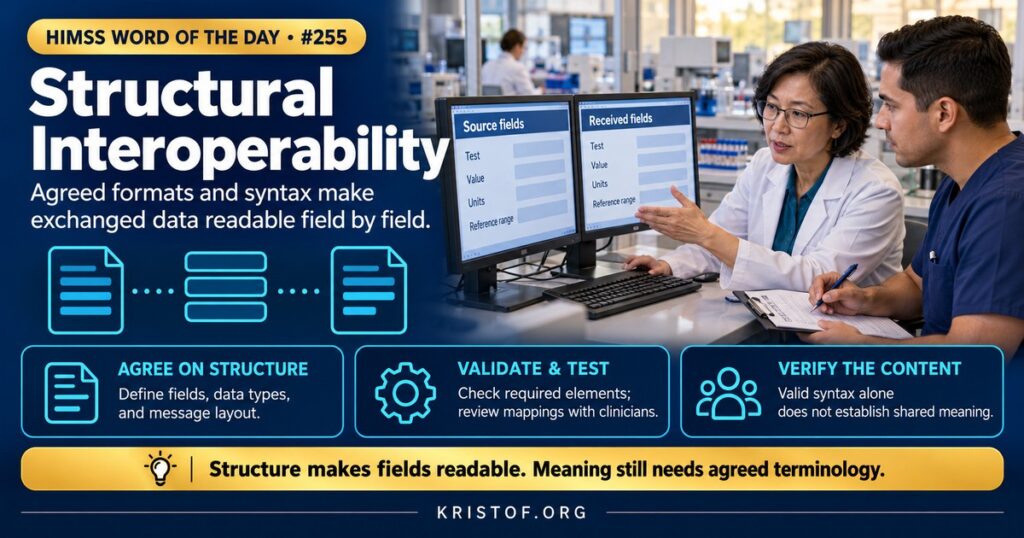
Structural interoperability concerns the structure or format of data exchange, such as the message format standards. The HIMSS Dictionary says it describes uniform movement of health data between systems without altering what the data are meant to convey, and that it defines the syntax of the exchange so that information technology systems can interpret data at the data field level. In everyday terms, structural interoperability means both sides agree on the layout: what fields exist, in what order or hierarchy, with what data types.
This is the second layer above basic connection. Foundational interoperability gets data from one system to another. Structural interoperability makes the data readable by field. Semantic interoperability goes further so that both sides share the meaning of the values in each field.
| Layer | Focus | Example of Success | Example of Failure |
|---|---|---|---|
| Foundational | Connection and transport | Message arrives securely | Link is down |
| Structural | Format and syntax | Receiver finds the allergy field | Field is missing or in the wrong place |
| Semantic | Shared meaning | Both sides use the same allergen code | Different codes for the same drug |
| Organizational | Policy and workflow | Staff know how to use the data | Data arrive but no one acts on them |
⚠️ Exam Alert: Structural interoperability is about format and syntax; semantic interoperability is about meaning. HL7 v2, CDA, and FHIR all define structure. Valid structure does not guarantee correct or meaningful content. Some sources use the term syntactic interoperability for the same level.
🌐 Why It Matters: Real-World Healthcare IT Context
Structure is what lets software read data without human help. If a laboratory result message always places the test name, value, units, and reference range in defined fields, a receiving system can file each piece in the right place. If the layout varies, an interface analyst must write custom mapping, and errors creep in.
Health care uses several structural standards. HL7 version 2 messages, a long-established messaging standard, carry admissions, orders, results, and many other events between hospital systems as delimited segments and fields. Clinical Document Architecture defines the structure of whole documents in XML. FHIR defines resources, such as Patient, Observation, and Medication Request, with defined elements, data types, and cardinality, and can be exchanged through web APIs. A 2025 scoping review of EHR interoperability described four levels in practice, technical or foundational, syntactic or structural, semantic, and process or organizational, and noted that standardization of data structures, transfer protocols, terminologies, vocabularies, and ontologies is the most common approach even though consensus on standards is lacking. The same review argued that a standardized data structure is not a prerequisite for useful interoperability, which means organizations should weigh the cost of rigid structure against the value of practical exchange.
Validation is how structure is checked. The FHIR specification describes validating a resource as checking its structure, cardinality, value domains, code bindings, invariants, and profile rules. A profile narrows a base standard for a specific use, and an implementation guide packages profiles and rules for a use case. Validators run in testing and, ideally, in production monitoring, so that a message with a missing required field is caught before it causes harm.
Structure works hand in hand with meaning. A 2024 framework for radiology results modeled findings as FHIR Observation resources and used Common Data Elements from the radiology societies as standardized semantic labels. The authors explained that labeling findings as discrete data for exchange requires two components, structure and semantics: FHIR provides the structure, and the data elements supply the identifiers that carry meaning. A 2025 development study converted a 216-element colorectal cancer pathology reporting dataset into a FHIR structured data capture form. Of the elements, 207 were bound to SNOMED CT concepts, and the nine that could not be coded were ambiguous. The structured form represented the dataset fully and was exported as FHIR R4 JSON. The result shows both layers at work, and also how ambiguity in the source content shows up as a coding problem even when the structure is sound.
Common structural pitfalls are subtle. A sender may use a field for a different purpose than the receiver expects, such as placing free text in a coded field. Optional fields may be filled by one system and ignored by another. Local extensions may be valid but unrecognized. Character encoding or date format differences may corrupt values. A message may pass validation and still be clinically wrong. This is why interface testing includes clinical review of sample messages, not only technical checks.
Common structural interoperability problems:
- Messages that are valid but populated differently by each sender
- Free text placed in fields meant for coded values
- Local extensions that receivers do not understand
- Missing required fields caught late or not at all
- Date, time, or unit formats that differ between systems
- Validation done in testing but not monitored in production
What supports reliable structure:
- Use of national standards and published implementation guides
- Profiles that define exactly what each field must contain
- Automated validation in testing and production
- Sample messages reviewed by clinical and technical staff
- Clear mapping documentation between local and standard fields
- Pairing structure with agreed vocabularies and workflows
🏥 The Nurse’s Perspective: Clinical, Bedside, & Workflow
Nurses notice structural problems as information that lands in the wrong place or does not appear.
At the Bedside
A result, allergy, or vital sign that a device or outside system sends may show up in an unexpected spot in the chart or not at all. When nurses spot data that look misplaced, such as a weight in a height field, they can correct the chart and report the problem with an exact example so analysts can trace the message.
Barcode scanning, device integration, and pump interfaces all depend on structured messages. A mismatch can mean values must be entered by hand.
In Clinical Workflow
Nurse managers hear about recurring problems, such as device readings that do not file or outside records that display poorly. Collecting examples and sharing them with informatics speeds repair. Care coordinators who rely on incoming documents help judge whether the structure serves their needs.
Nurse informaticists take part in interface design and testing. They define which nursing data elements need discrete fields, confirm that flowsheet rows map correctly, and test with real scenarios rather than only sample values.
In EHR Implementation (Go-Live Perspective)
An Epic Go-Live includes interface testing for devices, laboratory, pharmacy, imaging, and outside organizations. Analysts compare messages against expected formats and verify that data display where clinicians expect them. At-the-elbow support analysts hear when readings do not file or fields look wrong, and give interface teams the details needed to find a mapping or format error.
🎓 CAHIMS / CPHIMS & HIMSS Perspective
CAHIMS Exam Domain Mapping
Structural interoperability appears in standards, interfaces, and data exchange questions:
| CAHIMS Domain | How Structural Interoperability Appears |
|---|---|
| Healthcare & Technology Environments | Levels of interoperability, standards development organizations |
| Clinical Informatics | Discrete data capture, flowsheet mapping, clinical review of messages |
| Healthcare Information & Systems Management | HL7 v2, CDA, FHIR, validation, interface testing |
| Management & Leadership | Standards selection, vendor requirements, interface governance |
Key Terms to Know Alongside Structural Interoperability
- Syntax — rules for the arrangement of data elements in a message
- HL7 v2 — widely used delimited messaging standard for health care events
- FHIR Resource — defined unit of health data in the FHIR standard
- Profile — constraints that tailor a base standard to a use case
- Implementation Guide — document packaging rules, profiles, and examples for a use case
- Validation — checking data against structure and rules
HIMSS Organizational Position
HIMSS supports standards-based interoperability through its Interoperability and Health Information Exchange work, research, and education. Members can find related resources through the HIMSS Resource Center.
🔗 Explore Further: External References
- HL7 International — HL7 Version 2 Product Brief https://www.hl7.org/implement/standards/product_brief.cfm?product_id=185
- HL7 — FHIR Overview https://hl7.org/fhir/overview.html
- HL7 — FHIR Validating Resources https://hl7.org/fhir/validation.html
- El-Yafouri et al. (2025), Health Informatics Journal — A Scoping Review of Electronic Health Records Interoperability Levels, Expectations, Approaches, and Problems https://pubmed.ncbi.nlm.nih.gov/41134978/
- Tejani et al. (2024), Journal of the American Medical Informatics Association — Standardizing Imaging Findings Representation: Harnessing Common Data Elements Semantics and Fast Healthcare Interoperability Resources Structures https://pubmed.ncbi.nlm.nih.gov/38900188/
- Hwang et al. (2025), JMIR Medical Informatics — Building a Standardized Cancer Synoptic Report With Semantic and Syntactic Interoperability: Development Study Using SNOMED CT and FHIR https://pubmed.ncbi.nlm.nih.gov/40997319/
Term source: HIMSS Dictionary of Health Information and Technology Terms, Acronyms, and Organizations, 6th Edition (2025). All definitions in this series are paraphrased for editorial purposes. Readers are encouraged to consult the primary source for exact language.
Eric Andrew Kristof, RN, CAHIMS is a Healthcare IT professional and HIMSS Arkansas Chapter member based in Hot Springs Village, AR, with hands-on Epic Go-Live experience and a diverse healthcare and IT background. He writes at kristof.org at the intersection of clinical care and healthcare technology.
Leave a Reply