By Eric Andrew Kristof, RN, CAHIMS | Healthcare IT Professional | HIMSS Arkansas Chapter Member
About This Series: The HIMSS Word of the Day is a running blog series drawing from the HIMSS Dictionary of Health Information and Technology Terms, Acronyms, and Organizations, 6th Edition (2025) — the authoritative reference for healthcare IT professionals and the primary study resource for CAHIMS and CPHIMS certification. Each post paraphrases the term in plain language, grounds it in real-world healthcare IT context, and adds a bedside nursing perspective you won’t find in a textbook.
📖 The Term: Accountability (Data Accountability)
Source: HIMSS Dictionary of Health Information and Technology Terms, Acronyms, and Organizations, 6th Edition (2025)
🔍 Plain-Language Definition
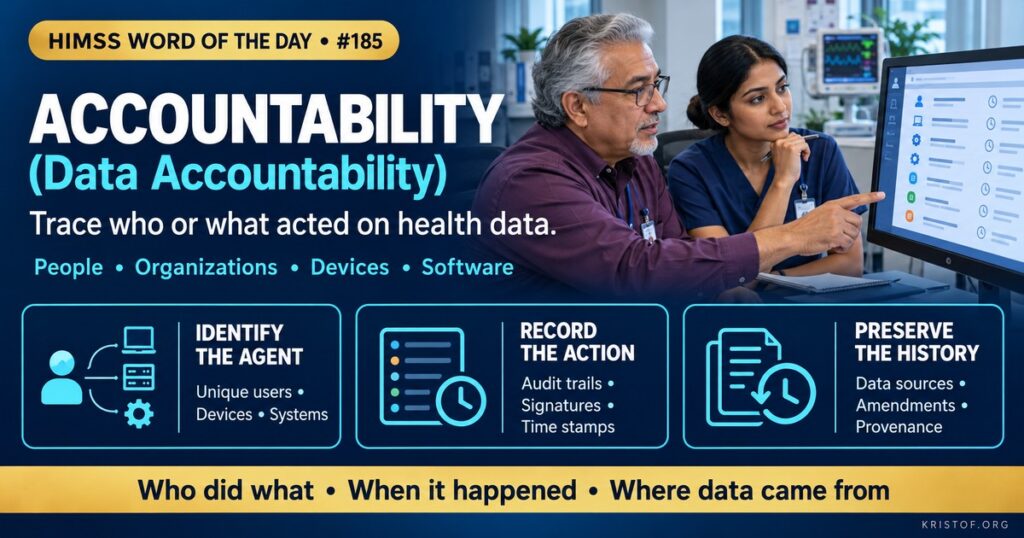
Accountability, in health information management and security, is the ability to identify who or what is responsible for each action taken on data, including creating, changing, verifying, accessing, disclosing, and transmitting it, so that actions can be traced and responsibility assigned.
The HIMSS Dictionary describes accountability as identifying which party, such as a person, organization, or business unit, or which agent, such as software, a device, an instrument, or a monitor, is responsible for each stage in the life of data: creating it, amending or verifying it, translating it, caring for it, using or disclosing it, and sending or receiving it.
| Accountability Mechanism | What It Shows | Healthcare Example |
|---|---|---|
| Unique User Identification | Which person performed an action | Each nurse logs in with personal credentials |
| Audit Trail | When records were accessed or changed and by whom | A log showing who viewed a chart |
| Electronic Signature | Who attests to a document | A signed progress note |
| Data Provenance | Where data came from and how it changed | A lab result labeled with the performing lab |
| Device and System Attribution | Which device or software created data | Vital signs tagged with the monitor that recorded them |
| Amendment History | What changed and why | A corrected entry with the original preserved |
⚠️ Exam Alert: Accountability answers who did what. Audit controls record activity; integrity ensures data is not improperly altered; non-repudiation prevents someone from denying an action. Provenance describes data origin and history. Shared logins break accountability.
🌐 Why It Matters: Real-World Healthcare IT Context
Trust in health data depends on knowing where it came from and who is responsible for it. Clinicians make decisions based on documented assessments, results, and medication histories, and they need to know who documented them and whether they have been changed.
HIPAA requires accountability mechanisms. The Security Rule requires unique user identification, audit controls that record and examine activity in systems containing ePHI, integrity protections, and person or entity authentication. These requirements allow organizations to detect inappropriate access, investigate incidents, and demonstrate compliance.
Patients increasingly ask who has viewed their records. Accounting of disclosures and access reports, where available, depend on reliable audit data, and transparency can strengthen patient trust.
Audit trails support privacy enforcement. Many privacy violations involve authorized users viewing records without a work-related reason. Audit monitoring, including proactive analytics, helps organizations detect such access and apply sanctions.
Accountability matters legally. The medical record is a legal document. Electronic signatures, date and time stamps, and preserved amendment histories establish authorship and when information was entered, which is important in litigation and regulatory reviews.
Provenance is increasingly important in interoperability. When data travels between organizations, recipients need to know its source. FHIR includes a Provenance resource to describe who or what created or changed information, and an AuditEvent resource for security and privacy logging. National data standards have added provenance elements so exchanged data carries information about its origin.
Devices and software add complexity. Data may come from monitors, pumps, patient devices, interfaces, or algorithms. Accountability requires identifying these agents, as the dictionary definition notes, and ensuring that clinicians validate automatically captured data before it is relied upon.
AI-generated content raises new questions. When AI drafts notes, summarizes records, or suggests documentation, organizations must define who is accountable for the final content, how AI involvement is indicated, and how clinicians review and attest to it.
Data stewardship assigns ongoing responsibility. Beyond individual actions, organizations designate data stewards who are accountable for the definitions, quality, and appropriate use of specific data domains, such as medication lists, problem lists, or quality measures. Stewardship makes it clear who decides how data should be recorded and who fixes problems when data quality issues are found.
Documentation practices can undermine accountability. Copy-forward and copy-paste can make it unclear who actually assessed a patient, and shared logins attribute actions to the wrong person. Policies and system design should discourage these practices.
Patients contribute data too. Questionnaires, home readings, and portal messages entered by patients should be labeled as patient-reported so clinicians understand their source and can verify them as needed.
Common accountability gaps:
- Shared or generic logins
- Copy-forward documentation without verification
- Audit logs collected but never reviewed
- Missing provenance for exchanged data
- Unclear responsibility for device and AI-generated data
- Amendments that overwrite instead of preserving history
Practices that strengthen accountability:
- Unique credentials and fast, secure login options
- Regular audit log review and proactive monitoring
- Clear rules for amendments and late entries
- Provenance tracking in exchanged data
- Policies for AI-assisted documentation and attestation
- Training on documentation integrity
🏥 The Nurse’s Perspective: Clinical, Bedside, & Workflow
Every nursing entry carries the nurse’s name and accountability.
At the Bedside
Logging in with one’s own credentials, and never documenting under someone else’s login, ensures that each action is attributed correctly. Shared logins put nurses at risk of being held responsible for actions they did not take.
When device data flows into the chart, nurses validate values before accepting them. That validation step makes the nurse accountable for confirming accuracy.
When a colleague asks to borrow a session to save time, offering to log out and let them log in protects both nurses’ accountability.
In Clinical Workflow
Late entries and corrections should follow organizational policy, clearly labeled with the time they were entered and the reason. Systems preserve the original entry, maintaining a transparent history.
Copy-forward should be used carefully. Assessments copied from previous shifts must be updated to reflect the current patient condition, since the nurse who signs the entry is accountable for its accuracy.
Audit trails also protect nurses. When questions arise about care, audit records can show what was documented, when, and by whom.
As AI documentation tools appear, nurses remain responsible for reviewing and correcting any drafted content before signing.
Students and orientees should document under their own credentials with cosignature by preceptors, preserving a clear record of who performed and who supervised each action.
In EHR Implementation (Go-Live Perspective)
During an Epic Go-Live, organizations configure audit logging, electronic signatures, late entry rules, and device data validation workflows. Training reinforces individual logins and documentation integrity.
At-the-elbow support analysts help nurses with documentation corrections and late entries, and discourage workarounds such as documenting under another user’s session.
🎓 CAHIMS / CPHIMS & HIMSS Perspective
CAHIMS Exam Domain Mapping
Accountability appears in security, privacy, and documentation questions:
| CAHIMS Domain | How Accountability Appears |
|---|---|
| Healthcare & Technology Environments | HIPAA audit and authentication requirements; legal record |
| Clinical Informatics | Documentation integrity, late entries, copy-forward, AI-assisted notes |
| Healthcare Information & Systems Management | Audit logs, provenance, FHIR Provenance and AuditEvent, signatures |
| Management & Leadership | Audit review programs, sanctions, policies, data stewardship |
Key Terms to Know Alongside Accountability
- Audit Trail — a chronological record of system activity
- Unique User Identification — assigning each user a distinct identifier
- Non-Repudiation — assurance that someone cannot deny an action they took
- Data Provenance — information about the origin and history of data
- Electronic Signature — an electronic indication of authorship or approval
- Data Stewardship — responsibility for managing data quality and appropriate use
HIMSS Organizational Position
HIMSS supports trustworthy health data through education on data governance, security, and interoperability, including provenance and audit practices. Members can find related education and research through the HIMSS Resource Center.
🔗 Explore Further: External References
- eCFR — 45 CFR 164.312, HIPAA Technical Safeguards https://www.ecfr.gov/current/title-45/subtitle-A/subchapter-C/part-164/subpart-C/section-164.312
- HL7 — FHIR Provenance Resource https://hl7.org/fhir/provenance.html
- HL7 — FHIR AuditEvent Resource https://hl7.org/fhir/auditevent.html
- ONC — Interoperability Standards Platform https://isp.healthit.gov/
- ONC — SAFER Guides https://healthit.gov/clinical-quality-and-safety/safer-guides/
- HIMSS — Healthcare Cybersecurity Community https://www.himss.org/networking/communities/healthcare-cybersecurity/
Term source: HIMSS Dictionary of Health Information and Technology Terms, Acronyms, and Organizations, 6th Edition (2025). All definitions in this series are paraphrased for editorial purposes. Readers are encouraged to consult the primary source for exact language.
Eric Andrew Kristof, RN, CAHIMS is a Healthcare IT professional and HIMSS Arkansas Chapter member based in Hot Springs Village, AR, with hands-on Epic Go-Live experience and a diverse healthcare and IT background. He writes at kristof.org at the intersection of clinical care and healthcare technology.
Leave a Reply