By Eric Andrew Kristof, RN, CAHIMS | Healthcare IT Professional | HIMSS Arkansas Chapter Member
About This Series: The HIMSS Word of the Day is a running blog series drawing from the HIMSS Dictionary of Health Information and Technology Terms, Acronyms, and Organizations, 6th Edition (2025) — the authoritative reference for healthcare IT professionals and the primary study resource for CAHIMS and CPHIMS certification. Each post paraphrases the term in plain language, grounds it in real-world healthcare IT context, and adds a bedside nursing perspective you won’t find in a textbook.
📖 The Term: ISA (Interoperability Standards Advisory)
Source: HIMSS Dictionary of Health Information and Technology Terms, Acronyms, and Organizations, 6th Edition (2025)
🔍 Plain-Language Definition
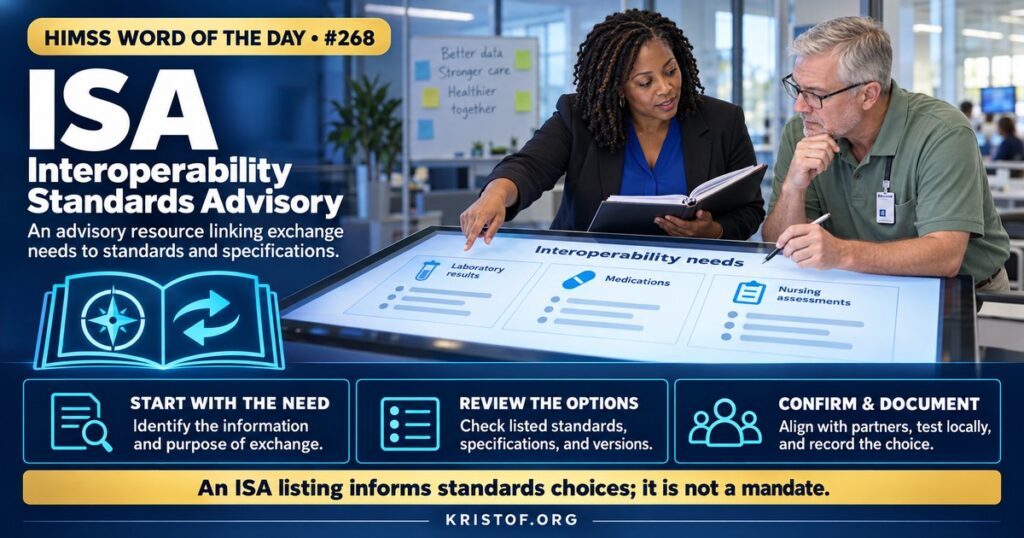
The Interoperability Standards Advisory (ISA) is both a process run by ONC, the Office of the National Coordinator for Health Information Technology, and the public web resource that results. ONC uses it to identify, assess, and publicize interoperability standards and implementation specifications that U.S. health care can use for specific needs. The HIMSS Dictionary describes it as ONC’s model for naming “recognized” standards for clinical health IT interoperability needs.
The ISA is organized by interoperability need, such as representing laboratory results, medications, immunizations, or clinical notes, and not by technology. Under each need it lists the relevant standards or implementation specifications and gives information such as an adoption level. Content areas include vocabularies and code sets, content and structure standards, services, and administrative standards, and the list includes a section on nursing: assessments, interventions, outcomes, and patient problems.
| ISA Feature | What It Provides | Why It Matters |
|---|---|---|
| Interoperability need | A specific purpose, such as representing allergies | Helps choose standards by task |
| Listed standards | Candidate standards and specifications | Single reference point |
| Adoption level | ONC’s general assessment of use in the field | Signals maturity |
| Emerging standards | Newer approaches needing pilot experience | Prompts testing |
| Reference Edition | Stable annual version | Can be cited in contracts |
| Public comment | Annual review period and ongoing input | Keeps content current |
⚠️ Exam Alert: The ISA is an advisory resource: a standard’s listing does not require its use. USCDI defines a data set for exchange, while the ISA lists standards for interoperability needs. A Reference Edition is a stable annual snapshot; the web version changes throughout the year.
🌐 Why It Matters: Real-World Healthcare IT Context
Interoperability depends on agreement, and agreement requires knowing the options. A hospital planning to exchange immunization data, a vendor building a lab interface, or a public health agency choosing a format for reporting would otherwise have to hunt across many specifications. ONC’s own materials describe the ISA as a resource that stakeholders have found helpful as a single list of available standards, and say it should be the first resource consulted when a developer or provider seeks to address a particular interoperability need.
The ISA’s scope has grown. According to ONC, starting with the 2017 edition the ISA more explicitly included public health and health research, and late in 2017 it added administrative functions, in coordination with CMS. It is designed to inform standards choices for all kinds of health IT that support interoperability, not just electronic health record systems. It is also not exhaustive. When more than one standard is listed for a need, the intent is to prompt industry discussion about whether one is enough or whether several can coexist, or to reflect a transition from an older version to a newer or next-generation approach. Standards in different sections are often combined; a listing in one section does not imply that it would be used apart from standards in another.
Adoption levels deserve a careful reading. ONC explains that the adoption level attempts to consider all implemented technology that would address the need, not only EHRs, and that it is based on factors including how long a standard has been in regulation for health IT certification or another HHS program, subject matter expert feedback, and public comments. The agency describes the designation as a general or “best guess” indication and not a pre-defined measured value. This is helpful context for a project team: an adoption level tells you what others have tried, not whether a standard will work in your environment.
Process matters too. ONC solicits comments during an annual review period and publishes Reference Editions, which began in 2017 when the ISA moved from a static document to an interactive web platform. The Reference Edition gives contracts and policies a stable version to cite, while the web version may change several times a year. ONC also states plainly that a standard’s listing in the ISA does not require its implementation or adoption. Requirements come from regulations, such as the certification criteria and the standards adopted for them, and from contracts and program rules. The ISA complements them by supporting voluntary alignment.
For informaticists, the ISA is a planning tool. During requirements gathering for an interface, teams can look up the interoperability need, review listed standards, check adoption and any comments, and decide what to propose to partners. During vendor selection, they can ask which listed standards a product supports and in what versions. For nursing, the ISA’s coverage of assessments, interventions, outcomes, and problems gives terminology teams a starting reference alongside the standards used in their own systems. The related USCDI, also published on the same ONC platform, defines the data classes and elements to be exchanged, and the two work together: USCDI says what data, and the ISA points to standards for representing and exchanging them.
Common ISA-related problems:
- Treating a listing as a requirement or an endorsement
- Reading adoption level as a measured fact
- Choosing a standard without checking the version in use by partners
- Using a Reference Edition for a decision that needs current information
- Overlooking that several standards must be combined for one task
- Ignoring emerging standards that need local testing
What supports good use:
- Starting from the interoperability need, not the technology
- Checking the current web version and the relevant Reference Edition
- Confirming standards and versions with trading partners
- Piloting emerging standards before wide deployment
- Documenting why a standard was chosen
- Participating in public comment when gaps appear
🏥 The Nurse’s Perspective: Clinical, Bedside, & Workflow
Nurses benefit from the ISA indirectly, every time nursing data moves between systems and keeps its meaning.
At the Bedside
Assessments, interventions, and outcomes documented at the bedside travel to other settings only if systems share a way to represent them. Careful documentation in structured fields gives standards something to carry. Free-text entries stay behind.
In Clinical Workflow
Nurse leaders in health systems and post-acute organizations rely on shared standards when patients transfer. Case managers and transitions-of-care nurses see the consequences when a discharge summary arrives without functional status or care plan information that the sending system recorded.
Nurse informaticists use the ISA as one reference when specifying interfaces and terminology maps, and they bring nursing needs to standards discussions and public comment. They check that nursing assessments and interventions have a path to the standards used by partner organizations.
In EHR Implementation (Go-Live Perspective)
An Epic Go-Live includes interfaces for labs, immunizations, and other exchange, and the build teams consult standards when mapping codes. At-the-elbow support analysts often learn from nurses which results or documentation elements appear incorrectly in outside records, and those findings help interface teams correct mappings and version choices.
🎓 CAHIMS / CPHIMS & HIMSS Perspective
CAHIMS Exam Domain Mapping
The ISA appears in standards, interoperability, and policy questions:
| CAHIMS Domain | How the ISA Appears |
|---|---|
| Healthcare & Technology Environments | ONC role, standards landscape, regulation versus guidance |
| Clinical Informatics | Terminology and data standards for clinical content |
| Healthcare Information & Systems Management | Interface design, standards selection, versions, testing |
| Management & Leadership | Vendor evaluation, contracting, interoperability strategy |
Key Terms to Know Alongside the ISA
- ONC — federal office that coordinates national health IT policy
- Implementation Specification — detailed instructions for using a standard
- USCDI — standardized set of health data classes and elements for exchange
- Reference Edition — stable annual version of the ISA
- Adoption Level — general indication of how widely a standard is used
- Interoperability Need — specific purpose for which data must be exchanged
HIMSS Organizational Position
HIMSS supports interoperability and standards-based exchange through its public policy work, research, and education. Members can find related resources through the HIMSS Resource Center and Public Policy and Advocacy pages.
🔗 Explore Further: External References
- ONC — About the Interoperability Standards Advisory (ISA) https://isp.healthit.gov/about-isa
- ONC — ISA Frequently Asked Questions https://isp.healthit.gov/faqs
- ONC — ISA Publications and Reference Editions https://isp.healthit.gov/isa-publications
- ONC — United States Core Data for Interoperability (USCDI) https://isp.healthit.gov/united-states-core-data-interoperability-uscdi
- HL7 International — FHIR Overview https://hl7.org/fhir/
Term source: HIMSS Dictionary of Health Information and Technology Terms, Acronyms, and Organizations, 6th Edition (2025). All definitions in this series are paraphrased for editorial purposes. Readers are encouraged to consult the primary source for exact language.
Eric Andrew Kristof, RN, CAHIMS is a Healthcare IT professional and HIMSS Arkansas Chapter member based in Hot Springs Village, AR, with hands-on Epic Go-Live experience and a diverse healthcare and IT background. He writes at kristof.org at the intersection of clinical care and healthcare technology.
Leave a Reply