By Eric Andrew Kristof, RN, CAHIMS | Healthcare IT Professional | HIMSS Arkansas Chapter Member
About This Series: The HIMSS Word of the Day is a running blog series drawing from the HIMSS Dictionary of Health Information and Technology Terms, Acronyms, and Organizations, 6th Edition (2025) — the authoritative reference for healthcare IT professionals and the primary study resource for CAHIMS and CPHIMS certification. Each post paraphrases the term in plain language, grounds it in real-world healthcare IT context, and adds a bedside nursing perspective you won’t find in a textbook.
📖 The Term: Security Administrator
Source: HIMSS Dictionary of Health Information and Technology Terms, Acronyms, and Organizations, 6th Edition (2025)
🔍 Plain-Language Definition
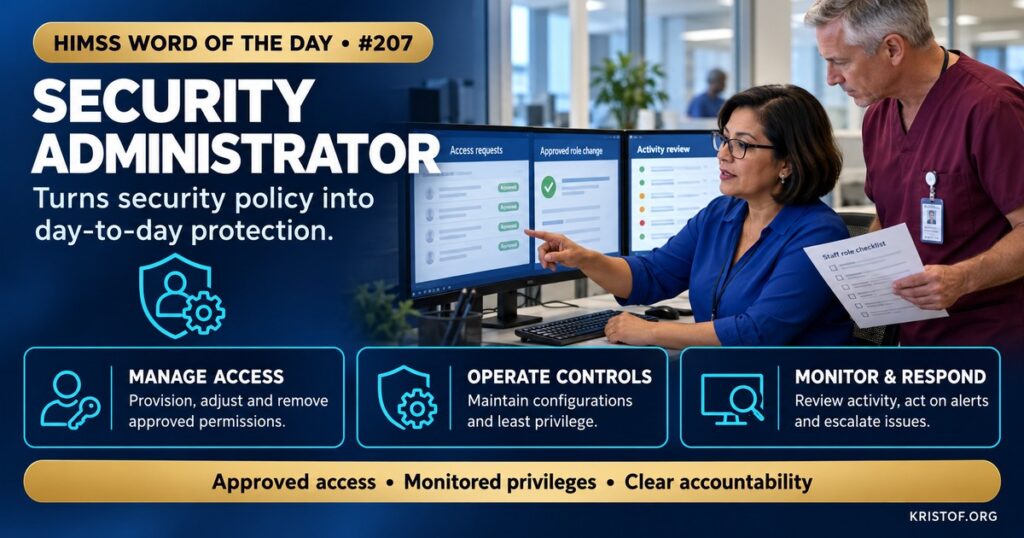
A security administrator is a trained security specialist on the data system management team who runs day-to-day protection for one or more networks, applying controls and watching for problems. The person has authority to enforce security measures and to help build a working environment that respects confidentiality and privacy.
The HIMSS Dictionary describes the role in operational terms: hands-on work that makes security policy real. That is different from the executive who owns the overall program, though in small organizations one person may do both.
| Role | Focus | Typical Responsibilities |
|---|---|---|
| HIPAA Security Official | Accountable for the security program | Policies, risk analysis, oversight, reporting |
| Security Administrator | Day-to-day control operation | Accounts, permissions, monitoring, configuration |
| Privacy Officer | Privacy policies and complaints | Privacy program, patient rights, investigations |
| Network or Systems Administrator | Infrastructure operation | Servers, networks, patching |
| Security Analyst | Detection and investigation | Alerts, log review, incident triage |
| Application Analyst | Application build and support | Configuration, security classes, user setup within the application |
⚠️ Exam Alert: The HIPAA Security Rule requires covered entities and business associates to identify a security official who is responsible for developing and implementing the required security policies and procedures. A security administrator carries out security tasks and may report to that official. The titles are not interchangeable, even when one person holds both.
🌐 Why It Matters: Real-World Healthcare IT Context
Security policy does little without people to operate it. Someone must create and remove accounts, adjust permissions, review logs, apply configuration standards, respond to alerts, and handle exceptions. The security administrator role covers many of these tasks, and its quality strongly affects how well controls work in practice.
HIPAA sets the accountability frame. Under the Security Rule’s administrative safeguards, covered entities and business associates must identify the security official responsible for the policies and procedures the rule requires, and must implement workforce security measures, including appropriate access to electronic protected health information and procedures for terminating access when employment ends or access is no longer justified. Security administrators perform much of that work: provisioning accounts through approved requests, changing access when roles change, and removing it when staff leave.
The role covers many technical domains. Typical duties include identity and access management, directory services, firewalls and network controls, endpoint protection, vulnerability management coordination, log monitoring, encryption key and certificate administration, and support for audits. Larger organizations split these among specialists, while smaller ones may combine them.
Privileged access deserves special attention. Administrators hold powerful accounts that can read data, change configurations, and disable logs. Good practice separates administrative accounts from everyday ones, grants only the privileges needed, requires strong authentication, records and reviews privileged actions, and divides duties so that no one person can both make and approve sensitive changes. Insider misuse and compromised administrator accounts are among the more damaging scenarios, so administrators are themselves subject to monitoring.
NIST guidance on implementing the HIPAA Security Rule helps map regulatory standards to practical controls, and the NIST NICE workforce framework describes the knowledge and skills for cybersecurity roles, which can guide job design, training, and hiring.
Collaboration is essential. Security administrators work with clinical leaders, human resources, clinical engineering, application teams, and vendors. Access requests need accurate role information from managers, offboarding depends on timely notice from HR, and device security needs input from biomedical engineering. Treating security as a service to clinicians, with clear request channels and realistic turnaround times, reduces workarounds.
Measurement keeps the role honest. Useful indicators include time to provision and remove access, share of accounts reviewed on schedule, number of orphaned or shared accounts, alerts handled within target, and audit findings closed.
Common problems in security administration:
- Slow provisioning that pushes staff to share logins
- Delayed removal of access after departures or role changes
- Shared or generic administrator accounts
- Unmonitored privileged activity
- One person able to make and approve sensitive changes
- Unclear boundaries between the security official, administrators, and application teams
What supports effective security administration:
- Documented request and approval workflows
- Least privilege and separation of duties
- Separate, monitored privileged accounts
- Timely offboarding linked to HR events
- Regular access reviews with clinical managers
- Defined metrics and escalation paths
🏥 The Nurse’s Perspective: Clinical, Bedside, & Workflow
Most nurses meet the security administrator through access requests, password issues, and privacy audits, so a good working relationship matters.
At the Bedside
Needing access at the start of a shift, such as for a new float assignment or a temporary role, is a common reason to contact the help desk and the security team. Requesting access ahead of time, through the approved channel and with manager approval, avoids the temptation to borrow a colleague’s login.
Reporting problems promptly helps. Lost badges, suspected phishing, accounts that behave strangely, or patient information visible where it should not be all deserve a call to security rather than a wait-and-see approach.
In Clinical Workflow
Nurse managers play a direct part in access governance. They request access for new staff, confirm role changes, and notify the right teams when employees leave. Periodic access reviews depend on managers confirming that each person still needs what they have.
Privacy audits sometimes flag access to records by staff with no clear job-related reason. Understanding that these checks protect patients, and that colleagues and family records are covered, helps staff approach them seriously.
Nurse informaticists often bridge between clinical needs and security controls, explaining why a delay in access affects care and helping design role templates that give nurses the right permissions without excess.
In EHR Implementation (Go-Live Perspective)
An Epic Go-Live involves setting up access for many users at once, including providers, super users, students, and contract staff, with security classes matched to job roles. Early planning with the security team avoids last-minute account problems.
At-the-elbow support analysts forward access issues quickly to the security and access teams, and they remind staff never to share credentials even when a go-live is busy.
🎓 CAHIMS / CPHIMS & HIMSS Perspective
CAHIMS Exam Domain Mapping
Security roles appear in governance, HIPAA, and access control questions:
| CAHIMS Domain | How the Security Administrator Appears |
|---|---|
| Healthcare & Technology Environments | HIPAA Security Rule requirements, workforce roles |
| Clinical Informatics | Role-based access design, clinical workflow impact of controls |
| Healthcare Information & Systems Management | Account provisioning, monitoring, privileged access, audit logs |
| Management & Leadership | Role definition, separation of duties, metrics, governance |
Key Terms to Know Alongside Security Administrator
- Security Official — individual HIPAA requires to be responsible for the security program
- Least Privilege — granting only the access necessary to do a job
- Separation of Duties — dividing responsibilities so one person cannot complete a sensitive action alone
- Privileged Account — account with elevated rights over systems or data
- Provisioning and Deprovisioning — creating, changing, and removing user access
- Audit Log — record of system and user activity used for review
HIMSS Organizational Position
HIMSS supports healthcare cybersecurity professionals through its Healthcare Cybersecurity Community, education, and research. Members can find related resources through the HIMSS Resource Center.
🔗 Explore Further: External References
- eCFR — 45 CFR 164.308, Administrative Safeguards (Assigned Security Responsibility and Workforce Security) https://www.ecfr.gov/current/title-45/subtitle-A/subchapter-C/part-164/subpart-C/section-164.308
- NIST — SP 800-66 Rev. 2, Implementing the HIPAA Security Rule https://csrc.nist.gov/pubs/sp/800/66/r2/final
- NIST — NICE Framework, Cybersecurity Workforce https://www.nist.gov/itl/applied-cybersecurity/nice
- HHS — The Security Rule https://www.hhs.gov/hipaa/for-professionals/security/index.html
- HHS 405(d) — Health Industry Cybersecurity Practices https://405d.hhs.gov/
- HIMSS — Healthcare Cybersecurity Community https://www.himss.org/networking/communities/healthcare-cybersecurity/
Term source: HIMSS Dictionary of Health Information and Technology Terms, Acronyms, and Organizations, 6th Edition (2025). All definitions in this series are paraphrased for editorial purposes. Readers are encouraged to consult the primary source for exact language.
Eric Andrew Kristof, RN, CAHIMS is a Healthcare IT professional and HIMSS Arkansas Chapter member based in Hot Springs Village, AR, with hands-on Epic Go-Live experience and a diverse healthcare and IT background. He writes at kristof.org at the intersection of clinical care and healthcare technology.
Leave a Reply