By Eric Andrew Kristof, RN, CAHIMS | Healthcare IT Professional | HIMSS Arkansas Chapter Member
About This Series: The HIMSS Word of the Day is a running blog series drawing from the HIMSS Dictionary of Health Information and Technology Terms, Acronyms, and Organizations, 6th Edition (2025) — the authoritative reference for healthcare IT professionals and the primary study resource for CAHIMS and CPHIMS certification. Each post paraphrases the term in plain language, grounds it in real-world healthcare IT context, and adds a bedside nursing perspective you won’t find in a textbook.
📖 The Term: Privacy Impact Assessment (PIA)
Source: HIMSS Dictionary of Health Information and Technology Terms, Acronyms, and Organizations, 6th Edition (2025)
🔍 Plain-Language Definition
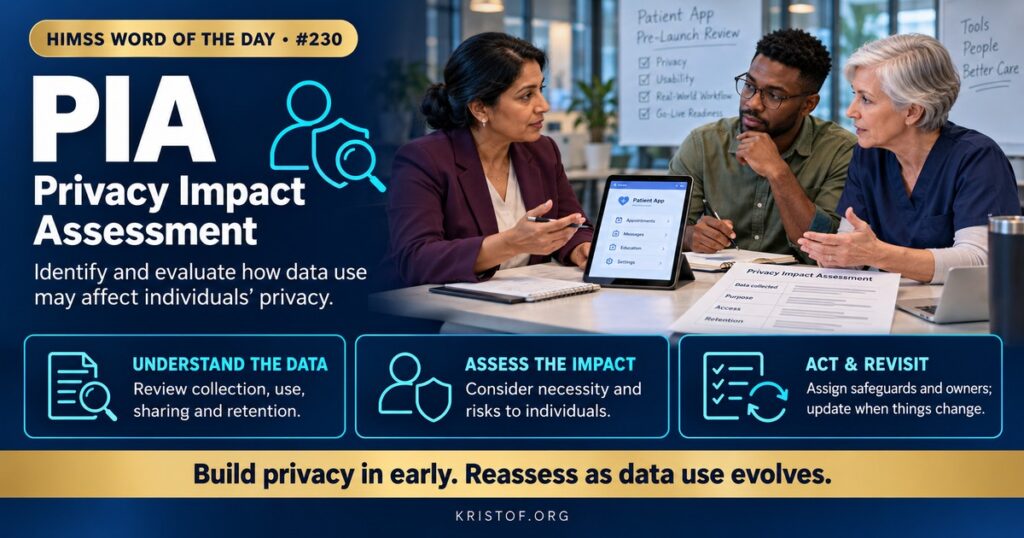
A privacy impact assessment (PIA) is a structured way to find and evaluate privacy risks while a program or system is being planned, built, and operated. According to the HIMSS Dictionary, a PIA lays out which personally identifiable information (PII) the system gathers and describes how it is stored, safeguarded, and passed on to others. The dictionary adds that privacy must be protected wherever PII is stored, and that safeguards such as PIAs help guard against violations, especially when a privacy problem is part of a cyber event.
A PIA is usually done early, when changes are still cheap, and revisited when the system, data, or use changes. Typical contents include a description of the system and purpose, a map of data flows, the legal basis or authority, the data elements involved, who has access, how long data are kept, safeguards, risks identified, and decisions about how to reduce them.
| Assessment | Main Question | Typical Timing |
|---|---|---|
| Privacy Impact Assessment (PIA) | How will this system affect the privacy of individuals? | Design, before launch, and at major changes |
| HIPAA Security Risk Analysis | What threats and vulnerabilities could affect ePHI? | Periodically and with environmental changes |
| Data Protection Impact Assessment (DPIA) | What are the risks of high-risk processing under GDPR? | Before processing begins |
| Vendor Risk Assessment | Does this vendor protect our data? | Procurement and renewal |
| Business Impact Analysis | What is lost if the system is down? | Continuity planning |
⚠️ Exam Alert: A PIA focuses on privacy risk to individuals and how data are collected, used, and shared. A security risk analysis focuses on threats and vulnerabilities to the confidentiality, integrity, and availability of information. They overlap but are not the same. The GDPR version is called a data protection impact assessment (DPIA).
🌐 Why It Matters: Real-World Healthcare IT Context
Privacy problems are easiest to prevent at design time. A new patient app that collects location, a research database that combines records from several sources, or an analytics tool that profiles patients can each create risks that nobody planned for. A PIA brings privacy, security, legal, clinical, and technical staff together to look at the whole picture before data start flowing.
Several authorities call for or shape PIAs. In the United States, the E-Government Act of 2002 requires federal agencies, before developing or procuring information technology that collects, maintains, or disseminates information in identifiable form, or before starting a new collection, to conduct a privacy impact assessment, have it reviewed by the chief information officer or equivalent, and, if practicable, make it publicly available. NIST’s Special Publication 800-122 helps federal agencies protect the confidentiality of PII, explains its relationship to privacy through the Fair Information Practices, and gives context-based guidance on identifying PII and determining the level of protection each instance needs, including recommendations for response plans for incidents involving PII. The NIST Privacy Framework offers a voluntary tool for managing privacy risk that organizations of any kind can use.
Outside the United States, the GDPR requires a data protection impact assessment, before processing, where a type of processing, particularly with new technologies, is likely to result in a high risk to the rights and freedoms of individuals. Article 35 gives examples that include large-scale processing of special categories of data, which covers health data. The assessment must at least describe the processing and its purposes, evaluate necessity and proportionality, assess the risks to individuals, and identify measures to address them.
HIPAA itself does not use the term privacy impact assessment for covered entities. Its Security Rule requires an accurate and thorough risk analysis of risks to the confidentiality, integrity, and availability of electronic protected health information, and its Privacy Rule requires policies and safeguards. Many health systems nonetheless adopt PIAs as good practice for new technologies, research data sharing, and vendor projects, because a PIA asks questions that a security risk analysis alone may not, such as whether the data collected are really needed, whether patients would expect the use, and whether sharing with a vendor is covered by an appropriate agreement.
Published examples show the method at work. A European public health project used a targeted PIA to choose the architecture for a cross-border diabetes information system that drew on clinical registries. The team used a literature search, analysis of data flow options, a questionnaire, and a Delphi panel, and the result was an architecture based on aggregation by group of patients and exchange of summary tables rather than record-level exchange. The authors concluded that public health information systems should be engineered only after a clear privacy strategy has been planned. Another study applied a PIA to a proposal to make emergency medical information available to first responders through mobile devices, following Australian government guidelines that include information flow mapping, compliance analysis, risk analysis, and recommendations to management. The output was a set of questions, commendations, and recommendations matched against national privacy principles.
A PIA is only as good as the follow-through. Findings need owners, due dates, and tracking. Decisions to accept a risk should be documented by an accountable leader. And the assessment should be updated when the system changes, for example when a vendor adds an analytics feature or when data are reused for a new purpose.
Common PIA problems:
- Performed after the system is already built
- Completed as a form without data flow mapping
- Focus on technical security and not on whether data collection is necessary
- No clinical or patient perspective in the review
- Findings recorded but not tracked to closure
- Never updated after the system changes
What supports effective PIAs:
- A required trigger in project intake and vendor procurement
- Data flow diagrams reviewed by privacy, security, and clinical staff
- Clear criteria for when a full PIA is needed
- Documented decisions and named owners for each risk
- Reassessment when purposes, vendors, or data elements change
- Alignment with security risk analysis and vendor assessments
🏥 The Nurse’s Perspective: Clinical, Bedside, & Workflow
Nurses help determine whether a system respects privacy in practice, not just on paper.
At the Bedside
New tools that collect patient information, such as bedside apps, wearable devices, ambient listening, or photo capture, raise questions that nurses can answer from experience. Where will the patient’s information appear? Who will see it? Would a patient expect it to be collected? Nurses who raise these questions early help prevent surprises after rollout.
Patients often ask nurses what happens with their data. Understanding that a review exists, and who to contact with questions, helps nurses answer honestly.
In Clinical Workflow
Nurse managers and informaticists join PIA reviews for tools that affect care. They check whether the data flows described match real workflows, such as shared devices, hallway conversations, or discharge instructions sent to patient email. They also verify that the minimum necessary information is collected and that consent and notice processes make sense on the unit.
Nurse researchers and quality leaders request PIAs or equivalent privacy reviews when planning projects that combine records or share data outside the organization.
In EHR Implementation (Go-Live Perspective)
An Epic Go-Live adds interfaces, portals, and third-party apps, each of which can raise privacy questions. Reviews before go-live consider which vendors receive which data and how access is controlled. At-the-elbow support analysts report unexpected data exposure they see in practice, such as a report that prints more information than needed, so privacy teams can respond.
🎓 CAHIMS / CPHIMS & HIMSS Perspective
CAHIMS Exam Domain Mapping
PIAs appear in privacy, risk management, and governance questions:
| CAHIMS Domain | How the PIA Appears |
|---|---|
| Healthcare & Technology Environments | Privacy law, HIPAA, GDPR, federal requirements |
| Clinical Informatics | Clinical workflow review, patient expectations, data minimization |
| Healthcare Information & Systems Management | Data flow mapping, safeguards, vendor assessment |
| Management & Leadership | Governance, risk acceptance, accountability, documentation |
Key Terms to Know Alongside the PIA
- PII (Personally Identifiable Information) — information that can identify an individual
- Data Flow Map — diagram of where data originate, move, and are stored
- Fair Information Practices — principles underlying many privacy laws
- DPIA (Data Protection Impact Assessment) — GDPR assessment for high-risk processing
- Privacy by Design — building privacy protections into systems from the start
- Risk Acceptance — documented decision to tolerate a residual risk
HIMSS Organizational Position
HIMSS supports privacy and security in health information through its public policy work, Healthcare Cybersecurity Community, and research. Members can find related resources through the HIMSS Resource Center and Public Policy and Advocacy pages.
🔗 Explore Further: External References
- NIST — SP 800-122, Guide to Protecting the Confidentiality of Personally Identifiable Information (PII) https://csrc.nist.gov/pubs/sp/800/122/final
- NIST — Privacy Framework https://www.nist.gov/privacy-framework
- U.S. Congress — E-Government Act of 2002 (Public Law 107-347), Section 208 https://www.govinfo.gov/content/pkg/PLAW-107publ347/html/PLAW-107publ347.htm
- GDPR — Article 35, Data Protection Impact Assessment https://gdpr-info.eu/art-35-gdpr/
- Di Iorio et al. (2009), Journal of Medical Ethics — Privacy Impact Assessment in the Design of Transnational Public Health Information Systems: The BIRO Project https://pubmed.ncbi.nlm.nih.gov/19948932/
- Croll (2012), Studies in Health Technology and Informatics — Privacy With Emergency Medical Information Used in First Response https://pubmed.ncbi.nlm.nih.gov/22797012/
Term source: HIMSS Dictionary of Health Information and Technology Terms, Acronyms, and Organizations, 6th Edition (2025). All definitions in this series are paraphrased for editorial purposes. Readers are encouraged to consult the primary source for exact language.
Eric Andrew Kristof, RN, CAHIMS is a Healthcare IT professional and HIMSS Arkansas Chapter member based in Hot Springs Village, AR, with hands-on Epic Go-Live experience and a diverse healthcare and IT background. He writes at kristof.org at the intersection of clinical care and healthcare technology.
Leave a Reply