By Eric Andrew Kristof, RN, CAHIMS | Healthcare IT Professional | HIMSS Arkansas Chapter Member
About This Series: The HIMSS Word of the Day is a running blog series drawing from the HIMSS Dictionary of Health Information and Technology Terms, Acronyms, and Organizations, 6th Edition (2025) — the authoritative reference for healthcare IT professionals and the primary study resource for CAHIMS and CPHIMS certification. Each post paraphrases the term in plain language, grounds it in real-world healthcare IT context, and adds a bedside nursing perspective you won’t find in a textbook.
📖 The Term: Sensitivity Label
Source: HIMSS Dictionary of Health Information and Technology Terms, Acronyms, and Organizations, 6th Edition (2025)
🔍 Plain-Language Definition
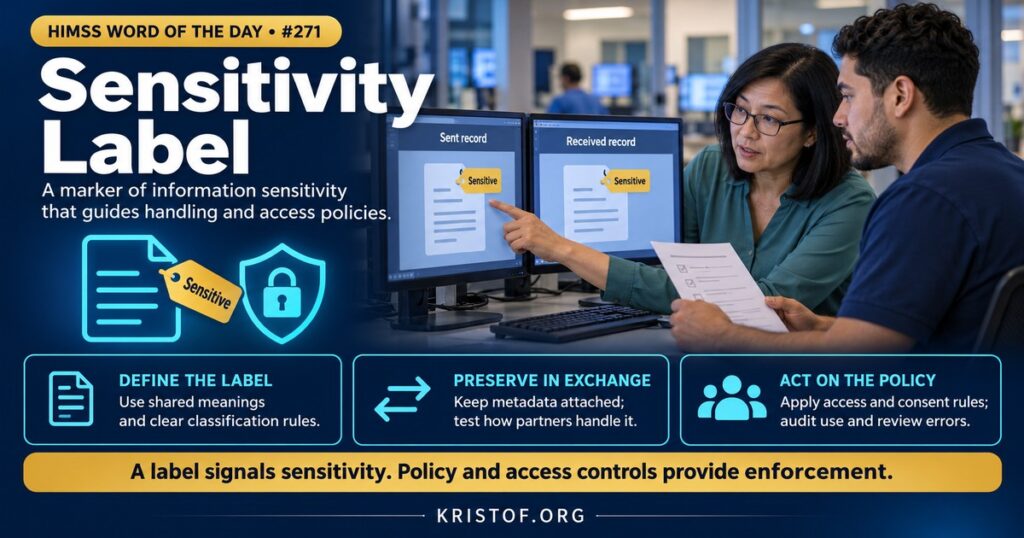
A sensitivity label is a security level attached to the content of a piece of information. The HIMSS Dictionary explains the idea in terms of harm: society has long treated certain information as sensitive because disclosing it could damage the patient or data subject, or others close to them, such as a spouse, children, friends, or sexual partners. A label does not hide anything by itself. It is a marker that tells people and systems how carefully the information should be treated.
In health IT, sensitivity labels are part of a wider family of security labels, which can describe confidentiality, the purpose for which data may be used, handling instructions, and obligations such as “do not redisclose.” The labels travel with the data, so that a receiving system has a chance to apply the same care as the sender.
| Label Element | What It Expresses | Example |
|---|---|---|
| Confidentiality | How sensitive the information is | Normal versus restricted |
| Category or sensitivity | Type of sensitive content | Behavioral health note |
| Purpose of use | Why the data may be used | Treatment, research, public health |
| Handling caveat | What the recipient must or must not do | Do not redisclose; delete after use |
| Provenance | Where the data came from | Source organization and author |
⚠️ Exam Alert: A label describes sensitivity; it does not enforce it. Enforcement requires access control and policy that act on the label. Data segmentation for privacy (DS4P) uses labels to carry limits on redisclosure. A label is only meaningful if the sender, receiver, and policy all agree on what it means.
🌐 Why It Matters: Real-World Healthcare IT Context
Not all health information carries the same risk. A routine blood pressure reading and a note about substance use, domestic violence, a sexually transmitted infection, or a minor’s confidential visit differ in how much damage unintended disclosure can do. Labels let organizations express that difference in a form software can read, which supports more precise sharing: instead of withholding a whole record or sharing everything, systems can handle each element according to its label.
HL7 FHIR, the widely used exchange standard, includes a defined approach. A security label in FHIR is metadata attached to a resource or bundle that provides security-related information about it. HL7 describes the intent as follows: a recipient of resources or bundles with security tags is obligated to enforce the handling caveats and to carry the labels forward as appropriate. Labels let more data flow because policy fragments can travel with the data. The specification defines core label sets for confidentiality classifications, purpose of use, and others drawn from the HL7 Healthcare Privacy and Security Classification System, and says implementations should use the applicable standard label if one exists, since defining additional labels increases the cost of portability.
The same HL7 documentation is candid about limits. Labels are a device to connect resources to a wider security framework; a full set of policy and consent statements, with the obligations that follow, is needed to give them meaning. Because of this, labels are most effective in fully trusted environments in which all trading partners have agreed to abide by them under a mutual trust framework. It also notes that labels support policy and that tagging every resource is not always required to implement policy correctly. In other words, a label is a signal, and organizations must agree on what the signal means and what to do with it.
Research on implementation underscores the challenge. A 2026 study in Applied Clinical Informatics interviewed 16 expert stakeholders about granular consent tools for sensitive data. Participants most often stressed patient-centered, trauma-informed, plain-language experiences (75 percent). Lack of trust, stigma, and workflow burden were major barriers (63 percent), alongside technical limits in EHRs that prevent reliable segmentation and enforcement of preferences (56 percent). Half viewed granular, computable consent as essential, and half cited legal and policy fragmentation. The sample was small and qualitative, so the percentages describe the interviewees and not the field, but the themes match what many organizations report. A 2023 study of 10 U.S. healthcare organizations caring for children found that all had implemented the information blocking provisions, yet they differed in how sensitive elements were protected when data were shared with parents, guardians, and adolescents. The authors warned that this variation can lead to privacy breaches and confusion about completeness of data.
Labeling also has practical hazards. Over-labeling slows care and frustrates users, because too much looks restricted. Under-labeling exposes patients. Labels applied by authors at the point of documentation depend on clinicians choosing the right place for sensitive content; labels applied by algorithms depend on rules or models that make errors. Labels may be lost in translation when data pass through systems that do not preserve them. Labels can themselves reveal something: a “restricted” mark on a behavioral health note signals that such a note exists. Good programs set clear definitions, test label handling across interfaces, audit outcomes, and give users a way to request review.
Common labeling problems:
- Labels defined differently by each organization
- Sensitive content scattered across free-text notes
- Receiving systems that drop or ignore labels
- Over-labeling that blocks legitimate care
- Labels that reveal the existence of sensitive information
- Lack of policy and consent processes to give labels meaning
What supports effective labeling:
- Standard label sets, such as those in HL7 FHIR
- Clear definitions of what is sensitive and who decides
- Structured places to document sensitive information
- Interface testing that confirms labels survive exchange
- Auditing of label use and access to labeled data
- Patient-friendly explanations and consent options
🏥 The Nurse’s Perspective: Clinical, Bedside, & Workflow
Nurses document some of the most sensitive information in the record, and their choices influence how labels are applied.
At the Bedside
A patient may confide a history of abuse, a substance use disorder, or a diagnosis they do not want shared with family. Documenting it in the correct place, and telling the patient honestly who can see it, respects both the care relationship and the rules. When a minor or proxy is involved, knowing the organization’s policy on what is visible to parents or guardians is essential.
In Clinical Workflow
Nurse managers train staff on where sensitive information belongs and on what to do when a patient asks that something not be shared. Charge nurses help staff handle visitor and family questions without confirming that sensitive information exists.
Nurse informaticists help define which notes, results, and flowsheets are treated as sensitive, how that status appears to users with different roles, and how it affects portal release and outside exchange. They test with realistic cases, including adolescent visits, behavioral health care, and transfers.
In EHR Implementation (Go-Live Perspective)
An Epic Go-Live establishes defaults for note types, result release, and confidentiality settings. At-the-elbow support analysts learn quickly when nurses do not know where to document sensitive information, or when a label hides something a nurse needs. They route those issues to privacy and build teams so that settings are corrected before habits form.
🎓 CAHIMS / CPHIMS & HIMSS Perspective
CAHIMS Exam Domain Mapping
Sensitivity labels appear in privacy, standards, and data management questions:
| CAHIMS Domain | How Sensitivity Labels Appear |
|---|---|
| Healthcare & Technology Environments | Privacy law, patient rights, information blocking |
| Clinical Informatics | Documentation of sensitive content, consent, adolescent care |
| Healthcare Information & Systems Management | Security labels in FHIR, access control, interface testing |
| Management & Leadership | Privacy governance, policy, auditing, patient trust |
Key Terms to Know Alongside Sensitivity Label
- Security Label — metadata describing confidentiality, purpose, or handling rules
- Data Segmentation for Privacy (DS4P) — approach for tagging data with privacy metadata
- Redisclosure — passing information on to another party
- Consent Directive — patient’s recorded permission or restriction
- Purpose of Use — the reason data are accessed or used
- Access Control — process that grants or denies access to information
HIMSS Organizational Position
HIMSS supports privacy and security in health information through its public policy work, Healthcare Cybersecurity Community, and research. Members can find related resources through the HIMSS Healthcare Cybersecurity Community page.
🔗 Explore Further: External References
- HL7 — FHIR Security Labels https://hl7.org/fhir/R4/security-labels.html
- HL7 — FHIR Data Segmentation for Privacy (DS4P) Implementation Guide https://build.fhir.org/ig/HL7/fhir-security-label-ds4p/
- Cooper et al. (2026), Applied Clinical Informatics — Designing Granular Consent Tools for Sensitive Health Data: Challenges, User Needs, and Stakeholder Guidance https://pubmed.ncbi.nlm.nih.gov/42447927/
- Sinha et al. (2023), Journal of the American Medical Informatics Association — Variation in Pediatric and Adolescent Electronic Health Data Sharing Practices Under the 21st Century Cures Act https://pubmed.ncbi.nlm.nih.gov/37643734/
- eCFR — 45 CFR 164.312, Technical Safeguards https://www.ecfr.gov/current/title-45/subtitle-A/subchapter-C/part-164/subpart-C/section-164.312
Term source: HIMSS Dictionary of Health Information and Technology Terms, Acronyms, and Organizations, 6th Edition (2025). All definitions in this series are paraphrased for editorial purposes. Readers are encouraged to consult the primary source for exact language.
Eric Andrew Kristof, RN, CAHIMS is a Healthcare IT professional and HIMSS Arkansas Chapter member based in Hot Springs Village, AR, with hands-on Epic Go-Live experience and a diverse healthcare and IT background. He writes at kristof.org at the intersection of clinical care and healthcare technology.
Leave a Reply