By Eric Andrew Kristof, RN, CAHIMS | Healthcare IT Professional | HIMSS Arkansas Chapter Member
About This Series: The HIMSS Word of the Day is a running blog series drawing from the HIMSS Dictionary of Health Information and Technology Terms, Acronyms, and Organizations, 6th Edition (2025) — the authoritative reference for healthcare IT professionals and the primary study resource for CAHIMS and CPHIMS certification. Each post paraphrases the term in plain language, grounds it in real-world healthcare IT context, and adds a bedside nursing perspective you won’t find in a textbook.
📖 The Term: ChatGPT
Source: HIMSS Dictionary of Health Information and Technology Terms, Acronyms, and Organizations, 6th Edition (2025)
🔍 Plain-Language Definition
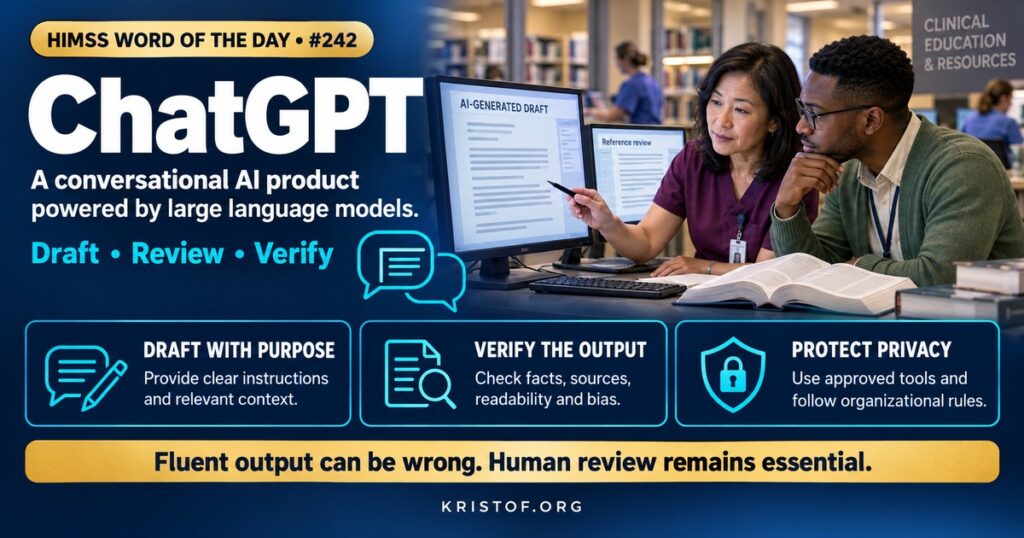
ChatGPT, short for Chat Generative Pre-trained Transformer, is a machine learning model that performs natural language generation tasks. The HIMSS Dictionary notes that its training drew on a vast body of unlabeled Internet text collected before 2022, that human-labeled data sets are used for further fine-tuning, and that its output is accurate enough to pass a Turing test. In practice, it is a conversational interface to a large language model, a system that predicts likely next words from patterns in text and so produces fluent answers to questions and instructions.
Because the output is generated from patterns, not looked up from a verified source, it can state wrong things in a confident tone, sometimes called hallucination. Quality also depends on how the request is worded, known as prompting, and on what additional information is supplied.
| Term | Meaning | Why It Matters |
|---|---|---|
| Large language model (LLM) | Model trained to predict and generate text | Foundation of tools like ChatGPT |
| Generative AI | AI that creates new text, images, or other content | Distinct from models that only classify or predict |
| Prompt | The instruction or question given to the model | Wording changes results |
| Hallucination | Fluent but false or unsupported output | Requires human verification |
| Fine-tuning | Further training for a task or domain | Can improve fit but needs testing |
| Human in the loop | Person reviews before output is used | Core safety control |
⚠️ Exam Alert: ChatGPT is one product built on a large language model; generative AI is the broader category. Its output is generated, not retrieved, so it requires verification. Entering protected health information into a tool without a business associate agreement and approved controls can violate HIPAA.
🌐 Why It Matters: Real-World Healthcare IT Context
Clinicians and patients began using ChatGPT soon after its release in November 2022, and health systems quickly faced questions about where it helps and where it harms. The most studied use is drafting text, especially responses to patient messages, which have grown with virtual care and add to workload.
An early cross-sectional study compared physician responses with ChatGPT responses to 195 questions drawn from a public social media forum. Licensed health professionals who did not know the source preferred the chatbot response in 78.6 percent of 585 evaluations. Chatbot answers were much longer, averaging 211 words versus 52, and were rated good or very good in quality far more often, 78.5 percent versus 22.1 percent, and empathetic or very empathetic more often, 45.1 percent versus 4.6 percent. The authors called for exploring the technology in clinical settings, such as drafting responses that physicians edit, and for randomized trials. The study used public forum posts, not real patient records or electronic health record messages, and length probably influenced the ratings.
A quality improvement study at NYU Langone tested drafts generated by a generative AI tool built into the EHR. Sixteen primary care physicians reviewed 344 messages, 175 drafted by the AI and 169 by health care professionals. The AI drafts were rated higher for communication style and similar for information content, and about the same proportion were judged usable, 69 percent versus 65 percent. Usable AI drafts were considered more empathetic, but they were less readable, which the authors flagged as a concern for patients with low health or English literacy. A cross-sectional survey of 49 primary care providers compared patient portal replies written by GPT-3.5-turbo with real doctor replies and found the GPT replies scored higher on empathy and readability. Together, the studies suggest that drafts can be useful and well received, but they do not show that patient outcomes improve or that workload falls in every setting.
Several risks follow from how these models work. Accuracy is not guaranteed, so a plausible but wrong medication instruction could harm a patient. Bias in training data can shape responses. Privacy is a major concern: staff who paste patient information into a public chatbot may disclose protected health information to a vendor with no agreement in place. Organizations therefore define approved tools, require agreements and security review before use with patient data, and prohibit unapproved use. Over-reliance is another risk, since a busy clinician may send a draft without careful reading.
Governance frameworks help. The NIST Generative AI Profile, companion to the AI Risk Management Framework, offers a structured way to identify and manage risks specific to generative AI. Health systems apply the same ideas through AI committees that review proposed uses, test tools on local data, define who reviews outputs, monitor performance after launch, and set rules for disclosure to patients. Clear labeling of AI-drafted content, a feedback channel for errors, and training on limits are part of a safe rollout.
Common ChatGPT problems in health care:
- Confident but incorrect or unsupported statements
- Patient information entered into tools without approved agreements
- Drafts sent without careful human review
- Responses that are too long or hard to read for patients
- Bias or missing context that affects some patient groups
- Tools adopted by individuals before the organization has set rules
What supports safe use:
- An approved-tool list, with agreements and security review for any use with patient data
- Human review of all content before it reaches a patient or the record
- Testing on local examples, including readability and equity checks
- Clear policy on disclosure and documentation
- Monitoring, error reporting, and periodic reevaluation
- Training for clinicians on prompts, limits, and privacy
🏥 The Nurse’s Perspective: Clinical, Bedside, & Workflow
Nurses are both users of AI drafting tools and gatekeepers who decide whether a draft is safe to send.
At the Bedside
A nurse may use an approved tool to draft patient education, a discharge explanation, or a reply to a portal message. The draft is a starting point. Checking it against the order, the plan of care, and organizational policy, and rewriting it in plain language at an appropriate reading level, keeps the nurse responsible for what the patient receives.
Patients may also arrive having used a public chatbot. Nurses can listen without judgment, correct errors, and encourage patients to bring such information to their clinicians.
In Clinical Workflow
Nurse managers set expectations: which tools are approved, what information may be entered, and how AI-assisted content is reviewed. Triage and message-pool nurses, who handle large volumes of patient messages, are among the people best placed to judge whether drafts reduce work or create new checking tasks.
Nurse informaticists serve on AI governance committees and pilot teams. They test drafts for accuracy, tone, readability, and bias, collect staff feedback, and bring nursing concerns about documentation and patient communication into decisions.
In EHR Implementation (Go-Live Perspective)
An Epic Go-Live that includes AI-assisted drafting features needs training on what the feature does, who is responsible for the final text, and how to report poor drafts. At-the-elbow support analysts watch how nurses actually use the tool, noting when staff accept drafts without edits or struggle to find errors, and pass that information to governance teams.
🎓 CAHIMS / CPHIMS & HIMSS Perspective
CAHIMS Exam Domain Mapping
ChatGPT appears in AI, privacy, and governance questions:
| CAHIMS Domain | How ChatGPT Appears |
|---|---|
| Healthcare & Technology Environments | AI and machine learning concepts, HIPAA, emerging technology |
| Clinical Informatics | Documentation support, patient communication, human review |
| Healthcare Information & Systems Management | Vendor agreements, security, integration, monitoring |
| Management & Leadership | AI governance, policy, risk management, change management |
Key Terms to Know Alongside ChatGPT
- Large Language Model (LLM) — AI model trained on large text collections to generate language
- Generative AI — AI that creates new content such as text or images
- Hallucination — fluent output that is false or unsupported
- Prompt Engineering — crafting inputs to get better outputs
- Business Associate Agreement — HIPAA contract required when a vendor handles protected health information
- AI Governance — policies and oversight for selecting and monitoring AI tools
HIMSS Organizational Position
HIMSS supports the responsible adoption of artificial intelligence in health care through its research, education, and community work. Members can find related resources through the HIMSS Resource Center.
🔗 Explore Further: External References
- NIST — AI Risk Management Framework: Generative Artificial Intelligence Profile https://www.nist.gov/publications/artificial-intelligence-risk-management-framework-generative-artificial-intelligence
- FDA — Artificial Intelligence-Enabled Medical Devices https://www.fda.gov/medical-devices/digital-health-center-excellence/artificial-intelligence-enabled-medical-devices
- Ayers et al. (2023), JAMA Internal Medicine — Comparing Physician and Artificial Intelligence Chatbot Responses to Patient Questions Posted to a Public Social Media Forum https://pubmed.ncbi.nlm.nih.gov/37115527/
- Small et al. (2024), JAMA Network Open — Large Language Model-Based Responses to Patients’ In-Basket Messages https://pubmed.ncbi.nlm.nih.gov/39012633/
- Kaur et al. (2025), Applied Clinical Informatics — Automating Responses to Patient Portal Messages Using Generative AI https://pubmed.ncbi.nlm.nih.gov/40132987/
Term source: HIMSS Dictionary of Health Information and Technology Terms, Acronyms, and Organizations, 6th Edition (2025). All definitions in this series are paraphrased for editorial purposes. Readers are encouraged to consult the primary source for exact language.
Eric Andrew Kristof, RN, CAHIMS is a Healthcare IT professional and HIMSS Arkansas Chapter member based in Hot Springs Village, AR, with hands-on Epic Go-Live experience and a diverse healthcare and IT background. He writes at kristof.org at the intersection of clinical care and healthcare technology.
Leave a Reply