By Eric Andrew Kristof, RN, CAHIMS | Healthcare IT Professional | HIMSS Arkansas Chapter Member
About This Series: The HIMSS Word of the Day is a running blog series drawing from the HIMSS Dictionary of Health Information and Technology Terms, Acronyms, and Organizations, 6th Edition (2025) — the authoritative reference for healthcare IT professionals and the primary study resource for CAHIMS and CPHIMS certification. Each post paraphrases the term in plain language, grounds it in real-world healthcare IT context, and adds a bedside nursing perspective you won’t find in a textbook.
📖 The Term: FQHC (Federally Qualified Health Center)
Source: HIMSS Dictionary of Health Information and Technology Terms, Acronyms, and Organizations, 6th Edition (2025)
🔍 Plain-Language Definition
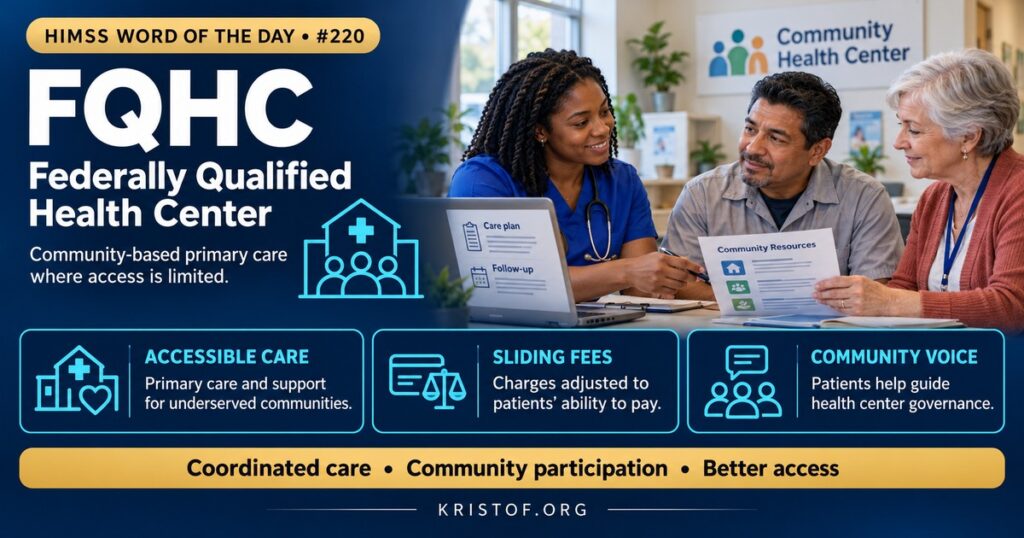
A federally qualified health center (FQHC) is a community-based health care provider that is funded through the Health Center Program of the Health Resources and Services Administration (HRSA) and delivers primary care where access is limited. The HIMSS Dictionary notes that FQHCs must meet demanding requirements, including charges adjusted on a sliding scale to what patients can afford and a governing board that includes patients. The category includes community health centers, migrant health centers, health care for the homeless programs, and centers serving residents of public housing.
Two federal agencies shape an FQHC’s operations. HRSA oversees the Health Center Program and its reporting requirements. CMS pays FQHCs for Medicare services under a distinct prospective payment system, and state Medicaid programs have their own payment rules.
| Element | What It Is | Why It Matters |
|---|---|---|
| HRSA Health Center Program | Federal funding and oversight for health centers | Sets program requirements and reporting |
| Sliding Fee Scale | Charges adjusted by ability to pay | Supports access regardless of income |
| Patient-Majority Governing Board | Board that includes patients | Gives the community a voice in governance |
| Uniform Data System (UDS) | HRSA’s annual reporting system for health centers | Source of national health center statistics |
| FQHC Prospective Payment System | CMS payment method for Medicare FQHC services | Pays a bundled rate per visit |
⚠️ Exam Alert: An FQHC is defined by federal program status and payment, not by building type or ownership. Key features are HRSA Health Center Program funding, a sliding fee scale, and a governing board that includes patients. The UDS is HRSA’s annual data reporting system. A rural health clinic is a different federal designation.
🌐 Why It Matters: Real-World Healthcare IT Context
FQHCs are a major part of the safety net. HRSA’s national Uniform Data System summary for 2024 reported 1,359 health center awardees serving 32,387,774 patients, and HRSA described the year as a record, with about 1.1 million more patients than the year before. These centers operate in cities and rural areas and serve many people who are uninsured, covered by Medicaid, or facing barriers such as language, housing, or transportation.
Payment rules add complexity. CMS describes a prospective payment system for FQHCs under which Medicare pays a bundled rate for qualifying visits. The system took effect for Medicare FQHC services on October 1, 2014, following the Affordable Care Act. For informatics and revenue cycle teams, this affects how encounters, visit types, and services are defined in the system and how claims are built.
Health IT is central. FQHCs report clinical and operational measures to HRSA each year through the Uniform Data System, so EHR data must be accurate, structured, and extractable. They also take part in quality programs and value-based arrangements, and they support care coordination across social, behavioral, and medical needs. Many centers operate with lean IT staffing compared with large health systems, so each decision about vendors, upgrades, and support carries more weight.
Research highlights both strengths and strain. A qualitative study of FQHCs and other priority primary care practices in Michigan, published in 2015, found that maintaining EHR technology requires ongoing expert technical support indefinitely beyond implementation to address upgrades and security needs, and that sustaining quality improvement requires ongoing support for leadership and change management. The authors noted that practices not tied to larger systems lacked technical expertise, financial resources, and leverage with vendors, and that rural practices were particularly challenged. The lesson is that go-live is not the end of the work; sustaining health IT in a low-resource setting is its own project.
At the same time, FQHC data are a rich resource. A 2026 analysis used EHR data from a 56-clinic FQHC network in Texas to study how quickly women aged 50 and older completed overdue cancer screening after receiving text message reminders, comparing screening types. Studies like this show how structured EHR data support quality improvement and research that can directly inform outreach practices for underserved populations. Another study of 18 FQHCs analyzed more than 1.3 million patients and nearly 20 million encounters over many years and found poor continuity with a single usual provider on average, illustrating how EHR data can reveal workforce and access patterns that matter for planning.
Interoperability matters particularly for patients who move between a health center, a hospital emergency department, specialty clinics, and community organizations. Standards-based exchange, shared care plans, and referral tracking help the center close loops that its small teams cannot chase by phone.
Common FQHC health IT challenges:
- Limited IT staffing and budget for upgrades and security
- Heavy reporting demands on data that are not consistently structured
- Fragmented referral and specialty care loops
- High turnover that strains training
- Multiple payer rules that complicate billing and quality measures
- Limited broadband or device access for patients and remote staff
What supports FQHC health IT success:
- Shared services, networks, or hosted solutions that pool expertise
- Structured data capture designed around UDS and quality measures
- Ongoing training and super user programs
- Strong vendor support agreements
- Care coordination tools linked to community resources
- Leadership attention to cybersecurity and downtime readiness
🏥 The Nurse’s Perspective: Clinical, Bedside, & Workflow
Nurses are central to FQHC care, working as care coordinators, population health nurses, clinic nurses, and nurse practitioners, often with broad scope.
At the Bedside
In a community health center, the nursing visit may include vaccines, chronic disease teaching, screening, medication reconciliation, and connecting patients to social services. Consistent, structured documentation matters because the same data feed clinical care, billing, and the annual UDS report.
Patients may lack stable phone service or housing, so recording preferred contact methods and barriers helps the team reach them.
In Clinical Workflow
Registered nurses and care coordinators monitor registries of patients overdue for screening or follow-up, make outreach calls, and track referrals. When registries are built on clean, structured data, outreach is faster and fairer. Nurse leaders collaborate with IT and quality staff on templates, reminders, and standing orders.
Nurse informaticists, where the center has them, shape workflows so that data entry supports care and reporting without extra clicks. In smaller centers, nurses often carry that role informally.
In EHR Implementation (Go-Live Perspective)
A go-live at a health center is often led by a small team that must balance training with open clinic schedules. An Epic Go-Live approach adapted to this setting relies on super users, at-the-elbow support analysts, and carefully staged workflows. After go-live, the team returns to sustain gains: refreshing training, cleaning up templates, and testing downtime procedures.
🎓 CAHIMS / CPHIMS & HIMSS Perspective
CAHIMS Exam Domain Mapping
FQHCs appear in policy, safety net, and reporting questions:
| CAHIMS Domain | How FQHCs Appear |
|---|---|
| Healthcare & Technology Environments | HRSA and CMS roles, safety-net providers, health equity |
| Clinical Informatics | Registries, quality measures, structured documentation |
| Healthcare Information & Systems Management | EHR support, UDS reporting, lean IT operations |
| Management & Leadership | Governance, funding, sustaining change in low-resource settings |
Key Terms to Know Alongside the FQHC
- HRSA (Health Resources and Services Administration) — federal agency overseeing the Health Center Program
- Uniform Data System (UDS) — HRSA’s annual health center reporting system
- Sliding Fee Scale — fees adjusted according to ability to pay
- FQHC PPS — Medicare prospective payment system for FQHC services
- Safety Net Provider — provider serving many uninsured or low-income patients
- Patient-Centered Medical Home — primary care model emphasizing coordination and continuity
HIMSS Organizational Position
HIMSS supports health equity and access through its Global Health Equity Community, research, and public policy work. Members can find related resources through the HIMSS Resource Center and community pages.
🔗 Explore Further: External References
- HRSA — Health Center Program National Data (Uniform Data System) https://data.hrsa.gov/topics/healthcenters/uds/overview/national
- CMS — Federally Qualified Health Center (FQHC) Prospective Payment System https://www.cms.gov/medicare/payment/prospective-payment-systems/fqhc_pps
- eCFR — 42 CFR 405.2462, Payment for RHC and FQHC Services https://www.ecfr.gov/current/title-42/chapter-IV/subchapter-B/part-405/subpart-X/section-405.2462
- Green et al. (2015), Annals of Family Medicine — Sustaining “Meaningful Use” of Health Information Technology in Low-Resource Practices https://pubmed.ncbi.nlm.nih.gov/25583887/
- Xu et al. (2026), JMIR mHealth and uHealth — Time to Cancer Screening Completion Following an SMS Reminder Intervention in a Large Federally Qualified Health Center Network https://pubmed.ncbi.nlm.nih.gov/42690898/
- Simon et al. (2025), Journal of the American Board of Family Medicine — Continuity of Care in Federally Qualified Health Centers: Examining Patient-Provider Relationships and Patient Centered Medical Home Recognition https://pubmed.ncbi.nlm.nih.gov/40789629/
Term source: HIMSS Dictionary of Health Information and Technology Terms, Acronyms, and Organizations, 6th Edition (2025). All definitions in this series are paraphrased for editorial purposes. Readers are encouraged to consult the primary source for exact language.
Eric Andrew Kristof, RN, CAHIMS is a Healthcare IT professional and HIMSS Arkansas Chapter member based in Hot Springs Village, AR, with hands-on Epic Go-Live experience and a diverse healthcare and IT background. He writes at kristof.org at the intersection of clinical care and healthcare technology.
Leave a Reply