By Eric Andrew Kristof, RN, CAHIMS | Healthcare IT Professional | HIMSS Arkansas Chapter Member
About This Series: The HIMSS Word of the Day is a running blog series drawing from the HIMSS Dictionary of Health Information and Technology Terms, Acronyms, and Organizations, 6th Edition (2025) — the authoritative reference for healthcare IT professionals and the primary study resource for CAHIMS and CPHIMS certification. Each post paraphrases the term in plain language, grounds it in real-world healthcare IT context, and adds a bedside nursing perspective you won’t find in a textbook.
📖 The Term: Computer Vision
Source: HIMSS Dictionary of Health Information and Technology Terms, Acronyms, and Organizations, 6th Edition (2025)
🔍 Plain-Language Definition
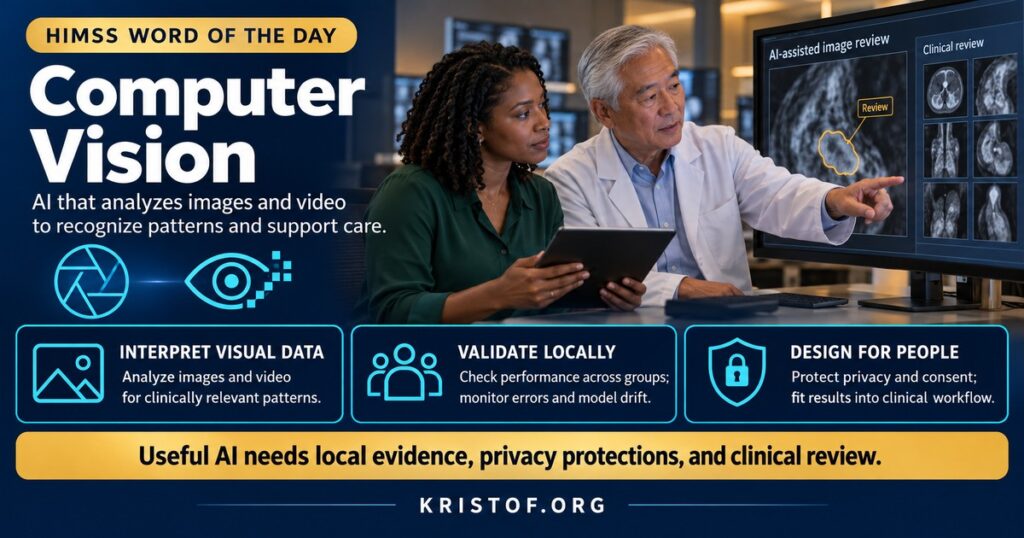
Computer vision is a technology that lets computers, phones, and other digital devices recognize objects visually. The HIMSS Dictionary explains that it rests on artificial intelligence and machine learning, has uses ranging from medical imaging to self-driving vehicles and agriculture, and has prompted concern about data privacy, confidentiality, and misuse of personal data. In health care, the “objects” are things like a lung collapse on a radiograph, a polyp on a colonoscopy video, a wound edge in a photo, or a patient’s position in a bed.
Modern systems are mostly built with deep learning, in which a model learns patterns from many labeled images. Performance depends on the quality and diversity of training data, on how the tool is used in workflow, and on how well results transfer to new sites and patients.
| Application Area | What the Model Does | Example |
|---|---|---|
| Diagnostic imaging | Flags or measures findings | Pneumothorax detection on chest radiographs |
| Screening | Supports population screening | Retinal images for diabetic retinopathy |
| Procedural support | Real-time detection during procedures | Polyp detection during colonoscopy |
| Patient monitoring | Interprets video of patient activity | Mobility, sedation, or fall-risk monitoring |
| Documentation | Analyzes photos | Wound measurement from images |
| Operations | Measures workflow | Room turnover or workload quantification |
⚠️ Exam Alert: Computer vision is a branch of AI that interprets images and video; natural language processing interprets text. Strong performance in one dataset does not guarantee performance at another site. Tools that influence diagnosis may be regulated as medical devices by the FDA.
🌐 Why It Matters: Real-World Healthcare IT Context
Images are central to modern care, and image volume keeps growing. Computer vision promises faster reads, consistent measurement, and extra eyes where specialists are scarce. The evidence supports some uses and cautions against others.
A systematic review and meta-analysis of deep learning for pneumothorax detection on chest radiographs included 23 studies, 34,011 patients, and 34,075 radiographs. Pooled sensitivity was 87 percent and pooled specificity was 95 percent. Study design, use of an institutional or public dataset, and risk of bias did not significantly change the results. Pneumothorax is time sensitive, so rapid flagging could shorten time to treatment, though the review measures diagnostic accuracy, not patient outcomes. A narrative review of AI in screening reports that prospective mammography trials show non-inferior cancer detection with large reductions in radiologist workload; that in diabetic retinopathy the first FDA-authorized autonomous system extends specialist-level screening into primary care and improves uptake; and that real-time computer vision during colonoscopy improves adenoma detection without increasing removal of non-neoplastic tissue. The same review identifies three constraints: the base-rate problem in low-prevalence cohorts, which magnifies the burden of false positives; limited generalizability and potential bias across institutions and populations; and practical barriers in workflow, regulation, and trust.
Computer vision is also moving into hospital rooms. A review focused on end-user applications describes recent advances in monitoring delirium, pain and sedation, patient deterioration, mechanical ventilation, mobility, patient safety, surgical applications, and workload in hospitals, and notes that applications in health care are limited by privacy, safety, and ethical concerns. Camera-based monitoring raises questions that image reading does not. Who sees the video? Is it stored? Do patients and visitors know and consent? Can the system be used for staff surveillance? Responsible programs minimize data collected, de-identify or process on the device where possible, set clear retention limits, and involve patients, staff, and privacy officers in design.
Regulation and governance apply. The FDA maintains a public list of AI-enabled medical devices that have been authorized, and many imaging tools are on it. Tools that influence diagnosis or treatment are typically regulated as devices, while operational tools may fall outside. Organizations still need their own governance: validate the tool on local data, measure performance by patient subgroup, define how clinicians use and document the output, monitor for drift, and keep a path to report and investigate problems. Integration matters as much as accuracy. A highly accurate model that delivers alerts into an inbox nobody checks, or marks images in a way that slows the radiologist, will not help.
For informatics teams, computer vision brings practical tasks: image storage and transfer, interfaces to PACS and the EHR, compute resources, model version control, and audit logs. It also brings questions about training data. Models trained on one population can underperform on another, so representative data and local testing are essential.
Common computer vision problems:
- Strong results in development that do not hold at a new site
- Bias across patient groups that is not measured
- High false-positive burden when the target condition is rare
- Alerts that do not reach the right person in workflow
- Video collection without clear consent, retention, and access limits
- Model updates or drift that go unmonitored
What supports responsible use:
- Local validation before and after go-live
- Performance review by subgroup, including age, sex, race, and site
- Workflow design that places output where clinicians act
- Privacy-by-design for any camera or image capture
- FDA status and intended use checked for each tool
- Clear ownership for monitoring, updates, and incident review
🏥 The Nurse’s Perspective: Clinical, Bedside, & Workflow
Nurses meet computer vision in imaging results, wound photos, and increasingly in monitoring at the bedside.
At the Bedside
A nurse may see an AI flag on a radiograph result, a wound measurement from a photo app, or a camera-based fall alert. Each is a prompt to look, not a final answer. Verifying the patient’s condition directly, documenting what was found, and reporting false alerts or misses helps keep the tool honest.
Patients should know when cameras or image analysis are part of their care. Nurses are often the ones asked what the camera is for and who sees it, so clear, accurate answers matter.
In Clinical Workflow
Unit leaders weigh benefits and burdens of video monitoring: whether it reduces sitter use or adds alert fatigue, whether it respects dignity in sensitive moments, and who responds. Nurse managers help define response protocols and escalation paths.
Nurse informaticists take part in tool selection, validation, and workflow design, and they bring staff and patient concerns to governance groups. They check that documentation of AI-assisted findings is clear.
In EHR Implementation (Go-Live Perspective)
An Epic Go-Live that includes image capture or device-integrated tools needs testing of how images and AI results are stored and displayed. At-the-elbow support analysts see how nurses actually use photo documentation and flags, noting workflows that are slow or confusing, and relay them so the build fits the work.
🎓 CAHIMS / CPHIMS & HIMSS Perspective
CAHIMS Exam Domain Mapping
Computer vision appears in AI, imaging informatics, and ethics questions:
| CAHIMS Domain | How Computer Vision Appears |
|---|---|
| Healthcare & Technology Environments | AI and machine learning, FDA regulation, privacy and ethics |
| Clinical Informatics | Imaging workflows, decision support, validation, bias |
| Healthcare Information & Systems Management | PACS integration, storage, model monitoring, security |
| Management & Leadership | AI governance, vendor evaluation, risk and change management |
Key Terms to Know Alongside Computer Vision
- Deep Learning — machine learning using multilayer neural networks
- Sensitivity and Specificity — measures of a test’s ability to detect disease and to exclude it
- Generalizability — ability of a model to perform well in new settings
- Algorithmic Bias — systematic differences in model performance across groups
- PACS — system for storing and viewing medical images
- Model Drift — decline in performance as data or practice changes
HIMSS Organizational Position
HIMSS supports the responsible adoption of artificial intelligence in health care through its research, education, and community work. Members can find related resources through the HIMSS Resource Center.
🔗 Explore Further: External References
- Lindroth et al. (2024), Journal of Imaging — Applied Artificial Intelligence in Healthcare: A Review of Computer Vision Technology Application in Hospital Settings https://pubmed.ncbi.nlm.nih.gov/38667979/
- Katzman et al. (2024), Canadian Association of Radiologists Journal — Deep Learning for Pneumothorax Detection on Chest Radiograph: A Diagnostic Test Accuracy Systematic Review and Meta Analysis https://pubmed.ncbi.nlm.nih.gov/38189265/
- Saito et al. (2026), Abdominal Radiology — AI for Screening in Healthcare: Promise and Challenges https://pubmed.ncbi.nlm.nih.gov/41524988/
- FDA — Artificial Intelligence-Enabled Medical Devices https://www.fda.gov/medical-devices/digital-health-center-excellence/artificial-intelligence-enabled-medical-devices
- NIST — AI Risk Management Framework https://www.nist.gov/itl/ai-risk-management-framework
Term source: HIMSS Dictionary of Health Information and Technology Terms, Acronyms, and Organizations, 6th Edition (2025). All definitions in this series are paraphrased for editorial purposes. Readers are encouraged to consult the primary source for exact language.
Eric Andrew Kristof, RN, CAHIMS is a Healthcare IT professional and HIMSS Arkansas Chapter member based in Hot Springs Village, AR, with hands-on Epic Go-Live experience and a diverse healthcare and IT background. He writes at kristof.org at the intersection of clinical care and healthcare technology.
Leave a Reply