By Eric Andrew Kristof, RN, CAHIMS | Healthcare IT Professional | HIMSS Arkansas Chapter Member
About This Series: The HIMSS Word of the Day is a running blog series drawing from the HIMSS Dictionary of Health Information and Technology Terms, Acronyms, and Organizations, 6th Edition (2025) — the authoritative reference for healthcare IT professionals and the primary study resource for CAHIMS and CPHIMS certification. Each post paraphrases the term in plain language, grounds it in real-world healthcare IT context, and adds a bedside nursing perspective you won’t find in a textbook.
📖 The Term: Acceptance Testing
Source: HIMSS Dictionary of Health Information and Technology Terms, Acronyms, and Organizations, 6th Edition (2025)
🔍 Plain-Language Definition
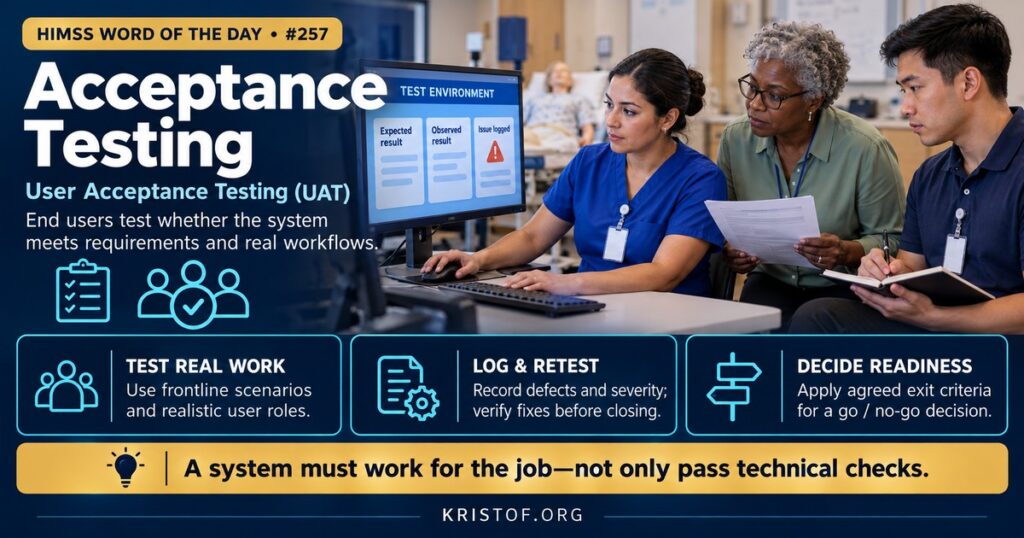
Acceptance testing is a user-run test event that demonstrates whether an application can meet business objectives and system requirements. The HIMSS Dictionary notes it is also called beta testing. In health IT, it is commonly called user acceptance testing (UAT), and the people who run it are the clinicians, registrars, pharmacists, billers, and others who will use the system.
Acceptance testing is distinct from earlier testing stages that technical teams run. Those stages ask whether the software works as built. Acceptance testing asks whether it works for the job: can a nurse admit, assess, order, document, and discharge a realistic patient using the new system and the new workflow?
| Test Stage | Question | Who Runs It |
|---|---|---|
| Unit testing | Does each piece of the build work? | Developers and analysts |
| Integration testing | Do systems and interfaces work together? | Interface and technical teams |
| System testing | Does the whole system meet specifications? | Analysts and testers |
| Acceptance testing (UAT) | Does it support real users and workflows? | End users with analysts |
| Regression testing | Did a change break something that worked? | Testers, repeated after changes |
| Go-live readiness / dress rehearsal | Are people, process, and technology ready? | Whole project team |
⚠️ Exam Alert: Acceptance testing is run by end users against business requirements and workflows, not just technical specifications. Regression testing re-checks existing functions after a change. Unit and integration testing come before acceptance testing in the usual sequence.
🌐 Why It Matters: Real-World Healthcare IT Context
Systems that pass technical testing can still fail in use. A screen may meet its specification and still be unusable at a busy nurses’ station. An order may transmit correctly and arrive at a pharmacy queue no one watches. Acceptance testing exposes these gaps while they are still cheap to fix, and gives users confidence that the system will support them.
Evidence shows why realistic testing matters. The Leapfrog Group’s pediatric computerized provider order entry evaluation tool presents test patients and orders that could cause harm and checks whether the system intercepts them. A study of 41 pediatric hospitals over two years found that CPOE systems identified 62 percent of potential medication errors in the test scenarios, with performance ranging widely from 23 percent to 91 percent across institutions. The highest scoring categories included drug-allergy interactions, dosing limits, and inappropriate routes of administration. Hospitals with longer experience with CPOE did not score better on their first test, but after initial testing scores improved by about four percentage points per year. The lesson is that systems can look configured and still miss hazards, and that repeated testing with realistic scenarios can lead to improvement.
Safety self-assessment shows a related gap. The SAFER Guides, released in 2014, provide recommended practices for proactive risk assessment of EHR-related policies, processes, procedures, and configurations. A study of eight organizations assessed adherence to 140 unique recommendations across nine guides. The sites fully implemented 25 of 140, or 18 percent. Adherence was highest for the guide on system interfaces and lowest for clinical communication, and higher for the “safe health IT” domain than for “using health IT safely” and “monitoring health IT.” The point is not that organizations are negligent, but that many safety practices, including testing, require sustained attention.
Good acceptance testing has structure. It starts with requirements and workflows, which become test scripts describing the patient, the user, the steps, and the expected result. Scripts should cover common paths and high-risk edge cases: a patient with a duplicate name, a downtime scenario, a medication with a weight-based dose, a verbal order, a transfer between units. Testers need a stable test environment with realistic data and the right security roles, because tests that run under a super-user account hide permission problems that real users will hit. Defects are logged with severity, reviewed by a decision group, and retested after fixes. Entry and exit criteria, such as no open critical defects and a defined pass rate, give leaders a clear basis for a go or no-go decision.
Timing and scope are the usual stumbling blocks. Testing is squeezed when earlier phases run late. Testers are pulled from clinical duty and lack protected time. Tests are written by analysts who know the system but not the unit’s work. To counter this, projects schedule testing early, backfill clinical staff, and include super users and frontline nurses in script design. Acceptance testing also covers workflow outside the software, such as paper downtime forms and communication with ancillary departments.
Common acceptance testing problems:
- Too little time, so testing is rushed or cut
- Scripts that follow the happy path and skip high-risk scenarios
- Testers using privileged accounts that hide security role problems
- Unrealistic test data
- Defects logged but not retested
- Sign-off treated as a formality and not a decision
What supports strong acceptance testing:
- Scripts based on real workflows and high-risk scenarios
- Frontline clinicians with protected time as testers
- Role-based test accounts that match production
- Clear defect severity rules and retest requirements
- Entry and exit criteria agreed in advance
- Repeated testing after changes, including regression checks
🏥 The Nurse’s Perspective: Clinical, Bedside, & Workflow
Nurses are among the most valuable acceptance testers because they know what real care looks like.
At the Bedside
A nurse testing an admission workflow tries to complete it the way a shift unfolds: interruptions, a second patient needing attention, a barcode that will not scan. Noticing that a required field makes no sense for the patient population, or that a medication administration screen hides the last dose time, is exactly what testing is for. Saying so clearly, with the step and the screen, lets analysts fix it.
In Clinical Workflow
Nurse managers release staff for test sessions and assign testers who represent different units and roles: med-surg, ICU, emergency, perioperative, and float pool. Charge nurses contribute scenarios, such as a rapid response or a patient transfer, that scripts often miss.
Nurse informaticists write and review scripts, run sessions, log defects, and translate between clinical and technical teams. They push back when a defect labeled low severity carries real safety risk.
In EHR Implementation (Go-Live Perspective)
An Epic Go-Live is preceded by multiple rounds of testing, including integrated scenarios that follow a patient across departments. Nurses and super users take part in dress rehearsals, and the findings shape training and go-live support plans. At-the-elbow support analysts later hear what testing missed, and good teams feed those lessons back into the test library for the next upgrade.
🎓 CAHIMS / CPHIMS & HIMSS Perspective
CAHIMS Exam Domain Mapping
Acceptance testing appears in system implementation, quality, and project questions:
| CAHIMS Domain | How Acceptance Testing Appears |
|---|---|
| Healthcare & Technology Environments | System development life cycle, patient safety standards |
| Clinical Informatics | Clinical scenarios, workflow validation, safety hazards |
| Healthcare Information & Systems Management | Test environments, defect tracking, regression testing, interfaces |
| Management & Leadership | Go/no-go decisions, resource planning, risk management, sign-off |
Key Terms to Know Alongside Acceptance Testing
- Test Script — step-by-step test case with expected results
- Defect — flaw found in testing, tracked by severity
- Regression Testing — retesting existing functions after a change
- Entry/Exit Criteria — conditions to start and to end a test phase
- Go/No-Go Decision — leadership decision to proceed with or delay implementation
- Test Environment — non-production system used for testing
HIMSS Organizational Position
HIMSS supports safe and effective health IT implementation through its education, research, and community work. Members can find related resources through the HIMSS Resource Center.
🔗 Explore Further: External References
- HealthIT.gov — SAFER Guides https://healthit.gov/clinical-quality-and-safety/safer-guides/
- Cho et al. (2015), International Journal of Medical Informatics — Acceptability and Feasibility of the Leapfrog Computerized Physician Order Entry Evaluation Tool for Hospitals Outside the United States https://pubmed.ncbi.nlm.nih.gov/26049311/
- Chaparro et al. (2017), Journal of the American Medical Informatics Association — National Trends in Safety Performance of Electronic Health Record Systems in Children’s Hospitals https://pubmed.ncbi.nlm.nih.gov/27638908/
- Sittig et al. (2018), Journal of the American Medical Informatics Association — Adherence to Recommended Electronic Health Record Safety Practices Across Eight Health Care Organizations https://pubmed.ncbi.nlm.nih.gov/29701854/
- Sittig et al. (2014), American Journal of Managed Care — The SAFER Guides: Empowering Organizations to Improve the Safety and Effectiveness of Electronic Health Records https://pubmed.ncbi.nlm.nih.gov/25181570/
Term source: HIMSS Dictionary of Health Information and Technology Terms, Acronyms, and Organizations, 6th Edition (2025). All definitions in this series are paraphrased for editorial purposes. Readers are encouraged to consult the primary source for exact language.
Eric Andrew Kristof, RN, CAHIMS is a Healthcare IT professional and HIMSS Arkansas Chapter member based in Hot Springs Village, AR, with hands-on Epic Go-Live experience and a diverse healthcare and IT background. He writes at kristof.org at the intersection of clinical care and healthcare technology.
Leave a Reply