By Eric Andrew Kristof, RN, CAHIMS | Healthcare IT Professional | HIMSS Arkansas Chapter Member
About This Series: The HIMSS Word of the Day is a running blog series drawing from the HIMSS Dictionary of Health Information and Technology Terms, Acronyms, and Organizations, 6th Edition (2025) — the authoritative reference for healthcare IT professionals and the primary study resource for CAHIMS and CPHIMS certification. Each post paraphrases the term in plain language, grounds it in real-world healthcare IT context, and adds a bedside nursing perspective you won’t find in a textbook.
📖 The Term: System Integration
Source: HIMSS Dictionary of Health Information and Technology Terms, Acronyms, and Organizations, 6th Edition (2025)
🔍 Plain-Language Definition
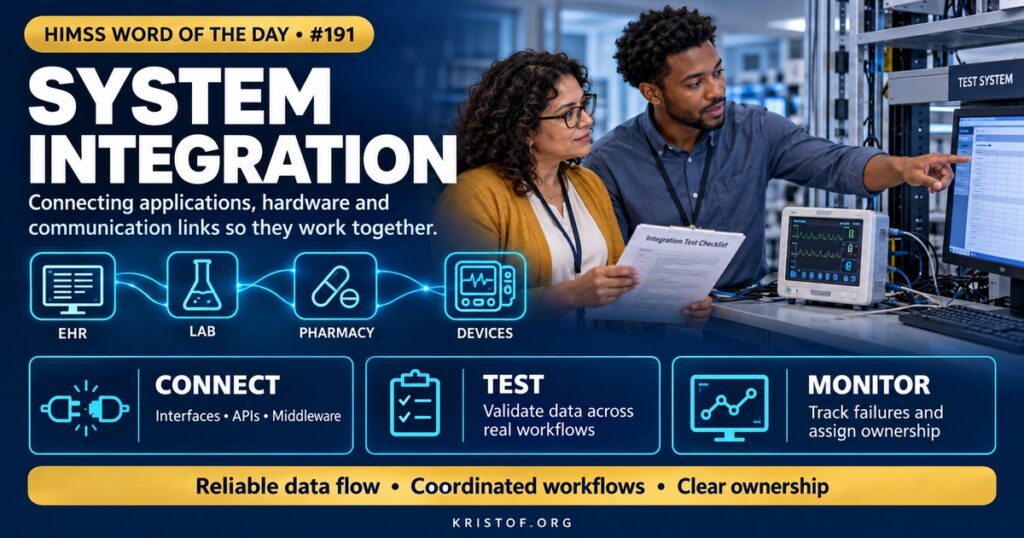
System integration is the work of combining separate elements, such as software applications, hardware, and communication links, so they operate together to accomplish a purpose none of them could achieve alone.
The HIMSS Dictionary describes two related ideas: putting parts together so they can deliver a capability, and the broader process of building a complex information system that may include a custom architecture or application, tied to hardware that is already in place or newly bought, off-the-shelf and custom software, and communication links. The dictionary also points readers to enterprise application integration.
| Integration Approach | How It Works | Healthcare Example |
|---|---|---|
| Point-to-Point Interface | One system connects directly to one other system | Lab system sending results straight to the EHR |
| Hub-and-Spoke (Interface Engine) | A central engine receives, translates, and routes messages | ADT messages fanned out to pharmacy, lab, and radiology |
| API-Based Integration | Systems call each other’s services on demand | A FHIR app reading medications from the EHR |
| Shared Platform | Modules built on one vendor platform and database | Single-vendor EHR with integrated pharmacy and billing |
| Middleware or Service Bus | Shared layer handling messaging, security, and monitoring | Device data routed to the record through middleware |
| Data Integration | Data copied into a common store for analysis | Feeds into a clinical data repository or warehouse |
⚠️ Exam Alert: System integration is the technical work of connecting systems. Interoperability is the ability of systems to exchange and use information, often through shared standards. Interfaces are the individual connections, while an interface engine is the tool that manages many of them. Integration can be achieved without open standards, but interoperability depends on them.
🌐 Why It Matters: Real-World Healthcare IT Context
Hospitals depend on dozens, sometimes hundreds, of applications: the EHR, laboratory, pharmacy, radiology, anesthesia, monitoring, scheduling, billing, supply chain, and more. Patients and clinicians experience care as a single continuous process, so the systems behind it must behave as one. System integration is the discipline that closes the gap.
Integration choices shape cost and risk. Point-to-point interfaces are simple at first but become hard to maintain as their number grows, because every new system may need a connection to every existing one. Interface engines reduce that tangle by translating and routing messages centrally. Newer approaches use application programming interfaces and standards such as HL7 FHIR so applications can request specific data when needed rather than waiting for a pushed message. Many organizations run all of these patterns at once, and older HL7 version 2 messaging remains common inside hospitals.
Organizations also choose between a single-vendor platform and a best-of-breed approach. A qualitative study of four health systems that adopted integrated, single-vendor EHRs found staff describing a loss of local autonomy while also reporting changes to communication, governance, optimization, and education roles. Integrated platforms can reduce the number of custom interfaces, but they shift decisions and dependence toward the vendor. Best-of-breed strategies can fit specialty workflows well but increase interface count and testing burden.
Integration is a patient safety topic. The ONC SAFER Guides include a guide on system interfaces because errors can arise at connection points: messages that fail silently, data mapped to the wrong field, units that change in translation, or updates that arrive late. Safe integration relies on interface design, monitoring, error queues, and clear ownership of each connection.
Testing deserves emphasis. Integration testing verifies that data flows correctly across systems under realistic conditions, including unusual cases such as merged patients, canceled orders, and late-arriving results. Regression testing after upgrades confirms that earlier connections still work. Monitoring after go-live catches problems that testing missed.
Security and governance matter as well. Each connection is a path that must be authenticated, encrypted, and logged, and each interface needs documentation, an owner, and a retirement plan. Business associate agreements and vendor management also apply when integrated services are hosted outside the organization.
Finally, integration supports downtime planning. When one system or interface fails, teams need to know what still works, what queues messages for later, and how to reconcile data afterward.
Common integration failure modes:
- Messages that fail or queue without anyone noticing
- Data mapped incorrectly between systems
- Too many custom point-to-point interfaces
- Upgrades that break connections nobody retested
- Unclear ownership of each interface
- Weak monitoring and alerting
What supports reliable integration:
- Standards-based interfaces and APIs
- A managed interface engine or integration platform
- Realistic integration and regression testing
- Active monitoring with clear escalation paths
- Documented ownership for every connection
- Downtime and reconciliation procedures
🏥 The Nurse’s Perspective: Clinical, Bedside, & Workflow
Nurses rarely see the plumbing, but nursing work depends on it. When integration works, orders appear in the right place, results file to the right chart, and device data lands in the flowsheet without retyping.
At the Bedside
Integration shows up as small conveniences, such as a medication scan that finds the active order, vital signs that populate from the monitor, and lab results that appear without a phone call. These conveniences also create reliance, so a missing result or a duplicated entry deserves attention rather than an assumption that the system is correct.
Spotting a pattern matters. A single missing value may be a one-time glitch, but the same problem across several patients suggests an interface issue that informatics or the help desk should know about quickly.
In Clinical Workflow
Reporting integration problems with specifics helps the people who fix them. Useful details include the patient, the time, which systems were involved, what was expected, and what appeared instead. Screenshots without patient identifiers, where policy allows, shorten troubleshooting.
Downtime procedures cover integration failures as well as full outages. When an interface to a device or lab system is down, nurses may need to chart manually or verify results through another route, then follow reconciliation steps afterward.
Nurse informaticists contribute by describing clinical workflows to analysts, reviewing test scenarios, and confirming that integrated data appears where nurses expect it.
In EHR Implementation (Go-Live Perspective)
An Epic Go-Live depends on dozens of interfaces working at once, from admission feeds to device integration to results and billing. Integration testing with realistic scenarios, including nurse-driven workflows such as barcode medication administration and device documentation, happens well before the first patient is registered.
At-the-elbow support analysts watch for integration problems during the first days, such as a result not filing or a device not communicating, and route them to interface teams. Rapid, specific reports from nurses speed those fixes.
🎓 CAHIMS / CPHIMS & HIMSS Perspective
CAHIMS Exam Domain Mapping
System integration appears in infrastructure, standards, and management questions:
| CAHIMS Domain | How System Integration Appears |
|---|---|
| Healthcare & Technology Environments | Interface standards, vendor landscape, integration architectures |
| Clinical Informatics | Workflow impact of interfaces, device integration, data accuracy |
| Healthcare Information & Systems Management | Interface engines, testing, monitoring, change control |
| Management & Leadership | Vendor strategy, ownership of interfaces, governance, downtime planning |
Key Terms to Know Alongside System Integration
- Interface Engine — software that translates and routes messages between systems
- HL7 Version 2 — widely used messaging standard for event-driven healthcare data exchange
- HL7 FHIR — modern standard that exposes health data through web-based APIs
- Middleware — software layer that sits between applications and handles shared functions
- Integration Testing — verifying that data flows correctly across connected systems
- Interoperability — ability of systems to exchange and use information
HIMSS Organizational Position
HIMSS advocates for interoperability and the exchange of health information through its public policy work and education, and its maturity models include infrastructure and interoperability concepts. Members can explore related resources through the HIMSS Resource Center.
🔗 Explore Further: External References
- HL7 International — HL7 Version 2 Product Brief https://www.hl7.org/implement/standards/product_brief.cfm?product_id=185
- HL7 International — FHIR https://www.hl7.org/fhir/
- IHE — Integration Profiles https://www.ihe.net/resources/profiles/
- ONC — SAFER Guides (including System Interfaces) https://healthit.gov/clinical-quality-and-safety/safer-guides/
- Brunner et al. (2023), Journal of General Internal Medicine — From “Local Control” to “Dependency”: Transitions to Single-Vendor Integrated Electronic Health Record Systems and Their Implications for the EHR Workforce https://pubmed.ncbi.nlm.nih.gov/37798579/
- ONC — Interoperability https://healthit.gov/interoperability/
Term source: HIMSS Dictionary of Health Information and Technology Terms, Acronyms, and Organizations, 6th Edition (2025). All definitions in this series are paraphrased for editorial purposes. Readers are encouraged to consult the primary source for exact language.
Eric Andrew Kristof, RN, CAHIMS is a Healthcare IT professional and HIMSS Arkansas Chapter member based in Hot Springs Village, AR, with hands-on Epic Go-Live experience and a diverse healthcare and IT background. He writes at kristof.org at the intersection of clinical care and healthcare technology.
Leave a Reply