By Eric Andrew Kristof, RN, CAHIMS | Healthcare IT Professional | HIMSS Arkansas Chapter Member
About This Series: The HIMSS Word of the Day is a running blog series drawing from the HIMSS Dictionary of Health Information and Technology Terms, Acronyms, and Organizations, 6th Edition (2025) — the authoritative reference for healthcare IT professionals and the primary study resource for CAHIMS and CPHIMS certification. Each post paraphrases the term in plain language, grounds it in real-world healthcare IT context, and adds a bedside nursing perspective you won’t find in a textbook.
📖 The Term: Pharmacy Informatics
Source: HIMSS Dictionary of Health Information and Technology Terms, Acronyms, and Organizations, 6th Edition (2025)
🔍 Plain-Language Definition
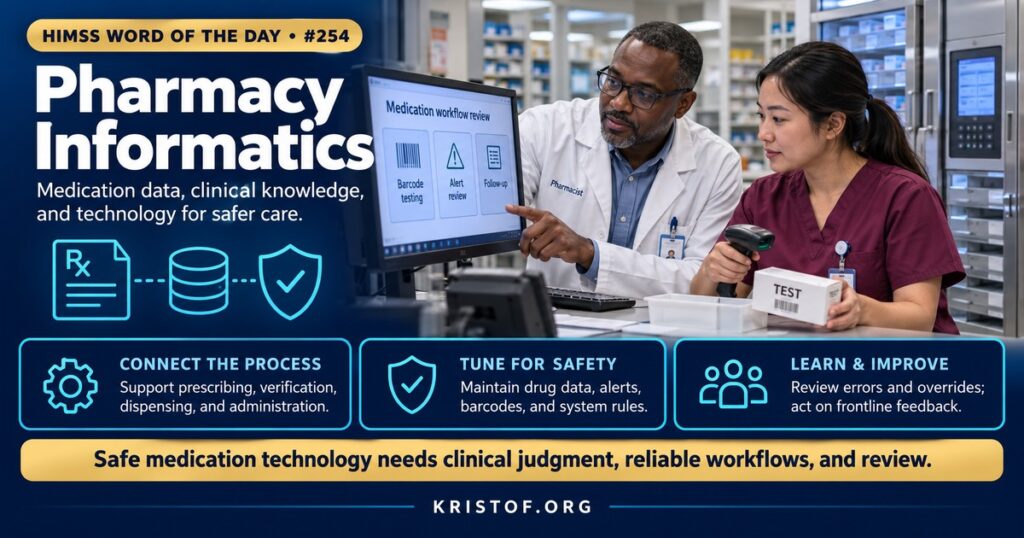
Pharmacy informatics is the scientific field concerned with medication-related data and knowledge across the healthcare continuum, including how they are acquired, stored, analyzed, used, and shared, to support the best possible medication-related care and outcomes. The HIMSS Dictionary describes it as a subset of health informatics that combines clinical expertise with knowledge of information technology to improve medication management and the safety of drug administration.
In practice, pharmacy informaticists configure and maintain the systems that touch every step of the medication-use process: prescribing, order verification, dispensing, administration, and monitoring. They manage drug databases, order sets, interaction rules, automated dispensing cabinets, barcode systems, and reports. They also analyze data to find where medication processes fail.
| Medication-Use Step | Informatics Tool | Typical Pharmacy Informatics Work |
|---|---|---|
| Prescribing | CPOE and order sets | Build and maintain order sets and dose rules |
| Verification | Pharmacy verification queue, autoverification | Define which orders can bypass manual review |
| Alerts | Drug interaction and allergy checking | Tune alert settings to reduce noise |
| Dispensing | Automated dispensing cabinets, robots | Configure access and controlled substance rules |
| Administration | Barcode scanning and eMAR | Maintain product barcodes and scan workflows |
| Monitoring | Reports and dashboards | Track errors, overrides, and adherence |
⚠️ Exam Alert: Pharmacy informatics is a specialty within clinical informatics focused on medication use. A closed-loop medication system links ordering, verification, dispensing, and bedside administration. Autoverification lets certain orders pass without manual pharmacist review, under defined rules.
🌐 Why It Matters: Real-World Healthcare IT Context
Medication use is one of the most complex and risky processes in health care. Orders pass between prescribers, pharmacists, nurses, and patients, using drugs with narrow safety margins and many interactions. Technology can reduce errors, but poorly configured technology can add new ones. Pharmacy informatics exists to make the technology fit the medication-use process and to keep it current.
Evidence on the tools is mixed in useful ways. A systematic review of alerts during bar code-assisted medication administration identified eight studies. Alert types included patient mismatch, wrong medication, and wrong dose, among others, and the frequency of alerts varied widely across studies, from 0.18 percent to 42 percent, with not all alerts clinically meaningful. The review called for more study of what drives alert patterns. A systematic review of 16 papers on automated dispensing cabinets, barcode administration, and closed-loop electronic medication management for controlled medications found that only four studies focused on controlled medications. It reported that ADC implementation eliminated manual end-of-shift counts of controlled medications, though drug diversion cases were still reported after cabinets were introduced, and three quantitative studies of barcode administration reported fewer medication errors while wrong or unreadable barcodes caused confusion and errors. The authors concluded that more targeted research is needed and that processes must supplement the technology. Taken together, these reviews suggest that technology helps but needs careful design, local tuning, and monitoring.
Pharmacists have been working on that tuning. A survey of 50 respondents, mostly pharmacists and nearly half with informatics training, evaluated a prototype Drug Interaction Customization Editor. The tool let organizations filter interaction warnings by factors such as route of administration, drug properties, and patient characteristics. The most useful features were filtering by route and by primary drug properties, which reflects a widespread view that low specificity of drug-drug interaction warnings causes alert burden. Another pharmacist-led project at a large academic medical center reevaluated autoverification, in which a medication order bypasses pharmacist verification and is automatically verified in the EHR. The team reviewed literature, EHR configuration, regulatory standards, and internal data, and redesigned the algorithm, cutting the overarching rules from 16 to 4, each representing a medication category in which autoverification is allowed. The project also created a policy and a maintenance process for reviewing new proposals. These examples show pharmacy informatics at work: translating safety principles and regulations into concrete system rules, and measuring the result.
Collaboration with nursing is essential, because nurses are the last check before the patient receives a drug. Barcode scanning only works if barcodes are scannable, scanners function, and workflows allow scanning at the bedside. Alerts only help if they are specific enough to be believed. Dispensing cabinet override lists must balance urgent access with safety. Pharmacy and nursing informaticists often share governance committees and review override reports together.
Security and regulation add layers. Controlled substances require tracking and, for electronic prescribing, specific identity and signing controls. Medication reconciliation at transitions depends on accurate lists and interfaces with outside pharmacies. And new tools, including AI-supported checking, require validation before use.
Common pharmacy informatics problems:
- Interaction alerts with low specificity that clinicians learn to ignore
- Barcode workarounds when scanners or labels fail
- Autoverification rules that are too broad or never revisited
- Order sets that are out of date after guideline or formulary changes
- Dispensing cabinet override lists that are too long
- Poor feedback loops between frontline nurses and informatics staff
What supports safe medication technology:
- Interdisciplinary medication safety and informatics governance
- Regular review of alert and override data
- Clear, evidence-based autoverification rules with maintenance processes
- Reliable barcode labels, scanners, and bedside workflows
- Order set maintenance tied to guideline and formulary updates
- Easy ways for nurses to report workflow problems
🏥 The Nurse’s Perspective: Clinical, Bedside, & Workflow
Nurses are the main users of the systems pharmacy informatics builds, and their feedback shows whether the build works.
At the Bedside
Scanning the wristband and the medication is the final safety check, and it only works when it is quick and reliable. When a scan fails, the nurse must follow policy and report the problem so labels, scanners, or workflows can be fixed. Alerts that appear during administration need to be understandable, so nurses can tell whether to stop, verify, or proceed.
Nurses also notice patterns, such as an alert that fires for nearly every dose of a common drug. Reporting those patterns helps pharmacists adjust settings.
In Clinical Workflow
Nurse managers review override and scan-compliance reports with pharmacy leaders and ask for changes when a process causes delays. Medication safety nurses and pharmacists investigate events together. Charge nurses coordinate when pharmacy verification delays affect timely administration of first doses.
Nurse informaticists and pharmacy informaticists co-design order sets, administration workflows, and reports. They test builds together, so that pharmacy and nursing views of an order match.
In EHR Implementation (Go-Live Perspective)
An Epic Go-Live is a major moment for medication systems. Teams verify drug databases, order sets, barcodes, and cabinet integration. At-the-elbow support analysts stay close to medication administration in the first days, watching scan failures, alerts, and delays, and reporting specifics to pharmacy informatics so that fixes can be made quickly.
🎓 CAHIMS / CPHIMS & HIMSS Perspective
CAHIMS Exam Domain Mapping
Pharmacy informatics appears in medication safety, clinical systems, and workflow questions:
| CAHIMS Domain | How Pharmacy Informatics Appears |
|---|---|
| Healthcare & Technology Environments | Medication-use process, regulations, safety organizations |
| Clinical Informatics | CPOE, eMAR, decision support, medication reconciliation |
| Healthcare Information & Systems Management | Drug databases, interfaces, dispensing automation, barcodes |
| Management & Leadership | Medication safety governance, policy, change management |
Key Terms to Know Alongside Pharmacy Informatics
- BCMA (Barcode Medication Administration) — scanning patient and drug barcodes before administration
- Closed-Loop Medication System — linked system from order to administration
- Autoverification — automatic order verification under defined rules
- Automated Dispensing Cabinet (ADC) — secured cabinet that stores and dispenses medications at the unit
- Alert Fatigue — reduced attention to alerts due to volume or low relevance
- eMAR (Electronic Medication Administration Record) — electronic record of medications given
HIMSS Organizational Position
HIMSS supports clinical informatics and medication safety through its education, research, and community work. Members can find related resources through the HIMSS Resource Center.
🔗 Explore Further: External References
- AHRQ PSNet — Medication Errors and Adverse Drug Events https://psnet.ahrq.gov/primer/medication-errors-and-adverse-drug-events
- Sloss et al. (2020), Journal of Nursing Care Quality — Alert Types and Frequencies During Bar Code-Assisted Medication Administration: A Systematic Review https://pubmed.ncbi.nlm.nih.gov/32433151/
- Zheng et al. (2021), Research in Social and Administrative Pharmacy — The Impact of Introducing Automated Dispensing Cabinets, Barcode Medication Administration, and Closed-Loop Electronic Medication Management Systems on Work Processes and Safety of Controlled Medications in Hospitals: A Systematic Review https://pubmed.ncbi.nlm.nih.gov/32891535/
- Romero et al. (2024), American Journal of Health-System Pharmacy — Evaluation of an Electronic Health Record Drug Interaction Customization Editor (DICE) https://pubmed.ncbi.nlm.nih.gov/38894513/
- Assabahi et al. (2025), American Journal of Health-System Pharmacy — Development and Implementation of Autoverification Best Practices https://pubmed.ncbi.nlm.nih.gov/40576409/
Term source: HIMSS Dictionary of Health Information and Technology Terms, Acronyms, and Organizations, 6th Edition (2025). All definitions in this series are paraphrased for editorial purposes. Readers are encouraged to consult the primary source for exact language.
Eric Andrew Kristof, RN, CAHIMS is a Healthcare IT professional and HIMSS Arkansas Chapter member based in Hot Springs Village, AR, with hands-on Epic Go-Live experience and a diverse healthcare and IT background. He writes at kristof.org at the intersection of clinical care and healthcare technology.
Leave a Reply