By Eric Andrew Kristof, RN, CAHIMS | Healthcare IT Professional | HIMSS Arkansas Chapter Member
About This Series: The HIMSS Word of the Day is a running blog series drawing from the HIMSS Dictionary of Health Information and Technology Terms, Acronyms, and Organizations, 6th Edition (2025) — the authoritative reference for healthcare IT professionals and the primary study resource for CAHIMS and CPHIMS certification. Each post paraphrases the term in plain language, grounds it in real-world healthcare IT context, and adds a bedside nursing perspective you won’t find in a textbook.
📖 The Term: Hype Cycle
Source: HIMSS Dictionary of Health Information and Technology Terms, Acronyms, and Organizations, 6th Edition (2025)
🔍 Plain-Language Definition
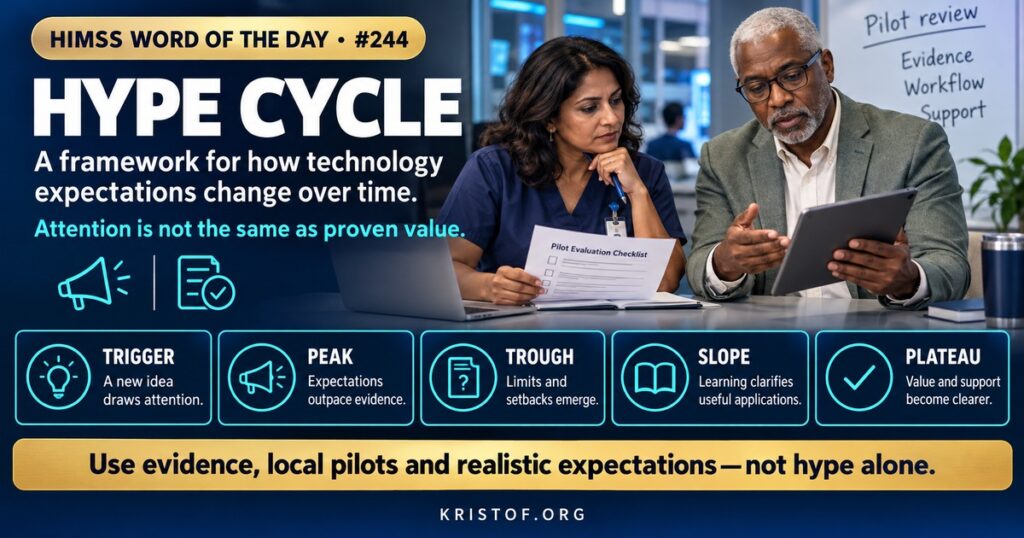
The Hype Cycle is a model from the research firm Gartner that describes how the visibility of an emerging technology changes over time. The HIMSS Dictionary lists five stages: the technology trigger, the peak of inflated expectations, the trough of disillusionment, the slope of enlightenment, and the plateau of productivity. The model conveys that new technologies tend to be oversold at first and, although they often become useful, seldom meet the early expectations.
The curve plots visibility or expectations against time. A new idea attracts attention, publicity inflates expectations, early projects fall short, interest and funding fall, and then a smaller group learns what the technology can actually do and builds practical uses.
| Stage | What Happens | Typical Signs in Health IT |
|---|---|---|
| Technology trigger | A breakthrough or demo draws attention | Early pilots, first publications, vendor announcements |
| Peak of inflated expectations | Publicity exceeds proven results | Every vendor adds the label to product pages |
| Trough of disillusionment | Real limits appear and interest drops | Failed pilots, unmet savings, user fatigue |
| Slope of enlightenment | Lessons produce better, narrower uses | Clear use cases, local evidence, improved workflows |
| Plateau of productivity | Mainstream use with understood value | Routine adoption, standard contracts, stable support |
⚠️ Exam Alert: The hype cycle describes visibility and expectations, not true value or effectiveness. The stages in order are trigger, peak, trough, slope, plateau. A technology in the trough may still be worth adopting, and one at the peak may be real but oversold. It is a framework for judgment, not a forecast.
🌐 Why It Matters: Real-World Healthcare IT Context
Health care is a constant target of new technology claims: electronic records, telehealth, blockchain, wearables, virtual reality, artificial intelligence. Executives, clinicians, and patients are all exposed to optimistic messages, and money and attention follow them. Recognizing the pattern helps organizations avoid two errors: adopting something at its peak because everyone else is, and dismissing something in the trough because the early results were disappointing.
Researchers have used the model to make sense of specific technologies. A 2025 study in a rural health context used the Gartner Hype Cycle with system dynamics modeling to examine how clinician-to-clinician emergency telehealth affects rural workforce recruitment and retention in Australia. The team built a model with delays between recognizing benefits and recognizing limitations, tested 75 parameter scenarios, and found that only 15 percent maintained sustainable on-site staffing over the long term. Those scenarios involved conservative initial telehealth use, realistic expectation management, and strategies suited to the size of the facility. After the trough, the model showed three patterns: collapse, recovery to stable levels, or avoiding the trough entirely. The study illustrates a practical lesson: expectations themselves are a managed risk.
In imaging, a 2026 narrative review mapped advances in radiology onto the hype cycle across software and algorithms, advanced imaging tools, and clinical practice paradigms. It offered strategic considerations for radiologists, trainees, and leaders on telling lasting innovations from those that fade. A review of artificial intelligence for colorectal polyp assessment described early randomized trials showing substantial gains in adenoma and polyp detection, which raised expectations, followed by real-world evidence of more modest and varied benefits. The authors placed AI in endoscopy on the slope of enlightenment, characterized by practical adoption, better human-AI interaction, and more explainable systems. Another paper applied the same framing to relaxometry in magnetic resonance imaging. In each case, the lesson is that early trial results and later routine results can differ.
The model has limits. It is a metaphor, not a measurement, and technologies do not follow a smooth curve. Some never leave the trough, some skip stages, and the time spent in each stage varies widely. Placement on the curve is a judgment, often made by analysts with their own views. The curve also tracks attention more than clinical or financial value. A technology can be hyped and effective, or quiet and useless.
For health IT teams, the practical use is as a discipline for conversation. Ask where a technology sits and who says so. Ask what evidence exists from comparable organizations. Match risk to maturity: pilot at the peak with clear stop criteria, invest more as local evidence builds, and standardize on the plateau. Define success measures before launch, and plan for the trough, because the first months after go-live often bring frustration even for sound technologies.
Common hype cycle problems:
- Buying because competitors announced a similar tool
- Pilots with no pre-defined success measures
- Dropping a promising tool after early implementation problems
- Treating vendor claims as evidence
- Underestimating workflow and training effort
- No plan to retire or scale a pilot
What supports sound technology decisions:
- Evidence review that includes real-world results, not only trials or demos
- Pilots with clear goals, stop criteria, and clinical sponsors
- Expectation setting with staff and leaders
- Local measurement of benefit, safety, and workload
- Governance that sorts ideas by maturity and risk
- Patience through the learning curve once the case is sound
🏥 The Nurse’s Perspective: Clinical, Bedside, & Workflow
Nurses are often handed new technology after the hype and asked to make it work at the bedside.
At the Bedside
A device or app promoted as a time saver may add steps at first. Nurses see this quickly and can report specific effects: extra clicks, slow screens, alerts that interrupt. That feedback separates real value from marketing, and it should be gathered early and honestly.
When expectations have been set too high, frustration is predictable. Clear messages about what a tool will and will not do help staff keep a balanced view.
In Clinical Workflow
Nurse leaders and informaticists on technology review committees ask practical questions: What problem does this solve on the unit? What happens to workflow? What evidence exists in similar settings? Who maintains it? They also help design pilots that include real measures, such as time spent, errors, and staff satisfaction.
Nurse informaticists help teams stay with a good technology through the trough, using feedback to refine build and training rather than abandoning it at the first complaint.
In EHR Implementation (Go-Live Perspective)
An Epic Go-Live shows the cycle in miniature. Excitement before go-live is followed by a dip in the first weeks, when productivity falls and complaints rise, and then recovery as staff learn and build is tuned. At-the-elbow support analysts see the trough directly and reassure staff that it is expected, while collecting concrete problems for fixes that move the unit up the slope.
🎓 CAHIMS / CPHIMS & HIMSS Perspective
CAHIMS Exam Domain Mapping
The hype cycle appears in change management and technology assessment questions:
| CAHIMS Domain | How the Hype Cycle Appears |
|---|---|
| Healthcare & Technology Environments | Emerging technology, adoption models, innovation |
| Clinical Informatics | Evaluating new tools, workflow impact, evidence use |
| Healthcare Information & Systems Management | Technology assessment, pilots, vendor claims |
| Management & Leadership | Strategic planning, expectation management, change management |
Key Terms to Know Alongside the Hype Cycle
- Technology Trigger — event that first draws attention to an emerging technology
- Trough of Disillusionment — stage when limits appear and enthusiasm falls
- Plateau of Productivity — stage of mainstream, well-understood use
- Pilot — small trial of a technology before wider adoption
- Technology Assessment — structured evaluation of value, risk, and fit
- Expectation Management — setting realistic views of what a technology can do
HIMSS Organizational Position
HIMSS supports evidence-based adoption of emerging health technology through its research, education, and community work. Members can find related resources through the HIMSS Resource Center.
🔗 Explore Further: External References
- Osman et al. (2025), npj Health Systems — Conceptualising the Impact of Telehealth on Rural Workforce Sustainability Using System Dynamics and the Gartner Hype Cycle https://pubmed.ncbi.nlm.nih.gov/42527458/
- Dogra et al. (2026), Academic Radiology — From Artificial Intelligence to Robotics: How to Navigate Technological Innovation in Radiology With the Gartner Hype Cycle https://pubmed.ncbi.nlm.nih.gov/41781096/
- Sinonquel et al. (2026), Digestive and Liver Disease — The Slope of Enlightenment: Towards a More Realistic Understanding of the Strengths and Weaknesses of Artificial Intelligence for Colorectal Polyp Assessment https://pubmed.ncbi.nlm.nih.gov/42442968/
- Stikov et al. (2023), Frontiers in Physiology — The Relaxometry Hype Cycle https://pubmed.ncbi.nlm.nih.gov/38028766/
- Polyakov et al. (2025), Reproductive BioMedicine Online — Innovations in Reproductive Medicine, Gartner Hype Cycle and Dunning-Kruger Effect https://pubmed.ncbi.nlm.nih.gov/40554247/
Term source: HIMSS Dictionary of Health Information and Technology Terms, Acronyms, and Organizations, 6th Edition (2025). All definitions in this series are paraphrased for editorial purposes. Readers are encouraged to consult the primary source for exact language.
Eric Andrew Kristof, RN, CAHIMS is a Healthcare IT professional and HIMSS Arkansas Chapter member based in Hot Springs Village, AR, with hands-on Epic Go-Live experience and a diverse healthcare and IT background. He writes at kristof.org at the intersection of clinical care and healthcare technology.
Leave a Reply