By Eric Andrew Kristof, RN, CAHIMS | Healthcare IT Professional | HIMSS Arkansas Chapter Member
About This Series: The HIMSS Word of the Day is a running blog series drawing from the HIMSS Dictionary of Health Information and Technology Terms, Acronyms, and Organizations, 6th Edition (2025) — the authoritative reference for healthcare IT professionals and the primary study resource for CAHIMS and CPHIMS certification. Each post paraphrases the term in plain language, grounds it in real-world healthcare IT context, and adds a bedside nursing perspective you won’t find in a textbook.
📖 The Term: Web Services
Source: HIMSS Dictionary of Health Information and Technology Terms, Acronyms, and Organizations, 6th Edition (2025)
🔍 Plain-Language Definition
Web services are a common method for connecting web-based applications so that one can use another’s functions over a network. The HIMSS Dictionary names the traditional open standards behind them: XML for structuring data, SOAP for messaging, WSDL for describing a service, and UDDI for finding services, all running over an internet protocol backbone. It also uses the term more broadly for any service that a business makes available from a web server to people or to other web-connected programs, ranging from large offerings like storage management and customer relationship management to narrow, specific functions.
The W3C describes SOAP 1.2 as a lightweight protocol for exchanging structured information in a decentralized, distributed environment, with an extensible messaging framework defined using XML that can be carried over a variety of underlying protocols. It describes WSDL 2.0 as an XML language for describing web services based on an abstract model of what the service offers. The W3C’s Web Services Architecture identifies the functional components and the relationships among them.
| Concept | What It Does | Example |
|---|---|---|
| Service provider | Offers a function over the network | A remote decision support engine |
| Service requester | Calls the function | An EHR sending patient data |
| Message format | Structures the request and response | SOAP envelope in XML, or JSON |
| Service description | Tells callers how to use the service | WSDL document |
| Transport | Carries the messages | HTTP over TLS |
| API (REST style) | Simpler, resource-oriented web interface | FHIR API |
⚠️ Exam Alert: SOAP is a messaging protocol; WSDL describes a service; XML is the data format both rely on. REST-style APIs, including FHIR, are a lighter alternative that use ordinary web methods on resources. A web service is not secure simply because it uses the web: TLS, authentication, and authorization must be added.
🌐 Why It Matters: Real-World Healthcare IT Context
Health systems rarely run on a single product. They combine an EHR, pharmacy, laboratory, imaging, billing, patient portal, and many specialty tools, often from different vendors. Web services provide a common way for these pieces to call each other without sharing internal code or databases. A medication ordering screen can ask an external service to check an interaction. A registration screen can ask a payer’s service about eligibility. A public health agency can receive reports through a service interface.
Two studies show the approach in practice. A 2016 report in the International Journal of Medical Informatics described integrating the Epic EHR with a web-based clinical decision support service, the Enterprise Clinical Rules Service, at two emergency departments in a multicenter trial of prediction rules for children with minor blunt head trauma. The service’s mean execution time was 0.74 seconds, but the mean total transaction time differed greatly between the two sites, 19.67 seconds and 3.99 seconds, showing that the surrounding integration and network matter as much as the service itself. Of 1,930 analyzed transactions, 60 percent of recommendations triggered by physician documentation and 99 percent of those triggered by nurse documentation came from the remote service, with a vendor-based backup that triggered when no recommendation was available. The study documented feasibility and performance characteristics, not clinical outcomes, but it illustrates how a remote service can power decision support while a local fallback protects workflow.
A 2012 article in Telemedicine and e-Health described an enterprise healthcare information system at National Taiwan University Hospital built on a multitier service-oriented architecture. The hospital used HL7 middleware, DICOM, and Integrating the Healthcare Enterprise workflow, with HL7 data exchanges embedded in XML and Microsoft .NET web services to integrate heterogeneous platforms and move from legacy systems to a new inpatient system. The authors reported evaluating performance to verify the efficiency and effectiveness of the architecture. It is an older single-hospital account, but it shows why the approach appealed: it allowed reuse and gradual replacement of components.
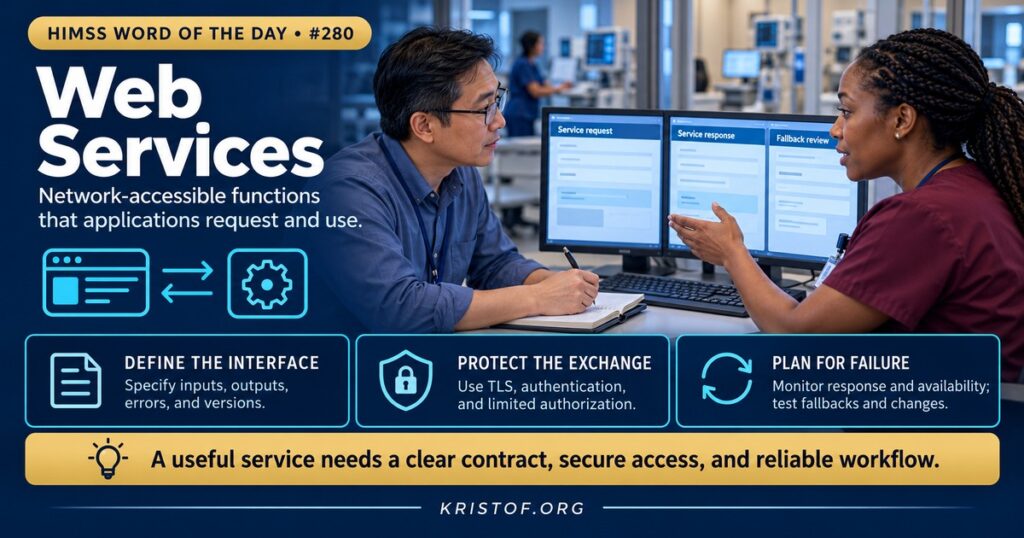
Today, many new integrations use REST-style APIs and the HL7 FHIR standard instead of SOAP, because they are simpler for developers and fit mobile and web applications. SOAP-based services remain common in established interfaces, including some payer, public health, and enterprise systems. Both styles carry the same concerns. Contracts must be clear: what inputs a service accepts, what it returns, how errors are reported, and how versions change. Performance needs service-level expectations and monitoring, since a slow service can freeze a clinical screen. Reliability needs fallbacks, as in the decision support trial, and downtime plans for when a service is unavailable.
Security is essential. The HIPAA Security Rule requires technical measures to guard against unauthorized access to electronic protected health information transmitted over a network, and addressable specifications for integrity controls and encryption. In practice that means TLS for all service traffic, strong authentication of calling systems, authorization limited to what each caller needs, input validation, logging, and rate limiting. Every external service is also a business relationship: contracts, business associate agreements where PHI is involved, and security review of the vendor.
Governance is often the harder part. Teams should keep an inventory of services in use, owners, versions, dependencies, and contacts. Changes to a service can break callers; testing and notice periods matter. Monitoring should cover availability, response time, and error rates, with alerts routed to people who can act.
Common web service problems:
- Slow or unavailable services that freeze clinical workflows
- Unclear or changing interface contracts
- Weak authentication between systems
- PHI sent to services without proper agreements or encryption
- No inventory of which services depend on which
- Versions retired without notice to callers
What supports reliable and secure services:
- Clear service descriptions and versioning rules
- TLS, strong authentication, and least-privilege authorization
- Performance targets with monitoring and alerts
- Local fallbacks and downtime procedures
- Business associate agreements and vendor security review
- Change control and testing with partners
🏥 The Nurse’s Perspective: Clinical, Bedside, & Workflow
Nurses use web services every day without seeing them, whenever a screen pulls information from another system.
At the Bedside
A drug interaction warning, a calculated risk score, an eligibility check at registration, or a result that appears from an outside lab may come from a service called in the background. When a screen is slow or an alert does not appear, nurses report what they were doing and what they saw. That detail helps analysts trace which service was involved.
In Clinical Workflow
Nurse managers see the effects of service reliability in delayed discharges, slow scanning, and workarounds that appear when a tool is unreliable. They help set priorities: which tools must work, which can fall back, and what staff do in the meantime.
Nurse informaticists take part in designing and testing integrations, defining what a remote decision support service should do, how its output appears, and what happens if it does not respond. They ensure that nursing workflows are included in test scenarios, as the decision support trial shows that nurse documentation can drive much of the service traffic.
In EHR Implementation (Go-Live Perspective)
An Epic Go-Live activates many service connections: eligibility, e-prescribing, decision support, patient portal, and outside records. Testing includes end-to-end scenarios under load. At-the-elbow support analysts note when specific screens pause or when outside data fail to load, and they pass those details to interface teams so the cause, such as a slow service or a failed certificate, is found quickly.
🎓 CAHIMS / CPHIMS & HIMSS Perspective
CAHIMS Exam Domain Mapping
Web services appear in integration, architecture, and security questions:
| CAHIMS Domain | How Web Services Appear |
|---|---|
| Healthcare & Technology Environments | Interoperability standards, APIs, regulatory expectations |
| Clinical Informatics | Decision support services, workflow integration |
| Healthcare Information & Systems Management | SOAP, REST, XML, interface engines, monitoring, security |
| Management & Leadership | Vendor management, service-level agreements, architecture strategy |
Key Terms to Know Alongside Web Services
- SOAP — XML-based messaging protocol for web services
- WSDL — XML language that describes a web service
- REST — architectural style using standard web methods on resources
- API — defined interface through which software requests services from other software
- Service-Oriented Architecture (SOA) — design approach that builds systems from reusable services
- Interface Engine — middleware that routes and transforms messages between systems
HIMSS Organizational Position
HIMSS supports standards-based integration and secure data exchange through its public policy work, research, and education. Members can find related resources through the HIMSS Resource Center and Public Policy and Advocacy pages.
🔗 Explore Further: External References
- W3C — Web Services Architecture https://www.w3.org/TR/ws-arch/
- W3C — SOAP Version 1.2 Part 1: Messaging Framework https://www.w3.org/TR/soap12-part1/
- W3C — Web Services Description Language (WSDL) Version 2.0 Part 1: Core Language https://www.w3.org/TR/wsdl20/
- Goldberg et al. (2016), International Journal of Medical Informatics — Use of a Remote Clinical Decision Support Service for a Multicenter Trial to Implement Prediction Rules for Children With Minor Blunt Head Trauma https://pubmed.ncbi.nlm.nih.gov/26806717/
- Hsieh et al. (2012), Telemedicine and e-Health — E-Health and Healthcare Enterprise Information System Leveraging Service-Oriented Architecture https://pubmed.ncbi.nlm.nih.gov/22480301/
- eCFR — 45 CFR 164.312, Technical Safeguards https://www.ecfr.gov/current/title-45/subtitle-A/subchapter-C/part-164/subpart-C/section-164.312
Term source: HIMSS Dictionary of Health Information and Technology Terms, Acronyms, and Organizations, 6th Edition (2025). All definitions in this series are paraphrased for editorial purposes. Readers are encouraged to consult the primary source for exact language.
Eric Andrew Kristof, RN, CAHIMS is a Healthcare IT professional and HIMSS Arkansas Chapter member based in Hot Springs Village, AR, with hands-on Epic Go-Live experience and a diverse healthcare and IT background. He writes at kristof.org at the intersection of clinical care and healthcare technology.
Leave a Reply