By Eric Andrew Kristof, RN, CAHIMS | Healthcare IT Professional | HIMSS Arkansas Chapter Member
About This Series: The HIMSS Word of the Day is a running blog series drawing from the HIMSS Dictionary of Health Information and Technology Terms, Acronyms, and Organizations, 6th Edition (2025) — the authoritative reference for healthcare IT professionals and the primary study resource for CAHIMS and CPHIMS certification. Each post paraphrases the term in plain language, grounds it in real-world healthcare IT context, and adds a bedside nursing perspective you won’t find in a textbook.
📖 The Term: Clinical Practice Guidelines
Source: HIMSS Dictionary of Health Information and Technology Terms, Acronyms, and Organizations, 6th Edition (2025)
🔍 Plain-Language Definition
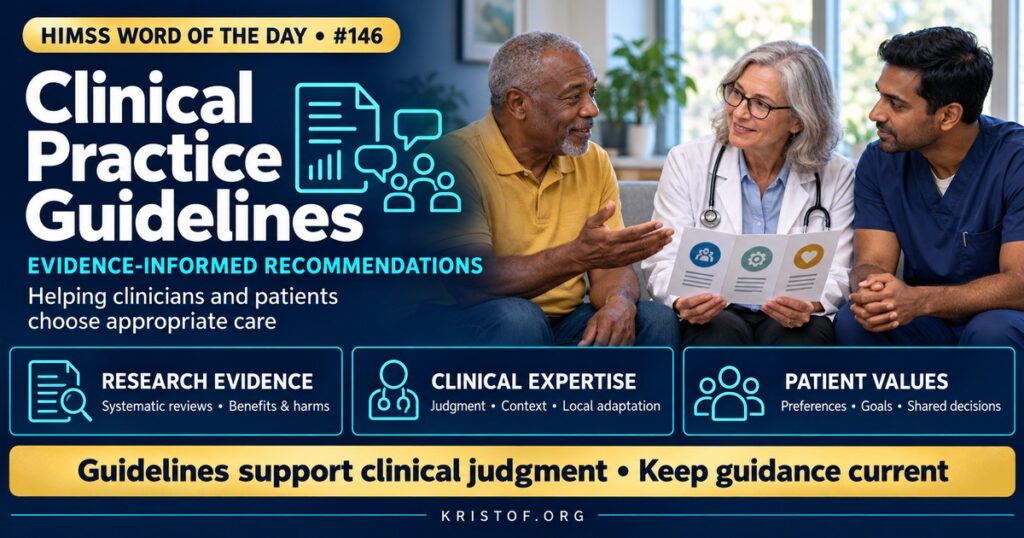
Clinical practice guidelines are systematically developed recommendations that help clinicians and patients make decisions about appropriate care for specific clinical circumstances. High-quality guidelines are based on systematic reviews of evidence and an assessment of the benefits and harms of alternative options.
The HIMSS Dictionary describes clinical practice guidelines as systematically developed statements, typically grounded in scientific evidence, intended to help practitioners and patients decide on appropriate healthcare in particular clinical situations.
| Concept | What It Means | Example |
|---|---|---|
| Guideline | Evidence-based recommendations for a condition or decision | Recommendations for managing hypertension |
| Systematic Review | A structured synthesis of research evidence | A review of trials comparing treatments |
| Strength of Recommendation | How confidently a recommendation is made | Strong versus conditional recommendations |
| Certainty of Evidence | Confidence that estimates of effect are correct | High, moderate, low, or very low certainty under GRADE |
| Protocol or Pathway | A local, operational version of guidance | A sepsis bundle or postoperative care pathway |
| Computable Guideline | Guideline logic expressed in machine-readable form | Decision support rules built from a guideline |
⚠️ Exam Alert: A guideline offers recommendations that support judgment; a protocol often specifies required steps for a local process. A standard of care is a legal and professional concept. Evidence-based practice integrates evidence, clinical expertise, and patient values. Guidelines inform but do not replace clinical judgment.
🌐 Why It Matters: Real-World Healthcare IT Context
Guidelines aim to reduce unwarranted variation and bring the best available evidence into everyday decisions. Without them, each clinician would need to evaluate large bodies of research independently, which is impractical in busy care settings.
Not all guidelines are equally trustworthy. In 2011, the Institute of Medicine, now the National Academy of Medicine, published standards for trustworthy guidelines in Clinical Practice Guidelines We Can Trust. They emphasize transparency, management of conflicts of interest, multidisciplinary development groups, use of systematic reviews, rating of evidence and recommendation strength, external review, and updating.
Evidence rating frameworks support consistency. The GRADE approach, used by many guideline developers, rates the certainty of evidence and the strength of recommendations, making clear when recommendations rest on strong evidence and when they reflect weaker evidence or values judgments. Organizations such as the U.S. Preventive Services Task Force publish graded recommendations for preventive services.
Guidelines change care only when they reach the point of decision. Health IT translates them into order sets, care plans, documentation templates, health maintenance reminders, alerts, and dashboards. Well-designed tools make the recommended action the easiest one, while still allowing clinicians to deviate for appropriate reasons.
Translation is difficult. Guidelines are often written in narrative text with ambiguous terms, exceptions, and conditional recommendations. Turning them into precise logic requires clinical and informatics expertise. Efforts such as HL7’s Clinical Practice Guidelines implementation guide for FHIR, sometimes called CPG on FHIR, aim to represent guideline recommendations in computable form so they can be shared and implemented more consistently.
Keeping tools current is a persistent challenge. Guidelines are updated as evidence evolves, and organizations must track changes and revise order sets, alerts, and templates. Outdated decision support can steer clinicians toward old recommendations.
Local adaptation is often necessary. Organizations may adjust national recommendations to fit their patient populations, formularies, staffing, and resources, turning broad guidance into specific protocols and pathways. That adaptation should be documented and reviewed by multidisciplinary teams so that local versions remain faithful to the evidence while being practical to follow.
Patients belong in the process. Guidelines increasingly address shared decision-making, recognizing that patient preferences and circumstances affect the right choice. Patient-facing tools can help explain options and trade-offs.
Common challenges in using guidelines:
- Conflicting recommendations from different organizations
- Narrative recommendations that are hard to translate into logic
- Outdated order sets and alerts after guideline updates
- Alert fatigue from overly rigid decision support
- Limited applicability to complex patients with multiple conditions
- Variable quality and potential conflicts of interest
What helps guidelines improve care:
- Selection of trustworthy, current guidelines
- Multidisciplinary review before local adoption
- Integration into order sets, pathways, and workflow
- Governance for monitoring updates and retiring outdated content
- Measurement of adherence and outcomes
- Support for shared decision-making with patients
🏥 The Nurse’s Perspective: Clinical, Bedside, & Workflow
Nurses use guidelines daily and help translate them into consistent care at the bedside.
At the Bedside
Many nursing interventions are guided by evidence-based recommendations, such as fall prevention, pressure injury prevention, catheter-associated infection prevention, pain management, and early warning recognition. Order sets and nursing care plans built on these guidelines help ensure consistent practice.
Nurses also apply judgment. When a guideline-based protocol does not fit a patient’s situation, nurses communicate concerns to the care team and document the rationale, recognizing that guidelines support rather than replace clinical judgment.
In Clinical Workflow
Nurse-driven protocols, such as those for catheter removal, glucose management, or early mobility, often originate from guidelines. Clear protocols embedded in the EHR allow nurses to act promptly within their scope.
Nurses frequently participate in practice councils that review new guidelines and update policies, procedures, and documentation tools. Their input ensures that changes are practical and fit real workflows.
Patient education materials based on guidelines help patients understand recommendations, such as screening schedules or self-management for chronic conditions. Nurses tailor this education to each patient’s needs and preferences.
Nurse informaticists often lead the translation of guidelines into flowsheets, care plans, and alerts, working with clinical experts to define precise logic.
Measuring adherence closes the loop. Reports showing how often guideline-based bundles are completed, such as fall or infection prevention measures, help nursing teams see progress and identify barriers.
In EHR Implementation (Go-Live Perspective)
During an Epic Go-Live, organizations review and rebuild order sets, care plans, and protocols, often using the opportunity to update content to current guidelines. Clinical content review by nurses and physicians is a major part of preparation.
At-the-elbow support analysts help clinicians find guideline-based order sets and pathways in the new system. Feedback about missing or outdated content after Go-Live should be routed to content governance teams.
🎓 CAHIMS / CPHIMS & HIMSS Perspective
CAHIMS Exam Domain Mapping
Clinical practice guidelines appear in clinical informatics and decision support questions:
| CAHIMS Domain | How Clinical Practice Guidelines Appear |
|---|---|
| Healthcare & Technology Environments | Guideline developers; preventive services recommendations; trustworthy standards |
| Clinical Informatics | Order sets, care plans, decision support, nurse-driven protocols |
| Healthcare Information & Systems Management | Computable guidelines, content management, FHIR-based representation |
| Management & Leadership | Content governance, standardization, quality improvement |
Key Terms to Know Alongside Clinical Practice Guidelines
- Evidence-Based Practice — integrating research evidence, clinical expertise, and patient values
- GRADE — a framework for rating certainty of evidence and strength of recommendations
- Systematic Review — a structured synthesis of research on a specific question
- Order Set — a predefined group of orders for a condition or procedure
- Clinical Decision Support (CDS) — tools that provide timely, relevant information to support decisions
- Care Pathway — a structured multidisciplinary plan for a specific condition
HIMSS Organizational Position
HIMSS supports clinical decision support and content governance that bring evidence into practice through its clinical informatics education and research. Members can find related education and research through the HIMSS Resource Center.
🔗 Explore Further: External References
- National Academies — Clinical Practice Guidelines We Can Trust (2011) https://www.nationalacademies.org/read/13058/chapter/1
- GRADE Working Group https://www.gradeworkinggroup.org/
- U.S. Preventive Services Task Force https://www.uspreventiveservicestaskforce.org/uspstf/
- HL7 — Clinical Practice Guidelines (CPG on FHIR) Implementation Guide https://hl7.org/fhir/uv/cpg/
- AHRQ — Guidelines and Measures https://www.ahrq.gov/gam/index.html
- HIMSS — Nursing Informatics Community https://www.himss.org/networking/communities/nursing-informatics/
Term source: HIMSS Dictionary of Health Information and Technology Terms, Acronyms, and Organizations, 6th Edition (2025). All definitions in this series are paraphrased for editorial purposes. Readers are encouraged to consult the primary source for exact language.
Eric Andrew Kristof, RN, CAHIMS is a Healthcare IT professional and HIMSS Arkansas Chapter member based in Hot Springs Village, AR, with hands-on Epic Go-Live experience and a diverse healthcare and IT background. He writes at kristof.org at the intersection of clinical care and healthcare technology.
Leave a Reply