By Eric Andrew Kristof, RN, CAHIMS | Healthcare IT Professional | HIMSS Arkansas Chapter Member
About This Series: The HIMSS Word of the Day is a running blog series drawing from the HIMSS Dictionary of Health Information and Technology Terms, Acronyms, and Organizations, 6th Edition (2025) — the authoritative reference for healthcare IT professionals and the primary study resource for CAHIMS and CPHIMS certification. Each post paraphrases the term in plain language, grounds it in real-world healthcare IT context, and adds a bedside nursing perspective you won’t find in a textbook.
📖 The Term: TCP/IP (Transmission Control Protocol/Internet Protocol)
Source: HIMSS Dictionary of Health Information and Technology Terms, Acronyms, and Organizations, 6th Edition (2025)
🔍 Plain-Language Definition
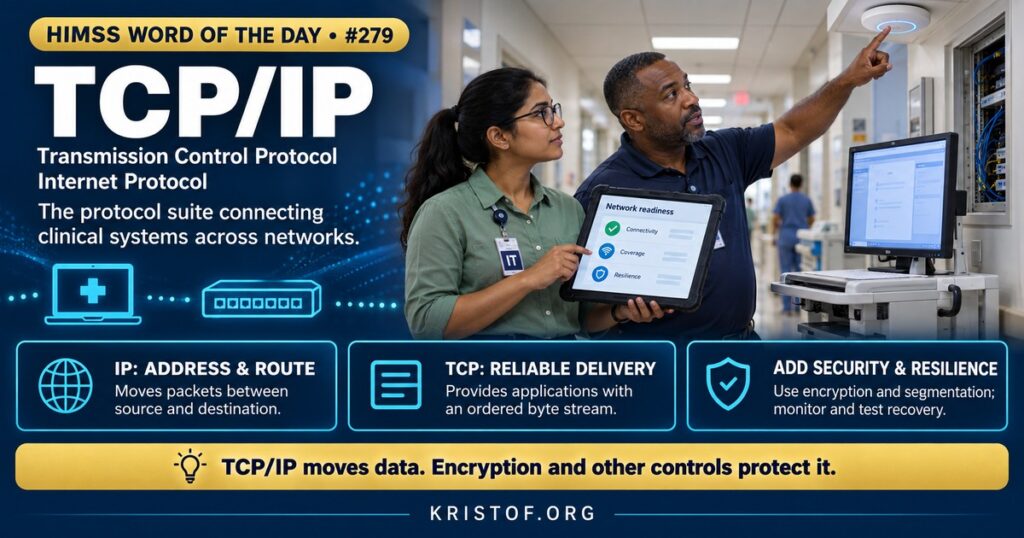
TCP/IP stands for Transmission Control Protocol/Internet Protocol. It is a family of communication protocols that lets computers exchange data across networks, and it is the basis of the internet. The HIMSS Dictionary describes it as a routable protocol needed for internet access, with the TCP portion associated with the data and the IP portion with delivering packets from source to destination. A second meaning covers the broader suite of protocols for transporting packets, holding sessions, transferring files, and sending mail, supported by many hardware and software vendors.
The two named protocols do different jobs. The Internet Protocol (IP), first specified in 1981, moves blocks of data called datagrams from a source to a destination, each identified by an address, and handles fragmentation and reassembly when a datagram must cross a network that carries only small packets. The Transmission Control Protocol (TCP) runs on top of IP. According to the current TCP specification, RFC 9293, TCP provides a reliable, in-order byte-stream service to applications, with each TCP segment carried inside an IP datagram, and with reliability achieved by detecting packet losses and errors and retransmitting.
| Layer | Role | Health Care Example |
|---|---|---|
| Application | Software protocol or service | HL7 message, FHIR API call, web page |
| Transport (TCP) | Reliable, ordered delivery between applications | Lab result message arrives complete and in order |
| Internet (IP) | Addressing and routing of packets | Packet from a bedside device to a server |
| Link / physical | Wired or wireless transmission | Ethernet, Wi-Fi |
⚠️ Exam Alert: IP handles addressing and routing; TCP handles reliable delivery between applications. IPv4 and IPv6 are versions of IP; IPv6 uses a much larger address space. TCP/IP moves data but does not protect it: TLS, VPNs, and firewalls add security. UDP is a different transport protocol that does not guarantee delivery.
🌐 Why It Matters: Real-World Healthcare IT Context
Nearly every clinical system depends on TCP/IP. EHR workstations connect to application and database servers across it. Interface engines move HL7 and FHIR content between laboratory, pharmacy, imaging, and billing systems. Infusion pumps, monitors, and bedside scanners join wired and wireless networks. Telehealth platforms, patient portals, and remote monitoring send data over the internet. When the network is slow, congested, or down, the symptoms show up as frozen screens, delayed results, and devices that cannot reach their servers.
The suite continues to evolve. The IPv6 specification, published in 2017 as RFC 8200, defines the newer version of the Internet Protocol, and the 2022 TCP specification consolidated decades of changes made since the original 1981-era documents. For hospitals, the practical points are address planning, support for both IP versions where needed, and keeping network equipment and device firmware current. Medical devices with long lifespans may lack current security features, which makes network design around them important.
Security is a layer on top. The HIPAA Security Rule‘s technical safeguards, at 45 CFR 164.312(e), require covered entities and business associates to implement technical security measures against unauthorized access to electronic protected health information transmitted over an electronic communications network, including integrity controls (addressable) and encryption (addressable). TCP/IP itself does not encrypt data; organizations use Transport Layer Security, virtual private networks, and similar tools, guided by resources such as NIST’s guidelines for TLS implementations. Network design also matters: segmenting medical devices from general traffic, using firewalls with defined rules, monitoring for unusual traffic, and limiting which systems can talk to which.
Attacks exploit the protocols’ behavior. The TCP specification itself notes that some attacks aim to exhaust the resources of a TCP server, with SYN flooding as an example, and that operating systems implement mitigations while defenses such as proxies and stateful firewalls operate outside the end host. A 2026 study in the International Journal of Medical Informatics designed and evaluated a privacy-centric microservice framework for FHIR-based integration of heterogeneous medical data, built with a zero-trust posture using device-bound X.509 certificates and mutual TLS. The authors tested performance with 50 concurrent Android emulators over Wi-Fi and 4G with a 5 percent random loss model, and ran security probes, including an illustrative availability test at 50,000 SYN requests per second, where the design reduced the observed request rate. They described the results as an initial validation rather than a full penetration test and said large-scale clinical deployments would require independent security assessment. For a general reader, the study illustrates that secure communication is built from many layers on top of TCP/IP and must be tested under realistic network conditions, including packet loss.
Resilience is the other half. Clinical networks need redundant paths and power, monitoring, and a plan for what happens when part of the network fails. Wireless coverage for mobile workstations and devices needs surveys and capacity planning. When the network goes down, the care team needs downtime procedures that do not assume connectivity. Network teams and clinical leaders should agree on priorities, such as which systems must be restored first, and should test failover.
Common TCP/IP-related problems:
- Congested or poorly segmented networks that slow clinical systems
- Wireless dead zones in patient care areas
- Devices on flat networks that can reach too much
- Unencrypted traffic carrying PHI inside the network
- Single points of failure in switches, links, or power
- Address conflicts or misconfiguration after changes
What supports reliable and secure networks:
- Network segmentation and defined firewall rules
- Encryption of PHI in transit using current TLS versions
- Redundant links, power, and tested failover
- Monitoring and alerting for unusual traffic and capacity
- Device inventory with patching or compensating controls
- Clinical input into maintenance windows and priorities
🏥 The Nurse’s Perspective: Clinical, Bedside, & Workflow
Nurses rarely think about protocols, but they feel the network every shift.
At the Bedside
A slow chart, a barcode scanner that will not connect, or a pump that stops reporting to the EHR may reflect a network problem. Reporting exactly what happened, where, and when helps network staff diagnose it: “Room 412, wireless scanner, could not reach the medication system at about 0300.” Nurses also follow the downtime process when the network is down.
In Clinical Workflow
Nurse managers plan maintenance windows with IT so that upgrades do not collide with peak care times. Charge nurses know which devices rely on wireless and what to do when connectivity drops. Biomedical staff and nurses together learn which devices are on which networks.
Nurse informaticists translate clinical impact into priorities for network teams, such as which units depend on continuous monitoring or mobile workflows. They ensure that network changes are tested with realistic clinical tasks, including medication administration with scanning.
In EHR Implementation (Go-Live Perspective)
An Epic Go-Live places heavy new demands on the network: many more workstations, mobile devices, and printers. Network readiness, including wireless coverage and capacity, is part of go-live planning. At-the-elbow support analysts quickly spot patterns, such as one unit with repeated slowness or a corner of a floor where devices disconnect, and relay them so network staff can fix the cause.
🎓 CAHIMS / CPHIMS & HIMSS Perspective
CAHIMS Exam Domain Mapping
TCP/IP appears in infrastructure, networking, and security questions:
| CAHIMS Domain | How TCP/IP Appears |
|---|---|
| Healthcare & Technology Environments | HIPAA transmission security, internet-based care delivery |
| Clinical Informatics | Impact of connectivity on workflow and device integration |
| Healthcare Information & Systems Management | Network architecture, protocols, segmentation, monitoring |
| Management & Leadership | Infrastructure planning, resilience, vendor and risk management |
Key Terms to Know Alongside TCP/IP
- IP Address — numeric label that identifies a device on a network
- Packet / Datagram — unit of data sent across a network
- TLS — protocol that encrypts data in transit
- Firewall — control that allows or blocks traffic based on rules
- Network Segmentation — dividing a network into separate zones
- IPv6 — newer version of IP with a larger address space
HIMSS Organizational Position
HIMSS supports secure and resilient health information infrastructure through its Healthcare Cybersecurity Community, research, and education. Members can find related resources through the HIMSS Healthcare Cybersecurity Community page.
🔗 Explore Further: External References
- IETF — RFC 9293, Transmission Control Protocol (TCP) https://www.rfc-editor.org/rfc/rfc9293.html
- IETF — RFC 791, Internet Protocol https://www.rfc-editor.org/rfc/rfc791.html
- IETF — RFC 8200, Internet Protocol, Version 6 (IPv6) Specification https://www.rfc-editor.org/rfc/rfc8200.html
- eCFR — 45 CFR 164.312, Technical Safeguards https://www.ecfr.gov/current/title-45/subtitle-A/subchapter-C/part-164/subpart-C/section-164.312
- NIST — SP 800-52 Rev. 2, Guidelines for the Selection, Configuration, and Use of TLS Implementations https://csrc.nist.gov/pubs/sp/800/52/r2/final
- Ungurean et al. (2026), International Journal of Medical Informatics — A Privacy-Centric Microservice Framework for Secure FHIR-Based Integration of Heterogeneous Medical Data https://pubmed.ncbi.nlm.nih.gov/42114371/
Term source: HIMSS Dictionary of Health Information and Technology Terms, Acronyms, and Organizations, 6th Edition (2025). All definitions in this series are paraphrased for editorial purposes. Readers are encouraged to consult the primary source for exact language.
Eric Andrew Kristof, RN, CAHIMS is a Healthcare IT professional and HIMSS Arkansas Chapter member based in Hot Springs Village, AR, with hands-on Epic Go-Live experience and a diverse healthcare and IT background. He writes at kristof.org at the intersection of clinical care and healthcare technology.
Leave a Reply