By Eric Andrew Kristof, RN, CAHIMS | Healthcare IT Professional | HIMSS Arkansas Chapter Member
About This Series: The HIMSS Word of the Day is a running blog series drawing from the HIMSS Dictionary of Health Information and Technology Terms, Acronyms, and Organizations, 6th Edition (2025) — the authoritative reference for healthcare IT professionals and the primary study resource for CAHIMS and CPHIMS certification. Each post paraphrases the term in plain language, grounds it in real-world healthcare IT context, and adds a bedside nursing perspective you won’t find in a textbook.
📖 The Term: NIC (Nursing Interventions Classification)
Source: HIMSS Dictionary of Health Information and Technology Terms, Acronyms, and Organizations, 6th Edition (2025)
🔍 Plain-Language Definition
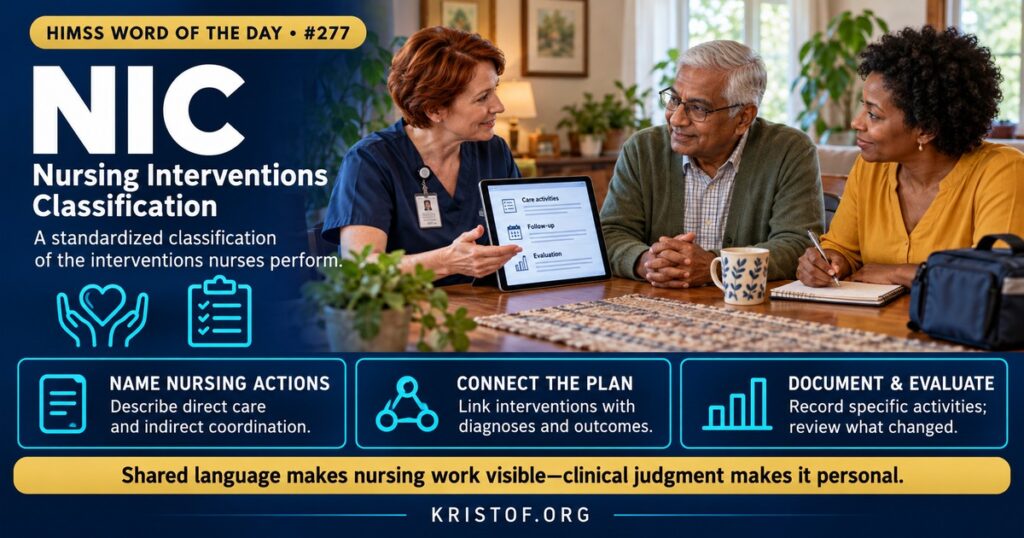
The Nursing Interventions Classification (NIC) is a standardized, research-based classification of the interventions nurses perform. The HIMSS Dictionary describes it as useful for standardizing clinical documentation, communicating care across settings, integrating data across systems, studying effectiveness, measuring productivity, evaluating competency, supporting reimbursement, and designing curricula. An intervention in NIC is a treatment based on clinical judgment and knowledge that a nurse performs to enhance patient outcomes. It can be direct, such as wound care, or indirect, such as care coordination.
NIC is one part of a trio often called NNN. NANDA-I supplies the nursing diagnosis, NOC (Nursing Outcomes Classification) supplies measurable outcomes, and NIC supplies the interventions. Experts have developed linkages that suggest which outcomes and interventions fit which diagnoses, so a nurse planning care for a given problem can start from evidence-informed options.
| Component | Role in the Nursing Process | Example for Risk for Falls |
|---|---|---|
| NANDA-I diagnosis | Assessment and diagnosis | Risk for Falls |
| NOC outcome | Planning and evaluation | Fall Prevention Behavior |
| NIC intervention | Implementation | Fall Prevention |
| Activities | Specific actions under an intervention | Bed alarm, toileting schedule, footwear check |
⚠️ Exam Alert: NIC names interventions; NANDA-I names diagnoses; NOC names outcomes. Do not confuse NIC with NIH or NICU. Each NIC intervention contains activities, the specific actions a nurse takes. Linkages connect the three vocabularies in care plans.
🌐 Why It Matters: Real-World Healthcare IT Context
Nursing is one of the largest components of care, yet it is often invisible in data. When nursing interventions are recorded as free text, they cannot be counted, compared, or linked to outcomes. A standard vocabulary changes that. It supports consistent documentation, handoffs that carry the same meaning across units and organizations, and research that examines which interventions work. ONC’s Interoperability Standards Advisory includes a nursing section, listing needs for representing nursing assessments, interventions, outcomes, and problems, which shows that the topic is part of national interoperability planning.
A 2026 systematic review in the International Journal of Nursing Knowledge evaluated the global impact of NANDA-I, NIC, and NOC on nursing care quality, consistency, and documentation. It searched studies from May 2019 to June 2024, identified 783 articles, and included 32 experimental and quasi-experimental studies, assessed with validated quality tools under a registered protocol. The included studies, mostly from Latin America and Southern Europe, reported positive effects on clinical reasoning, individualized care planning, documentation quality, and interdisciplinary communication. Barriers included insufficient training, system integration challenges, and limited uptake in regions such as North Africa and Asia. Few studies evaluated long-term clinical or organizational outcomes, and global implementation was uneven. The review supports the value of structured nursing language while showing that evidence on patient outcomes is still thin.
Linkage research shows how the vocabularies are being applied to specific populations. A 2026 study in the same journal developed NNN linkages for older people living with HIV. Sixteen experienced nurses rated the relevance of 45 NANDA-I diagnoses, 80 NOC outcomes, and 82 NIC interventions, and six experts, including NOC and NIC editors, finalized the linkages by consensus, producing 16 core linkages. Another 2026 study built linkages for the diagnosis Risk for Thrombosis, identifying 61 terms including 25 suggested NIC interventions. Both studies note that such linkages could support care planning and, in the thrombosis study, integration into clinical decision support and electronic records. Consensus linkages are not outcome studies; they give nurses and informaticists a structured starting point, which still requires clinical judgment.
For EHR design, NIC raises practical choices. Some organizations build care plans on NNN with picklists and linked activities. Others use simpler problem-goal-intervention structures, or map local interventions to NIC for reporting and research. Whichever route, the build should reflect how nurses actually work. A system that asks nurses to select from hundreds of interventions will be bypassed. A system that suggests a short list based on the diagnosis and patient context, and lets nurses document activities as part of regular workflow, can help. Mapping local content to reference terminologies, including SNOMED CT, allows exchange with other systems, and decision support can use structured interventions to trigger tasks, reminders, or outcome tracking.
Education matters as much as software. The 2026 pediatric nursing study discussed in an earlier post on NANDA Taxonomy II found that an 11-session standardized nursing language program improved documentation quality in one Egyptian hospital group, while the systematic review identifies inadequate training as a common barrier. Staff need to understand why the language exists and how it helps their patients, not only where to click.
Common NIC-related problems:
- Care plan modules built for compliance, not clinical use
- Intervention lists too long to search quickly
- Little training in the language and its purpose
- Local terms that do not map to NIC or SNOMED CT
- Documentation of activities duplicated in flowsheets and care plans
- Weak evidence on outcomes that makes the value hard to defend
What supports effective use:
- Diagnosis-driven short lists of suggested interventions
- Linkages reviewed by nurse experts and kept current
- Education that connects the language to clinical reasoning
- Mapping to reference terminologies for exchange
- Documentation designed so the same entry serves care and data
- Evaluation of effects on documentation and outcomes
🏥 The Nurse’s Perspective: Clinical, Bedside, & Workflow
NIC gives nurses words for work that is often described only as “care.”
At the Bedside
A nurse who documents Fall Prevention, Pressure Ulcer Prevention, or Medication Management with specific activities shows what was done and why. The same record helps the next shift continue the plan. When interventions are tied to a diagnosis and outcome, evaluation is clearer: did the intervention move the outcome?
In Clinical Workflow
Nurse leaders can use standardized interventions to describe workload, staffing needs, and contributions of nursing to outcomes. Nurse educators use NIC to teach what interventions involve and to assess competency. Case managers see consistent language across settings, which helps transitions.
Nurse informaticists work with practice councils to decide which interventions to include, how to word activities, how to link them to assessments and orders, and how to report on them. They also decide how much to automate, so that suggestions help and do not replace nursing judgment.
In EHR Implementation (Go-Live Perspective)
An Epic Go-Live decides whether nurses document care plans with standardized interventions or in simpler forms. At-the-elbow support analysts watch how nurses move through the care plan screens, and which interventions they use or skip. That feedback guides trimming of lists, better defaults, and training that ties each step to patient care.
🎓 CAHIMS / CPHIMS & HIMSS Perspective
CAHIMS Exam Domain Mapping
NIC appears in terminology, nursing informatics, and documentation questions:
| CAHIMS Domain | How NIC Appears |
|---|---|
| Healthcare & Technology Environments | Recognized terminologies, standards, nursing’s role in data |
| Clinical Informatics | Nursing process, care plans, linkages, decision support |
| Healthcare Information & Systems Management | Terminology mapping, content maintenance, reporting |
| Management & Leadership | Practice governance, training, evaluation of nursing documentation |
Key Terms to Know Alongside NIC
- NANDA-I — classification of nursing diagnoses
- NOC — Nursing Outcomes Classification
- NNN Linkages — expert-defined connections among diagnoses, outcomes, and interventions
- Nursing Intervention — treatment performed by a nurse based on clinical judgment
- Activity — specific action carried out under a nursing intervention
- Standardized Nursing Language — controlled vocabulary for nursing diagnoses, interventions, and outcomes
HIMSS Organizational Position
HIMSS supports nursing informatics through its Nursing Informatics Community, research, and education. Members can find related resources through the HIMSS Nursing Informatics Community page.
🔗 Explore Further: External References
- Fernane et al. (2026), International Journal of Nursing Knowledge — The Impact of NANDA-I, Nursing Interventions Classification (NIC), and Nursing Outcomes Classification (NOC) on the Improvement of Nursing Practice Worldwide: Systematic Review https://pubmed.ncbi.nlm.nih.gov/42841266/
- Shin et al. (2026), International Journal of Nursing Knowledge — Development of Linkages of NANDA International Diagnoses-Nursing Outcomes Classification-Nursing Interventions Classification for People Living with HIV Over 50 https://pubmed.ncbi.nlm.nih.gov/42808995/
- Mecheroni et al. (2026), International Journal of Nursing Knowledge — Identifying NANDA-I, NOC, and NIC Linkages for the Risk for Thrombosis Nursing Diagnosis https://pubmed.ncbi.nlm.nih.gov/42576156/
- ONC — About the Interoperability Standards Advisory (ISA) https://isp.healthit.gov/about-isa
- NLM — UMLS Source Release Documentation: Nursing Interventions Classification (NIC) https://www.nlm.nih.gov/research/umls/sourcereleasedocs/current/NIC/index.html
Term source: HIMSS Dictionary of Health Information and Technology Terms, Acronyms, and Organizations, 6th Edition (2025). All definitions in this series are paraphrased for editorial purposes. Readers are encouraged to consult the primary source for exact language.
Eric Andrew Kristof, RN, CAHIMS is a Healthcare IT professional and HIMSS Arkansas Chapter member based in Hot Springs Village, AR, with hands-on Epic Go-Live experience and a diverse healthcare and IT background. He writes at kristof.org at the intersection of clinical care and healthcare technology.
Leave a Reply