By Eric Andrew Kristof, RN, CAHIMS | Healthcare IT Professional | HIMSS Arkansas Chapter Member
About This Series: The HIMSS Word of the Day is a running blog series drawing from the HIMSS Dictionary of Health Information and Technology Terms, Acronyms, and Organizations, 6th Edition (2025) — the authoritative reference for healthcare IT professionals and the primary study resource for CAHIMS and CPHIMS certification. Each post paraphrases the term in plain language, grounds it in real-world healthcare IT context, and adds a bedside nursing perspective you won’t find in a textbook.
📖 The Term: NANDA Taxonomy II
Source: HIMSS Dictionary of Health Information and Technology Terms, Acronyms, and Organizations, 6th Edition (2025)
🔍 Plain-Language Definition
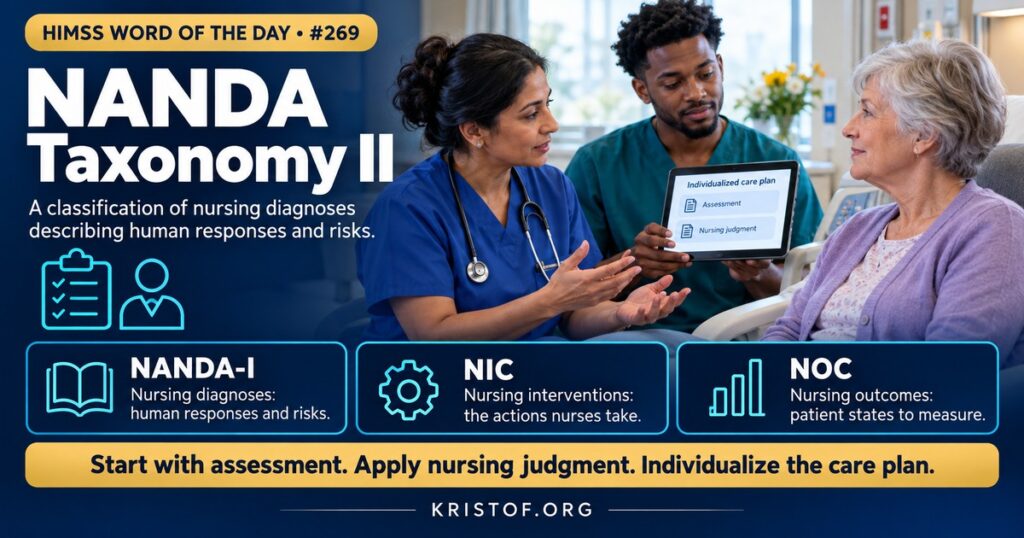
NANDA Taxonomy II is a classification of nursing diagnostic concepts that names and codes the ways patients respond to health problems or life events. The taxonomy is maintained by NANDA International (NANDA-I), and its labels are what nurses mean when they refer to a “NANDA diagnosis.” A nursing diagnosis is a clinical judgment about a human response, such as Risk for Falls, Impaired Skin Integrity, or Anxiety. It differs from a medical diagnosis, which names a disease.
Taxonomy II provides a structure for organizing diagnoses and a coding scheme that supports their use in records and research. In many organizations, NANDA-I diagnoses are paired with two companion classifications: the Nursing Interventions Classification (NIC), which names actions nurses take, and the Nursing Outcomes Classification (NOC), which names measurable patient outcomes. Together they are often called NNN.
| Component | What It Names | Example |
|---|---|---|
| NANDA-I diagnosis | A patient response or risk | Risk for Thrombosis |
| NOC outcome | A measurable patient state to track | Tissue Perfusion: Peripheral |
| NIC intervention | A nursing action | Embolus precautions |
| Defining characteristics | Signs and symptoms supporting the diagnosis | Observed during assessment |
| Risk factors | Conditions that increase vulnerability | Immobility |
| Related factors | Causes or contributors | Pain limiting movement |
⚠️ Exam Alert: NANDA-I names nursing diagnoses; NIC names interventions; NOC names outcomes. A nursing diagnosis is not the same as a medical diagnosis or a medical billing code. SNOMED CT can represent nursing concepts in many systems and is a different terminology.
🌐 Why It Matters: Real-World Healthcare IT Context
Nursing care planning needs a shared language. Without one, two nurses may describe the same problem in different words, making documentation hard to compare, search, or analyze. Standardized nursing language gives structure to clinical reasoning and makes nursing contributions visible in data. It also makes it possible to build decision support, to examine outcomes, and to study what nursing interventions achieve.
Evidence on education and documentation is encouraging but limited. A 2026 quasi-experimental study in the Journal of Pediatric Nursing examined an 11-session standardized nursing language education program for pediatric nurses in Egypt, which covered NANDA-I, NIC, and NOC. It included 104 nurses, 52 in each group, from three inpatient pediatric units. Documentation quality was measured with two validated instruments. In the experimental group, the mean total score on the Quality of Diagnoses, Interventions, and Outcomes tool rose from 2.95 to 10.67, and the D-Catch score rose from 1.83 to 3.59, with larger gains than in the control group, whose changes were 3.94 and 2.14. The authors concluded that targeted education improves documentation quality and recommended building the three classifications into documentation templates and electronic records. The study was from one city and did not measure patient outcomes, so its findings show a change in documentation and do not show better care.
Terminology work also continues. A 2026 article in the International Journal of Nursing Knowledge described the development of linkages among NANDA-I, NOC, and NIC for the diagnosis Risk for Thrombosis. Six nurse experts identified 61 terms, including five core outcomes about the occurrence of thrombosis, 20 outcomes related to risk factors, 11 related to at-risk populations and associated conditions, and 25 suggested interventions. The authors concluded that the linkages provide a structured framework for care planning and could support future integration into clinical decision support and electronic records. Another line of work examines the labels themselves. A 2019 analysis of 244 diagnostic labels found that most are built mainly from focus and judgment terms, and argued that additional axial terms would improve specificity. A 2020 discussion paper noted that 13 diagnoses include the word “syndrome” without a consistent label structure and proposed a clearer format.
Artificial intelligence is the newest question. A 2025 cross-sectional study in International Nursing Review tested four large language models on 10 realistic patient scenarios drawn from Taxonomy II, covering 12 domains, with five nursing experts rating accuracy and alignment in a single-blind process. Performance was similar across domains and overall, one model scored highest, interrater reliability was moderate, and the models showed small variations and occasional omissions. The authors concluded that expert review is still needed and that these tools are not yet reliable enough for independent use in clinical practice or nursing education. For informatics teams considering AI-assisted care planning, the message is to treat generated diagnoses as drafts for nurses to verify.
In EHRs, nursing diagnoses may be selected from a list, suggested from assessment data, or carried in a care plan that links to interventions and outcomes. Success depends on usable design. If selecting a diagnosis requires many clicks that do not support care, nurses will skip it. If diagnoses are auto-populated from assessments without review, the plan may not reflect the patient. Mapping to reference terminologies such as SNOMED CT allows exchange with other systems, and ONC’s Interoperability Standards Advisory lists a nursing section for assessments, interventions, outcomes, and problems.
Common NANDA-related problems:
- Care plan modules built for compliance and not for clinical use
- Diagnoses auto-generated without nurse review
- Free-text care plans that cannot be analyzed
- Limited education in standardized nursing language
- Diagnosis labels that lack specificity
- Poor mapping between nursing terminologies and exchange standards
What supports effective use:
- Education on diagnostic reasoning and the classifications
- Care plan design that fits real workflow
- Linkages among diagnoses, outcomes, and interventions
- Mapping to reference terminologies for exchange
- Nurse review of any automated or AI-generated suggestions
- Governance by nursing informatics and practice councils
🏥 The Nurse’s Perspective: Clinical, Bedside, & Workflow
Nursing diagnoses express what nurses uniquely assess and treat, so this vocabulary belongs to the profession.
At the Bedside
A nurse who identifies Risk for Falls, or Impaired Mobility, is naming a patient response that guides interventions: assistance, equipment, reassessment. Choosing the diagnosis based on assessment and defining characteristics, not on a default, makes the care plan useful to the next shift.
In Clinical Workflow
Nurse educators teach diagnostic reasoning and the use of standardized language. Nurse managers review care plans for quality and alignment with patient needs. Students and new graduates often learn NANDA-I in school and then find that a hospital’s EHR uses a simplified or different set, so orientation helps connect the two.
Nurse informaticists design care plan content, order sets linked to nursing interventions, and reports on outcomes. They work with practice councils to keep content current and to retire unused diagnoses that clutter the list.
In EHR Implementation (Go-Live Perspective)
An Epic Go-Live decides whether nursing care plans will be built on standardized nursing language or on simpler problem lists and goals. At-the-elbow support analysts see which care plan steps nurses use and which they skip, and they relay that to the nursing build team. Their observations help a hospital choose a care planning approach that supports clinical thinking and does not just fill a requirement.
🎓 CAHIMS / CPHIMS & HIMSS Perspective
CAHIMS Exam Domain Mapping
NANDA Taxonomy II appears in terminology, documentation, and nursing informatics questions:
| CAHIMS Domain | How NANDA Taxonomy II Appears |
|---|---|
| Healthcare & Technology Environments | Recognized nursing terminologies, standards organizations |
| Clinical Informatics | Nursing process, care planning, documentation design |
| Healthcare Information & Systems Management | Terminology mapping, content maintenance, reporting |
| Management & Leadership | Practice governance, education, quality of nursing documentation |
Key Terms to Know Alongside NANDA Taxonomy II
- Nursing Diagnosis — clinical judgment about a patient’s response to a health problem
- NIC — Nursing Interventions Classification
- NOC — Nursing Outcomes Classification
- Standardized Nursing Language — structured terms for nursing diagnoses, interventions, and outcomes
- Care Plan — documented plan linking assessment, diagnoses, interventions, and outcomes
- SNOMED CT — comprehensive clinical terminology used for exchange
HIMSS Organizational Position
HIMSS supports nursing informatics through its Nursing Informatics Community, research, and education. Members can find related resources through the HIMSS Nursing Informatics Community page.
🔗 Explore Further: External References
- Loutfy et al. (2026), Journal of Pediatric Nursing — The Effect of a Standardized Nursing Language Education Program on Documentation Practices Among Pediatric Nurses https://pubmed.ncbi.nlm.nih.gov/42442162/
- Mecheroni et al. (2026), International Journal of Nursing Knowledge — Identifying NANDA-I, NOC, and NIC Linkages for the Risk for Thrombosis Nursing Diagnosis https://pubmed.ncbi.nlm.nih.gov/42576156/
- Tuncer et al. (2025), International Nursing Review — Evaluation of ChatGPT-4, Gemini, Claude, and Copilot in Generating Nursing Diagnoses Based on NANDA-I Taxonomy II https://pubmed.ncbi.nlm.nih.gov/41311033/
- Miguel et al. (2019), International Journal of Nursing Knowledge — Call for the Use of Axial Terms: Toward Completeness of NANDA-I Nursing Diagnoses Labels https://pubmed.ncbi.nlm.nih.gov/30334611/
- Romeiro et al. (2020), International Nursing Review — Nursing Diagnoses: What About NANDA-I Syndromes? https://pubmed.ncbi.nlm.nih.gov/32779198/
- ONC — Interoperability Standards Advisory https://isp.healthit.gov/about-isa
Term source: HIMSS Dictionary of Health Information and Technology Terms, Acronyms, and Organizations, 6th Edition (2025). All definitions in this series are paraphrased for editorial purposes. Readers are encouraged to consult the primary source for exact language.
Eric Andrew Kristof, RN, CAHIMS is a Healthcare IT professional and HIMSS Arkansas Chapter member based in Hot Springs Village, AR, with hands-on Epic Go-Live experience and a diverse healthcare and IT background. He writes at kristof.org at the intersection of clinical care and healthcare technology.
Leave a Reply