By Eric Andrew Kristof, RN, CAHIMS | Healthcare IT Professional | HIMSS Arkansas Chapter Member
About This Series: The HIMSS Word of the Day is a running blog series drawing from the HIMSS Dictionary of Health Information and Technology Terms, Acronyms, and Organizations, 6th Edition (2025) — the authoritative reference for healthcare IT professionals and the primary study resource for CAHIMS and CPHIMS certification. Each post paraphrases the term in plain language, grounds it in real-world healthcare IT context, and adds a bedside nursing perspective you won’t find in a textbook.
📖 The Term: Vulnerability
Source: HIMSS Dictionary of Health Information and Technology Terms, Acronyms, and Organizations, 6th Edition (2025)
🔍 Plain-Language Definition
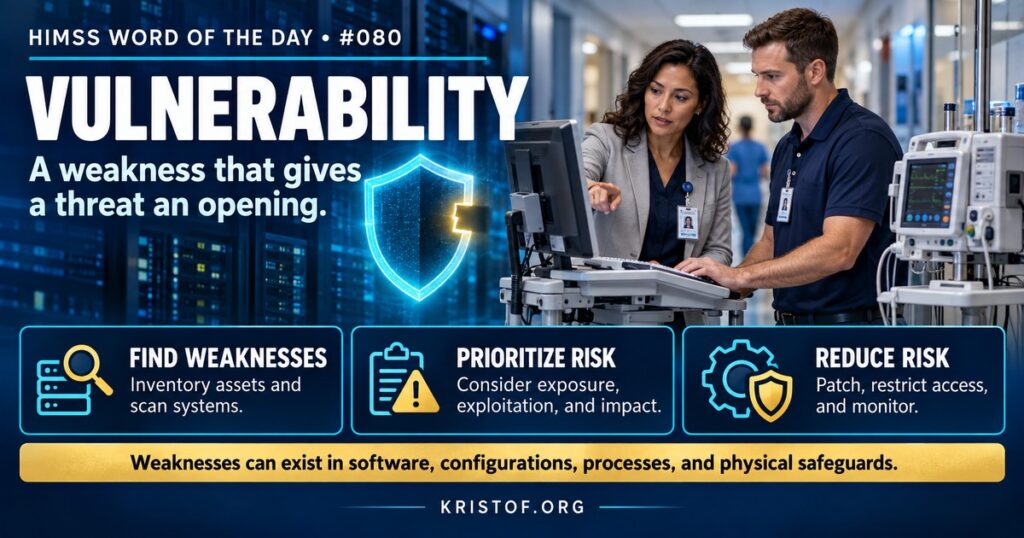
A vulnerability is a weakness that could allow an attacker, or an accident, to compromise the confidentiality, integrity, or availability of information or systems. It may be a flaw in software, a configuration error, a weak process, or a gap in physical security.
The HIMSS Dictionary describes a vulnerability as a cybersecurity term for a flaw in a system that may leave it open to attack. It adds that the term can describe any weakness, whether in a computer system, a process, or another safeguard, that gives a threat an opening.
Security professionals distinguish vulnerabilities from related terms:
| Term | Meaning | Healthcare Example |
|---|---|---|
| Threat | Something that could cause harm | A ransomware group targeting hospitals |
| Vulnerability | A weakness the threat could exploit | An unpatched remote access server |
| Exploit | A method or code that takes advantage of a vulnerability | Malware designed to attack that server flaw |
| Risk | The likelihood and impact of a threat exploiting a vulnerability | High, because the server is internet-facing and the flaw is actively exploited |
| Control | A safeguard that reduces risk | Patching, multifactor authentication, segmentation |
⚠️ Exam Alert: A vulnerability is a weakness; a threat is a potential cause of harm; risk combines likelihood and impact. A zero-day vulnerability is one that attackers exploit before a fix is available. A compensating control reduces risk when the vulnerability cannot be fixed directly. HIPAA‘s risk analysis requires organizations to identify threats and vulnerabilities to electronic protected health information.
🌐 Why It Matters: Real-World Healthcare IT Context
Hospitals run thousands of systems, from servers and workstations to infusion pumps and imaging equipment, and each can contain vulnerabilities. New flaws are disclosed constantly, and attackers move quickly to exploit those in internet-facing systems, such as remote access tools and file transfer software.
The cybersecurity community uses shared tools to track vulnerabilities. The CVE program assigns unique identifiers to publicly disclosed vulnerabilities, so everyone can refer to the same flaw. NIST’s National Vulnerability Database enriches CVE records with additional details. The Common Vulnerability Scoring System (CVSS), maintained by FIRST, rates severity on a scale from 0 to 10. Many organizations also consider whether a vulnerability is being actively exploited, which can matter more than the severity score alone.
Healthcare faces special challenges. Clinical systems run around the clock, so downtime for patches must be scheduled carefully. Some medical devices run older operating systems and can be updated only with the manufacturer’s approval. Vendors may need to validate patches before hospitals apply them. As a result, hospitals often rely on compensating controls, such as network segmentation, restricted access, and monitoring, to protect systems they cannot patch quickly.
Vulnerabilities are not only technical. Weak processes, such as onboarding that grants too much access, offboarding that leaves accounts active after staff leave, or vendor accounts with shared passwords, are vulnerabilities too. So are physical gaps, such as unlocked network closets or workstations in public areas. HIPAA’s risk analysis expects organizations to consider all of these, not just software flaws, when identifying risks to electronic protected health information.
FDA’s cybersecurity requirements for new connected medical devices, including a software bill of materials, help hospitals understand which components a device contains, so they can identify when a newly disclosed vulnerability affects their equipment.
Testing helps find weaknesses before attackers do. Vulnerability scans identify known flaws across systems, while penetration tests use skilled testers who try to break in the way an attacker would, revealing how individual weaknesses might be chained together. Results are most useful when they lead to tracked remediation with owners and deadlines, rather than reports that sit unread.
Common vulnerability management gaps:
- Incomplete inventories that miss devices and shadow IT
- Scanning without timely remediation
- Patching delayed by uptime pressures and vendor approvals
- Default passwords and unnecessary services left enabled
- Legacy systems kept running without compensating controls
- Prioritization based only on severity scores, ignoring exploitation and exposure
Characteristics of strong vulnerability management:
- A complete, current asset inventory, including medical devices
- Regular scanning and penetration testing
- Risk-based prioritization that considers exposure and active exploitation
- Defined patch windows coordinated with clinical operations
- Segmentation and monitoring for systems that cannot be patched
- Vendor contracts that require timely security updates and disclosure
🏥 The Nurse’s Perspective: Clinical, Bedside, & Workflow
Nurses are not responsible for patching systems, but their actions and observations affect how vulnerabilities are managed.
At the Bedside
Medical devices are part of the attack surface. When a device behaves unusually, displays unexpected messages, or loses its connection, reporting it helps clinical engineering and security teams determine whether the cause is technical, configuration related, or security related. Devices should be used only as configured, without connecting unapproved accessories or media.
Scheduled maintenance windows sometimes affect clinical tools. When a device or system is taken offline for updates, nurses may need to use backups or alternate equipment for a short period. Understanding that these updates fix real weaknesses helps teams plan around them rather than resist them.
Access requests are part of vulnerability management too. Asking for only the access a job requires, and reporting when a former colleague’s account still appears active, closes gaps that attackers could use.
In Clinical Workflow
Many vulnerabilities are exploited through people. Opening an unexpected attachment, clicking a link, or plugging in an unknown USB drive can give attackers a way to exploit a weakness in a workstation. Careful habits reduce that exposure.
Workstations need updates too. Restart prompts, brief slowdowns during updates, and occasional changes to familiar tools are often the visible side of patching. Delaying restarts indefinitely can leave workstations vulnerable.
In EHR Implementation (Go-Live Perspective)
During an Epic Go-Live, technical teams build and harden new servers, workstations, and devices, and run vulnerability scans before systems go live. Once the system is live, patch schedules must balance security with clinical availability, often using redundant systems so updates can be applied without downtime.
At-the-elbow support analysts may notice outdated software, unsupported browsers, or devices that do not match the standard build. Reporting these through the proper channel helps security and infrastructure teams close gaps before they are exploited.
🎓 CAHIMS / CPHIMS & HIMSS Perspective
CAHIMS Exam Domain Mapping
Vulnerabilities appear in risk analysis and security operations questions:
| CAHIMS Domain | How Vulnerabilities Appear |
|---|---|
| Healthcare & Technology Environments | HIPAA risk analysis; FDA device cybersecurity; threat landscape |
| Clinical Informatics | Device behavior reporting; maintenance windows and clinical availability |
| Healthcare Information & Systems Management | Scanning, CVE and CVSS, patch management, segmentation, hardening |
| Management & Leadership | Risk-based prioritization, vendor requirements, resource allocation, risk acceptance |
Key Terms to Know Alongside Vulnerability
- Threat — a potential cause of an unwanted incident that may harm a system or organization
- CVE (Common Vulnerabilities and Exposures) — a program that assigns unique identifiers to publicly disclosed vulnerabilities
- CVSS (Common Vulnerability Scoring System) — a standard method for rating vulnerability severity
- Patch Management — the process of acquiring, testing, and applying software updates
- Compensating Control — an alternative safeguard used when a primary control cannot be applied
- Zero-Day Vulnerability — a flaw exploited before a fix is publicly available
HIMSS Organizational Position
HIMSS treats vulnerability management, including for legacy systems and medical devices, as a core part of healthcare cybersecurity, and its Healthcare Cybersecurity Community shares practices for prioritizing and remediating weaknesses. Members can find related education and research through the HIMSS Resource Center.
🔗 Explore Further: External References
- NIST — National Vulnerability Database https://nvd.nist.gov/
- CVE Program https://www.cve.org/
- FIRST — Common Vulnerability Scoring System https://www.first.org/cvss/
- FDA — Medical Device Cybersecurity https://www.fda.gov/medical-devices/digital-health-center-excellence/cybersecurity
- HHS 405(d) Program — Health Industry Cybersecurity Practices https://405d.hhs.gov/
- NIST — Glossary: Vulnerability https://csrc.nist.gov/glossary/term/vulnerability
Term source: HIMSS Dictionary of Health Information and Technology Terms, Acronyms, and Organizations, 6th Edition (2025). All definitions in this series are paraphrased for editorial purposes. Readers are encouraged to consult the primary source for exact language.
Eric Andrew Kristof, RN, CAHIMS is a Healthcare IT professional and HIMSS Arkansas Chapter member based in Hot Springs Village, AR, with hands-on Epic Go-Live experience and a diverse healthcare and IT background. He writes at kristof.org at the intersection of clinical care and healthcare technology.
Leave a Reply