By Eric Andrew Kristof, RN, CAHIMS | Healthcare IT Professional | HIMSS Arkansas Chapter Member
About This Series: The HIMSS Word of the Day is a running blog series drawing from the HIMSS Dictionary of Health Information and Technology Terms, Acronyms, and Organizations, 6th Edition (2025) — the authoritative reference for healthcare IT professionals and the primary study resource for CAHIMS and CPHIMS certification. Each post paraphrases the term in plain language, grounds it in real-world healthcare IT context, and adds a bedside nursing perspective you won’t find in a textbook.
📖 The Term: Semantic Interoperability
Source: HIMSS Dictionary of Health Information and Technology Terms, Acronyms, and Organizations, 6th Edition (2025)
🔍 Plain-Language Definition
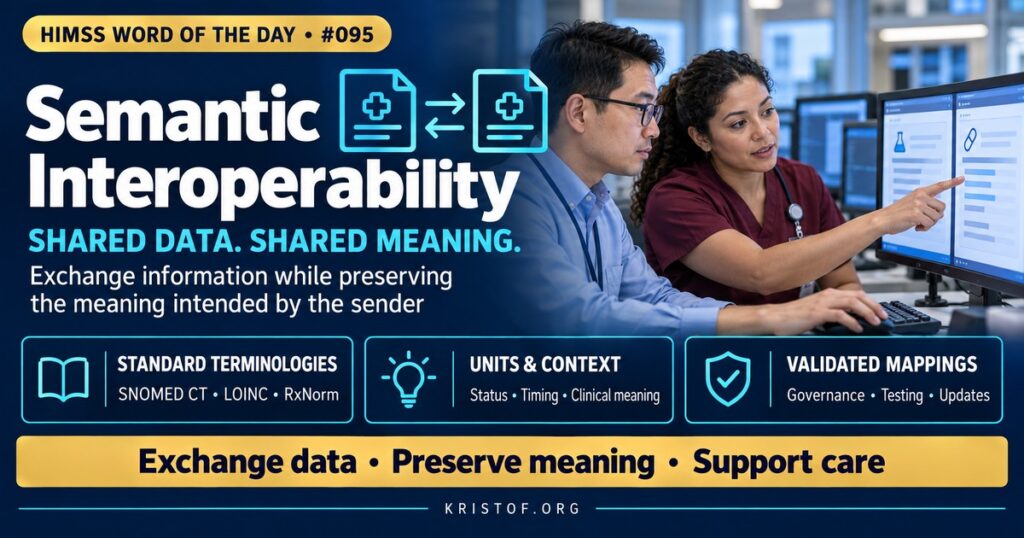
Semantic interoperability is the ability of different systems to exchange information so that the receiving system understands it in exactly the way the sender meant. It goes beyond moving data: the meaning of each data element must survive the trip.
The HIMSS Dictionary describes semantic interoperability as providing common underlying models and coding of data, including data elements whose definitions come from public, standardized value sets and code systems, so that users share an understanding of what the data means. It refers readers to the broader term interoperability.
HIMSS commonly describes interoperability in four levels:
| Level | What It Ensures | Example |
|---|---|---|
| Foundational | Data can be sent and received | One system can transmit a file to another |
| Structural | The format and organization of the data are understood | Fields in an HL7 message or FHIR resource are in the expected places |
| Semantic | The meaning of the data is shared | A LOINC-coded potassium result with standard units is understood as potassium |
| Organizational | Governance, policy, legal, and workflow support exchange | Data use agreements, consent policies, and processes for acting on received data |
⚠️ Exam Alert: Structural interoperability is about format and syntax. Semantic interoperability is about meaning, achieved through standard terminologies, value sets, and information models. A message can be structurally perfect and semantically meaningless if it uses local codes the receiver does not recognize. Questions often describe a scenario and ask which level is missing.
🌐 Why It Matters: Real-World Healthcare IT Context
Exchange without shared meaning creates risk. If a receiving system cannot recognize an incoming allergy code, it may store the allergy as text that never triggers an alert. If a lab result arrives with different units than the receiver expects, a normal value may look dangerous or a dangerous value may look normal. If a medication is identified by a local product code, the receiving system may be unable to check it for interactions.
Standard terminologies provide the shared vocabulary: SNOMED CT for clinical concepts such as problems and findings, LOINC for laboratory tests and observations, RxNorm for medications, and others for specific domains. Value sets define which codes may be used for a particular data element, and information models such as FHIR resources define how data elements relate to one another.
U.S. policy builds semantic interoperability into certification and exchange. USCDI specifies data classes and elements with associated vocabulary standards, and certified EHRs must support them. National exchange frameworks and quality reporting programs depend on the same shared definitions.
Quality measurement is a clear example of semantic interoperability at work. Electronic clinical quality measures define their logic using value sets drawn from standard terminologies. If a hospital records diabetes, a medication, or a lab test using codes outside those value sets, the measure cannot recognize the data, and patients who received the right care appear as failures. The same principle applies to registries, research networks, and public health reporting.
Even with standards, meaning can be lost. Different organizations may choose different codes for the same concept, map local terms imperfectly, or record context, such as whether a condition is current or historical, inconsistently. Achieving true semantic interoperability requires ongoing governance, mapping, and testing, not just adopting a standard.
Artificial intelligence raises the stakes further. Models trained on data from one organization assume that codes and units mean the same thing everywhere they are deployed. When semantics differ, a model may quietly misinterpret inputs. Shared meaning is therefore a prerequisite not only for exchange but for safe use of analytics and AI across organizations.
Where meaning gets lost:
- Local codes without mappings to standard terminologies
- Inconsistent units of measure
- Missing context, such as negation, status, or timing
- Different granularity, where one system is far more specific than another
- Free-text entries that receiving systems cannot interpret
- Outdated terminology versions on either side of an exchange
What supports semantic interoperability:
- Standard terminologies behind clinical picklists and results
- Shared value sets for specific uses, such as quality measures
- Common information models such as FHIR and USCDI
- Terminology services and governed mapping
- Testing exchanges with real data, not just sample messages
- Organizational agreements that define expectations for data
🏥 The Nurse’s Perspective: Clinical, Bedside, & Workflow
Semantic interoperability shows up at the bedside whenever information from another organization appears in the chart.
At the Bedside
When a patient arrives from another hospital, incoming allergies, medications, and problems may appear for reconciliation. If those items are coded, the EHR can often match them to local equivalents and run safety checks. If they arrive as free text, the nurse and pharmacist must interpret them manually. Recognizing the difference helps nurses know when extra verification is needed.
Lab results from outside sources need the same attention. Checking units and reference ranges on outside results, especially when values seem surprising, prevents misinterpretation.
Medication reconciliation shows the benefit clearly. When outside medications arrive with standard RxNorm codes, the EHR can match them to local formulary items and check doses and interactions automatically, leaving nurses and pharmacists to focus on clinical questions rather than translation.
In Clinical Workflow
Nursing documentation contributes to shared meaning. Choosing coded options for allergies, reactions, vital signs, and assessments, rather than typing free text, allows information to be exchanged and understood by other organizations, registries, and quality programs.
Care transitions depend on semantic interoperability as well. A discharge summary sent to a skilled nursing facility is most useful when its medication list, problems, and allergies can be imported directly rather than retyped, reducing transcription errors.
In EHR Implementation (Go-Live Perspective)
During an Epic implementation, terminology mapping is a large but often invisible task. Local lab codes, medication records, and allergy lists from the legacy system must be mapped to standard codes so that historical data remains meaningful and exchange partners can interpret new data.
At-the-elbow support analysts may hear that outside information appears as text rather than coded data, or that certain results do not trend with local results. Reporting specific examples helps terminology and integration teams improve mappings.
🎓 CAHIMS / CPHIMS & HIMSS Perspective
CAHIMS Exam Domain Mapping
Semantic interoperability is a core interoperability concept:
| CAHIMS Domain | How Semantic Interoperability Appears |
|---|---|
| Healthcare & Technology Environments | Levels of interoperability; national standards and USCDI |
| Clinical Informatics | Reconciliation of outside data; coded documentation; safety checks |
| Healthcare Information & Systems Management | Terminologies, value sets, mapping, information models, testing |
| Management & Leadership | Data governance, exchange agreements, standards strategy |
Key Terms to Know Alongside Semantic Interoperability
- Structural Interoperability — exchange in which the format and organization of data are understood
- Foundational Interoperability — the basic ability to send and receive data between systems
- Value Set — a defined list of codes allowed for a specific data element or purpose
- Information Model — a structure defining data elements and their relationships
- Terminology Mapping — linking local terms to standard codes
- USCDI — the U.S. Core Data for Interoperability, a standardized set of data classes and elements for exchange
HIMSS Organizational Position
HIMSS has long promoted interoperability as a core priority and describes it across foundational, structural, semantic, and organizational levels, supporting standards adoption and governance needed to make exchanged data meaningful. Members can find related education and research through the HIMSS Resource Center.
🔗 Explore Further: External References
- ONC — Interoperability https://healthit.gov/interoperability/
- ONC — United States Core Data for Interoperability (USCDI) https://isp.healthit.gov/united-states-core-data-interoperability-uscdi
- NLM — Unified Medical Language System (UMLS) https://www.nlm.nih.gov/research/umls/index.html
- NLM — SNOMED CT (United States) https://www.nlm.nih.gov/healthit/snomedct/index.html
- Regenstrief Institute — LOINC https://www.regenstrief.org/real-world-solutions/loinc/
- HL7 — FHIR Terminologies https://hl7.org/fhir/terminologies.html
Term source: HIMSS Dictionary of Health Information and Technology Terms, Acronyms, and Organizations, 6th Edition (2025). All definitions in this series are paraphrased for editorial purposes. Readers are encouraged to consult the primary source for exact language.
Eric Andrew Kristof, RN, CAHIMS is a Healthcare IT professional and HIMSS Arkansas Chapter member based in Hot Springs Village, AR, with hands-on Epic Go-Live experience and a diverse healthcare and IT background. He writes at kristof.org at the intersection of clinical care and healthcare technology.
Leave a Reply