By Eric Andrew Kristof, RN, CAHIMS | Healthcare IT Professional | HIMSS Arkansas Chapter Member
About This Series: The HIMSS Word of the Day is a running blog series drawing from the HIMSS Dictionary of Health Information and Technology Terms, Acronyms, and Organizations, 6th Edition (2025) — the authoritative reference for healthcare IT professionals and the primary study resource for CAHIMS and CPHIMS certification. Each post paraphrases the term in plain language, grounds it in real-world healthcare IT context, and adds a bedside nursing perspective you won’t find in a textbook.
📖 The Term: Value Stream Mapping (VSM)
Source: HIMSS Dictionary of Health Information and Technology Terms, Acronyms, and Organizations, 6th Edition (2025)
🔍 Plain-Language Definition
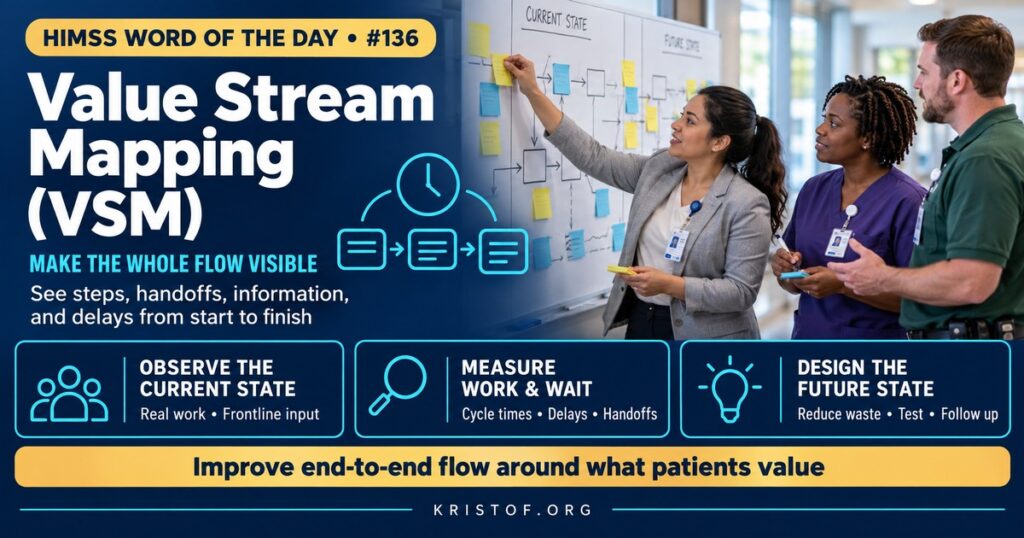
Value stream mapping (VSM) is a Lean improvement technique that visually documents all the steps, information flows, wait times, and handoffs needed to deliver a product or service from beginning to end, so teams can identify waste and design a better process.
The HIMSS Dictionary describes VSM as a Lean manufacturing or Lean enterprise method for documenting, analyzing, and improving the flow of materials or information needed to produce a product or service. It gives the example of a hospital using value stream mapping to find and remove waste so its processes become more efficient and profitable.
| VSM Element | What It Shows | Healthcare Example |
|---|---|---|
| Process Steps | Each activity in the flow | Triage, registration, provider exam, lab draw, admission order |
| Information Flow | How requests and data move | Orders, pages, bed requests, EHR status updates |
| Wait Time | Delays between steps | Time waiting for a bed after the admission decision |
| Cycle Time | Time to complete a step | Minutes to clean and turn over a room |
| Value-Added Time | Time that directly benefits the patient | Assessment, treatment, education |
| Future State | The redesigned process | Bed cleaning triggered automatically at discharge |
⚠️ Exam Alert: Value stream mapping covers an end-to-end flow, including information and wait times. A process map or flowchart shows steps and decisions but may not quantify time or waste. Lean focuses on removing waste and improving flow; Six Sigma focuses on reducing variation and defects. Value-added means the customer, or patient, would value the step.
🌐 Why It Matters: Real-World Healthcare IT Context
Healthcare processes often span many departments, and no single person sees the whole picture. A patient moving from the emergency department to an inpatient bed may pass through registration, triage, testing, consults, bed management, environmental services, transport, and nursing handoff. Delays in any step affect everyone downstream.
VSM brings the people who do the work together to map what actually happens, not what the policy says should happen. Teams typically walk the process, observe steps, measure times, and record handoffs and information flows. The resulting current state map often reveals that most of the elapsed time is waiting rather than value-added care.
Lean thinking identifies several types of waste, such as waiting, unnecessary motion, transportation, overprocessing, excess inventory, defects, and overproduction. Many organizations also add unused human talent. In healthcare, these appear as patients waiting for results, nurses walking to find supplies, duplicate documentation, and errors that require rework.
After analyzing the current state, teams design a future state map that removes waste and improves flow, then plan changes and measure results. Improvement events, often called Kaizen events, may follow to implement specific changes.
VSM is valuable in health IT work. Before automating a process, mapping it helps avoid simply digitizing inefficiency. EHR implementations, order set redesign, discharge workflows, and interface projects benefit from understanding where information flows break down. Electronic data such as timestamps can also help measure steps more precisely than manual observation.
Evidence is mixed but encouraging. Reviews of VSM in healthcare have found it widely applied, especially to patient flow and laboratory or pharmacy processes, with many reports of reduced waiting times. However, study designs are often limited, and sustaining improvements depends on leadership support and ongoing measurement.
Culture matters. VSM works best when staff feel safe pointing out problems and when leaders act on what the map shows. When mapping becomes a one-time exercise without follow-through, staff may lose trust in improvement efforts.
Common VSM pitfalls:
- Mapping the ideal process instead of the real one
- Excluding frontline staff from mapping sessions
- Scope too large to analyze meaningfully
- No time measurements, only process steps
- Future state designs never implemented
- Improvements not sustained or measured over time
What makes VSM effective:
- Direct observation of the actual process
- Multidisciplinary teams that include frontline staff
- Clear scope with defined start and end points
- Measured cycle times and wait times
- Leadership commitment to act on findings
- Follow-up measurement and adjustment
🏥 The Nurse’s Perspective: Clinical, Bedside, & Workflow
Nurses are often at the center of the value streams that hospitals try to improve, and their insight is essential.
At the Bedside
Nurses experience the effects of process waste every shift: searching for supplies, waiting for medications from pharmacy, repeating information already documented elsewhere, or tracking down missing equipment. These experiences are exactly what VSM is designed to reveal.
Participating in mapping sessions allows nurses to describe real workflows, including workarounds that never appear in policies. That honesty makes future state designs more realistic.
In Clinical Workflow
Patient flow projects often involve admissions, transfers, and discharges. Nurses can identify delays such as waiting for transport, late discharge orders, incomplete medication reconciliation, or beds that are clean but not marked available in the system.
Discharge processes are a common VSM target. Mapping steps from the discharge decision to the patient leaving can show how education, prescriptions, transportation, and documentation could happen in parallel rather than sequence.
Nurse leaders and informaticists can use EHR timestamps and reports to measure process times, supplementing direct observation and tracking whether improvements last.
Respecting staff time is part of the value stream. Reducing nonvalue-added work, such as duplicate charting or unnecessary steps, frees nurses for patient care and reduces frustration.
In EHR Implementation (Go-Live Perspective)
Before an Epic Go-Live, workflow analysts often map current state processes and design future state workflows that the new system will support. VSM principles help ensure that the new build eliminates waste rather than recreating it.
At-the-elbow support analysts see new bottlenecks quickly after Go-Live, such as tasks routed to the wrong role or steps that now take longer. Capturing these observations supports rapid optimization and can feed later value stream mapping events.
🎓 CAHIMS / CPHIMS & HIMSS Perspective
CAHIMS Exam Domain Mapping
Value stream mapping appears in process improvement and project management questions:
| CAHIMS Domain | How VSM Appears |
|---|---|
| Healthcare & Technology Environments | Lean in healthcare; quality improvement methods |
| Clinical Informatics | Workflow analysis, current and future state design, patient flow |
| Healthcare Information & Systems Management | Requirements gathering, workflow redesign before automation, process metrics |
| Management & Leadership | Change management, improvement culture, operational efficiency |
Key Terms to Know Alongside VSM
- Lean — an improvement approach focused on maximizing value and eliminating waste
- Waste — any activity that consumes resources without adding value for the patient
- Current State Map — a map of how a process works today
- Future State Map — a map of the redesigned, improved process
- Kaizen — continuous improvement, often through focused improvement events
- Six Sigma — an improvement approach focused on reducing variation and defects
HIMSS Organizational Position
HIMSS supports workflow analysis and process improvement as essential to successful health IT through education, research, and its CPHIMS certification, which covers systems analysis and design. Members can find related education and research through the HIMSS Resource Center.
🔗 Explore Further: External References
- Lean Enterprise Institute — Value Stream Mapping https://www.lean.org/lexicon-terms/value-stream-mapping/
- Marin-Garcia et al. (2021), International Journal of Environmental Research and Public Health — The Role of Value Stream Mapping in Healthcare Services: A Scoping Review https://pubmed.ncbi.nlm.nih.gov/33499116/
- Nowak et al. (2017), Systematic Reviews — Does Value Stream Mapping Affect the Structure, Process, and Outcome Quality in Care Facilities? A Systematic Review https://pubmed.ncbi.nlm.nih.gov/28838320/
- Institute for Healthcare Improvement https://www.ihi.org/
- Gellad and Day (2016), American Journal of Gastroenterology — What Is Value Stream Mapping, and How Can It Help My Practice? https://pubmed.ncbi.nlm.nih.gov/26925882/
- HIMSS — Certifications (CAHIMS and CPHIMS) https://www.himss.org/certifications
Term source: HIMSS Dictionary of Health Information and Technology Terms, Acronyms, and Organizations, 6th Edition (2025). All definitions in this series are paraphrased for editorial purposes. Readers are encouraged to consult the primary source for exact language.
Eric Andrew Kristof, RN, CAHIMS is a Healthcare IT professional and HIMSS Arkansas Chapter member based in Hot Springs Village, AR, with hands-on Epic Go-Live experience and a diverse healthcare and IT background. He writes at kristof.org at the intersection of clinical care and healthcare technology.
Leave a Reply