By Eric Andrew Kristof, RN, CAHIMS | Healthcare IT Professional | HIMSS Arkansas Chapter Member
About This Series: The HIMSS Word of the Day is a running blog series drawing from the HIMSS Dictionary of Health Information and Technology Terms, Acronyms, and Organizations, 6th Edition (2025) — the authoritative reference for healthcare IT professionals and the primary study resource for CAHIMS and CPHIMS certification. Each post paraphrases the term in plain language, grounds it in real-world healthcare IT context, and adds a bedside nursing perspective you won’t find in a textbook.
📖 The Term: Master Patient Index (MPI)
Source: HIMSS Dictionary of Health Information and Technology Terms, Acronyms, and Organizations, 6th Edition (2025)
🔍 Plain-Language Definition
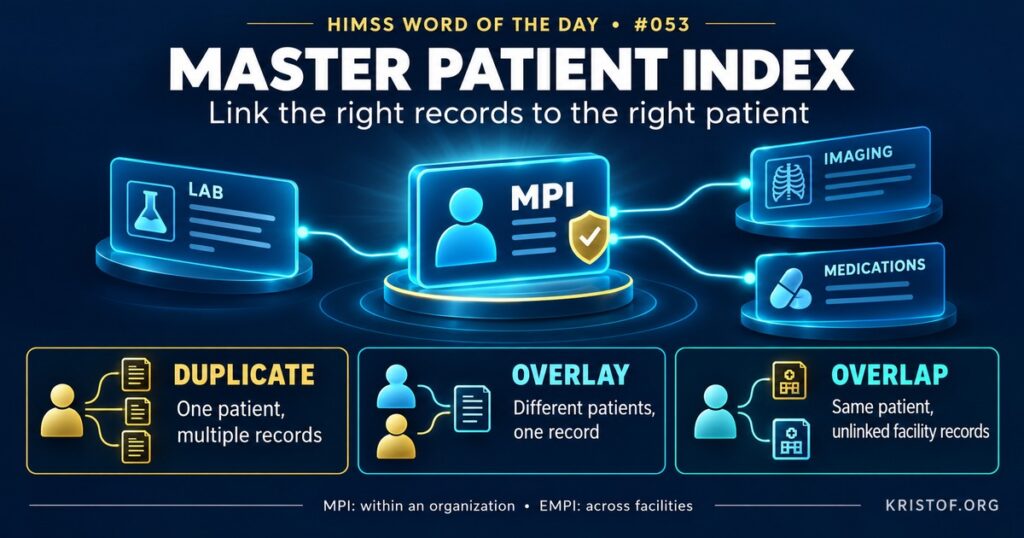
A master patient index (MPI) is the master list an organization uses to identify each patient and to connect all of that patient’s records, so that a lab result, an x-ray, and a medication list all attach to the same person.
The HIMSS Dictionary describes the MPI as the tool that supports identifying patients and linking their clinical information within one institution. It adds that an index covering several institutions is sometimes called an enterprise master patient index (EMPI). The Dictionary also makes a subtle point: the MPI is not itself a strategy for managing patient identity. It is the information structure in which identity strategies are carried out. Most MPIs use a matching algorithm to find likely matches and then assign a unique identifier that follows the patient going forward.
| Concept | What It Means | Example |
|---|---|---|
| MPI | Patient index for a single organization or system | A hospital’s registration database of patients and medical record numbers |
| EMPI | Index spanning multiple facilities or systems | A health system linking records from hospitals, clinics, and labs |
| Duplicate | One patient with two or more records | A patient registered twice under slightly different names |
| Overlay | Two patients’ information combined in one record | One patient’s results filed into another patient’s chart |
| Overlap | One patient with records in different facilities that are not linked | Records in two hospitals of the same system that were never connected |
⚠️ Exam Alert: The MPI is the index that links records to a patient. A medical record number (MRN) is an identifier the MPI assigns or tracks. Patient matching is the process of deciding whether two records belong to the same person. A duplicate is a false negative (the system failed to match), while an overlay is a false positive (the system matched two different people). Overlays are usually considered the more dangerous error.
🌐 Why It Matters: Real-World Healthcare IT Context
Patient identity is the foundation of every other function in the EHR. Medication orders, allergy alerts, imaging comparisons, and clinical decision support all assume that the record in front of the clinician belongs to the patient in front of the clinician.
Matching is harder than it sounds. Names are misspelled, people change names, addresses change, birthdates are entered incorrectly, and some patients arrive without identification. A 2016 study in Perspectives in Health Information Management by Beth Haenke Just and colleagues examined nearly 400,000 records with confirmed duplicates. Middle name was the field most often mismatched, followed by Social Security number, and many name mismatches came from simple misspellings.
MPIs use several matching approaches:
- Deterministic matching requires exact agreement on selected fields, such as name and date of birth.
- Probabilistic matching weighs agreement across many fields and assigns a likelihood score.
- Referential matching compares records against an external reference database of identities.
The United States has no national patient identifier, and a long-standing appropriations restriction has kept HHS from spending funds to adopt one. As a result, organizations rely on demographic matching. ONC has supported efforts to improve data quality for matching, including standardizing how addresses are recorded through Project US@ and including patient demographics in USCDI.
Common causes of identity errors:
- Typing errors and inconsistent name formats at registration
- Temporary names for unidentified trauma patients and newborns
- Missing or outdated addresses and phone numbers
- Matching thresholds set too loosely, creating overlays
- Mergers and system conversions that combine separate indexes
- Interfaces that create new patients instead of matching existing ones
Characteristics of strong identity management:
- Standardized registration procedures and data entry formats
- Well-tuned matching algorithms with human review of uncertain matches
- Regular duplicate monitoring and timely merges by health information management
- Photo capture or biometric verification at registration where appropriate
- Clear processes for correcting overlays and notifying affected clinicians
- Identity cleanup before system conversions
🏥 The Nurse’s Perspective: Clinical, Bedside, & Workflow
Nurses are the last checkpoint between a patient’s identity in the system and the patient in the bed.
At the Bedside
Using two patient identifiers before medications, procedures, and specimen collection protects against wrong-patient care, but it depends on the wristband and the record being correct to begin with. When a patient says “that is not my medication” or “I have never had that surgery,” the cause may be an overlay or a mismatched record, and the nurse should stop and escalate rather than assume the patient is confused.
Trauma and newborn care involve temporary identities. Unidentified patients are often registered under a placeholder name, and newborns may be registered before they are named. Nurses help make sure records are updated and linked correctly once the real identity is known.
In Clinical Workflow
Signs of a duplicate record include missing allergies, a history that seems incomplete, or results the patient insists were done that do not appear in the chart. Nurses who notice those signs can alert registration or health information management so the records can be reviewed and merged if appropriate.
Specimen labeling is another identity-critical task. A mislabeled specimen can attach a result to the wrong patient, and correcting it later is difficult. Labeling at the bedside, after scanning the patient’s wristband, reduces that risk.
In EHR Implementation (Go-Live Perspective)
Before an Epic Go-Live, organizations typically clean up the legacy MPI: identifying and resolving duplicates so they are not carried into the new system. During conversion, patient identity data must be loaded accurately so that historical results and documents link to the right new records.
After Go-Live, new registration workflows and interfaces can create duplicates if they are not configured carefully. At-the-elbow support analysts often see this as “the patient’s history is missing” or “the patient shows up twice in the lookup.” Reporting these quickly to health information management helps prevent documentation from splitting across records.
🎓 CAHIMS / CPHIMS & HIMSS Perspective
CAHIMS Exam Domain Mapping
The MPI appears in data integrity, interoperability, and safety questions:
| CAHIMS Domain | How the MPI Appears |
|---|---|
| Healthcare & Technology Environments | Absence of a national patient identifier; federal patient matching initiatives |
| Clinical Informatics | Patient identification practices; wrong-patient errors; specimen labeling |
| Healthcare Information & Systems Management | Matching algorithms, EMPI architecture, interfaces, data conversion, duplicate management |
| Management & Leadership | Data governance for identity, registration training, HIM staffing, merger integration |
Key Terms to Know Alongside MPI
- EMPI (Enterprise Master Patient Index) — an index that links patient records across multiple facilities or systems
- Patient Matching — determining whether records from different sources refer to the same individual
- Duplicate Record — a second record created for a patient who already has one
- Overlay — a record that incorrectly contains information belonging to two different people
- Probabilistic Matching — a method that scores the likelihood that records match based on several weighted fields
- Medical Record Number (MRN) — the identifier an organization assigns to a patient’s record
HIMSS Organizational Position
HIMSS has long identified accurate patient identification and matching as essential to patient safety and interoperability, and it engages on federal policy related to patient identity through its public policy work. Members can find related education and research through the HIMSS Resource Center.
🔗 Explore Further: External References
- ONC — Patient Identity and Patient Record Matching https://healthit.gov/standards-and-technology/patient-identity-and-patient-record-matching/
- ONC — Patient Matching Resources https://healthit.gov/resources/patient-matching/
- Just et al. (2016), Perspectives in Health Information Management — Why Patient Matching Is a Challenge https://pubmed.ncbi.nlm.nih.gov/27134610/
- ONC — United States Core Data for Interoperability (USCDI) https://isp.healthit.gov/united-states-core-data-interoperability-uscdi
- The Sequoia Project https://sequoiaproject.org/
- AHIMA — American Health Information Management Association https://www.ahima.org/
Term source: HIMSS Dictionary of Health Information and Technology Terms, Acronyms, and Organizations, 6th Edition (2025). All definitions in this series are paraphrased for editorial purposes. Readers are encouraged to consult the primary source for exact language.
Eric Andrew Kristof, RN, CAHIMS is a Healthcare IT professional and HIMSS Arkansas Chapter member based in Hot Springs Village, AR, with hands-on Epic Go-Live experience and a diverse healthcare and IT background. He writes at kristof.org at the intersection of clinical care and healthcare technology.
Leave a Reply