By Eric Andrew Kristof, RN, CAHIMS | Healthcare IT Professional | HIMSS Arkansas Chapter Member
About This Series: The HIMSS Word of the Day is a running blog series drawing from the HIMSS Dictionary of Health Information and Technology Terms, Acronyms, and Organizations, 6th Edition (2025) — the authoritative reference for healthcare IT professionals and the primary study resource for CAHIMS and CPHIMS certification. Each post paraphrases the term in plain language, grounds it in real-world healthcare IT context, and adds a bedside nursing perspective you won’t find in a textbook.
📖 The Term: Digital Therapeutics (DTx)
Source: HIMSS Dictionary of Health Information and Technology Terms, Acronyms, and Organizations, 6th Edition (2025)
🔍 Plain-Language Definition
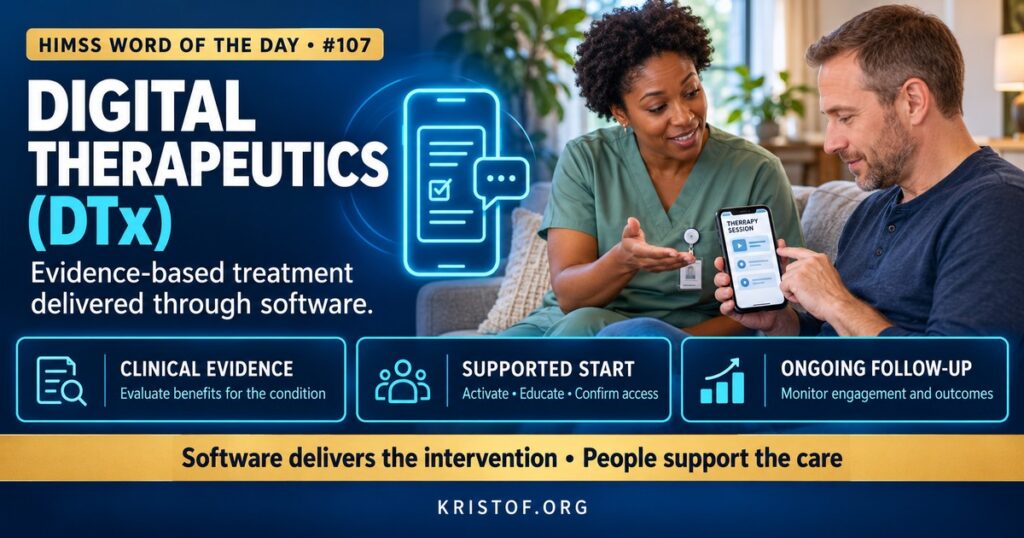
Digital therapeutics (DTx) are software-based interventions designed to prevent, manage, or treat a medical disorder or disease. Many deliver behavioral therapies, such as cognitive behavioral therapy, through an app, while others use games, sensors, or guided programs to produce a clinical effect.
The HIMSS Dictionary describes digital therapeutics as a class of digital tools that help people make positive, lasting behavior changes, and notes that their effect can rival, and sometimes exceed, that of medication.
The key distinction is evidence and intended use. A general wellness app encourages healthy habits; a digital therapeutic makes a claim about treating or managing a condition and is expected to show clinical evidence for that claim.
| Category | Purpose | Regulatory Status |
|---|---|---|
| General Wellness App | Encourages healthy lifestyle without disease claims | Generally outside FDA device oversight |
| Digital Health Support Tool | Helps track symptoms, medications, or appointments | Varies; often not regulated as a device |
| Digital Therapeutic | Delivers an intervention intended to treat or manage a condition | Often regulated as software as a medical device |
| Prescription Digital Therapeutic | A digital therapeutic available only with a clinician’s prescription | FDA-cleared or authorized for a specific indication |
⚠️ Exam Alert: Digital therapeutics treat or manage a condition with evidence-based software. mHealth is the broad use of mobile technology for health. Remote patient monitoring collects data for clinicians to review. Software as a Medical Device (SaMD) is the regulatory category that many digital therapeutics fall into. A wellness app becomes a regulated device when it makes disease-related claims.
🌐 Why It Matters: Real-World Healthcare IT Context
Digital therapeutics aim to extend evidence-based care beyond clinic walls. Behavioral therapies, for example, can be hard to access because of clinician shortages, cost, and travel. Software that delivers structured therapy at home may reach more patients and support adherence between visits.
Regulation follows intended use. FDA has authorized a number of digital therapeutics as medical devices, including software for substance use disorder treatment and a video game-based treatment for attention deficit hyperactivity disorder in children, typically through De Novo or 510(k) pathways. FDA’s Software as a Medical Device framework guides how these products are evaluated.
Payment has been a major barrier. Medicare took a step in its 2025 physician fee schedule by creating codes for digital mental health treatment devices. According to analyses of the final rule, the codes cover supplying FDA-cleared or authorized devices for mental or behavioral health treatment and the associated treatment management time, used alongside ongoing care from a billing practitioner. Coverage by other payers varies widely.
Clinical integration is still developing. Prescribing a digital therapeutic may involve sending a prescription to a specialty pharmacy or vendor platform, receiving an activation code, and monitoring progress in a separate dashboard. When those steps are not connected to the EHR, prescriptions can stall and clinicians may never see whether patients engaged. Integration of ordering and progress data into clinical workflows is one of the main factors that determines whether digital therapeutics become part of routine care.
Questions remain. Evidence quality differs across products, and real-world engagement often drops after the first weeks. Digital therapeutics require a smartphone or computer, reliable internet, and digital skills, which can widen disparities if alternatives are not offered. Data privacy matters too, especially when products are offered directly to consumers outside HIPAA-covered relationships.
Common challenges with digital therapeutics:
- Low long-term engagement after initial enthusiasm
- Uneven evidence quality across products
- Limited and inconsistent insurance coverage
- Integration with EHR workflows for prescribing and monitoring
- Digital access and literacy barriers
- Privacy practices that vary by vendor
Evaluation should include outcomes that matter to patients. Engagement statistics alone do not show benefit; organizations should look for improvements in symptoms, function, and quality of life, as well as effects on utilization.
What supports successful use:
- Selecting products with strong clinical evidence for the intended population
- Clear prescribing, onboarding, and follow-up workflows
- Integration of progress data into clinician workflows where possible
- Patient education and support for technical setup
- Monitoring engagement and outcomes over time
- Attention to equity, accessibility, and privacy
🏥 The Nurse’s Perspective: Clinical, Bedside, & Workflow
Nurses often determine whether a patient actually starts and sticks with a digital therapeutic.
At the Bedside
When a provider prescribes a digital therapeutic, nurses frequently help with onboarding: explaining what the program does, helping download and activate it, setting expectations about time commitment, and confirming the patient can use the device. A patient who leaves without a working login is unlikely to begin.
Nurses also assess fit. A patient with limited vision, low digital literacy, unreliable internet, or no private space may struggle with an app-based therapy, and raising those concerns early allows the team to consider alternatives or support.
Patient preference matters as well. Some patients welcome an app-based program they can use privately at any hour, while others prefer in-person therapy. Offering choices, rather than replacing human care, respects those differences.
In Clinical Workflow
Follow-up matters. Behavioral health nurses, care managers, and primary care nurses may review engagement reports, contact patients who have stopped using a program, and reinforce progress. That follow-up is part of what distinguishes a prescribed digital therapeutic from an app downloaded and forgotten.
Medication and symptom monitoring continue alongside digital therapy. A patient using a digital therapeutic for a substance use disorder or depression still needs clinical assessment, and nurses watch for warning signs that require escalation.
In EHR Implementation (Go-Live Perspective)
Digital therapeutics are usually added after core EHR implementation, but Go-Live planning can include how prescriptions for digital products are ordered, how activation codes are delivered, and where engagement data appears.
At-the-elbow support analysts may help clinicians find ordering pathways for digital therapies and locate any integrated progress reports. Clear workflows prevent prescriptions from stalling between the clinic and the vendor.
🎓 CAHIMS / CPHIMS & HIMSS Perspective
CAHIMS Exam Domain Mapping
Digital therapeutics appear in connected health and regulatory questions:
| CAHIMS Domain | How Digital Therapeutics Appear |
|---|---|
| Healthcare & Technology Environments | FDA regulation of software; reimbursement trends; consumer health |
| Clinical Informatics | Prescribing, onboarding, and monitoring workflows; patient engagement |
| Healthcare Information & Systems Management | Integration of app data, identity, security, vendor platforms |
| Management & Leadership | Evidence evaluation, payer strategy, equity, privacy |
Key Terms to Know Alongside Digital Therapeutics
- Software as a Medical Device (SaMD) — software intended for a medical purpose that operates without being part of a hardware device
- Prescription Digital Therapeutic — a digital therapeutic available only with a clinician’s prescription
- De Novo Classification — an FDA pathway for novel low- to moderate-risk devices without a predicate
- General Wellness Product — a low-risk product intended only to support a healthy lifestyle
- mHealth — the use of mobile devices to support health and healthcare
- Engagement — the extent to which patients actively use a digital intervention over time
HIMSS Organizational Position
HIMSS addresses digital therapeutics through its work on digital health, virtual care, and connected health, including its Virtual Care Community. Members can find related education and research through the HIMSS Resource Center.
🔗 Explore Further: External References
- Digital Therapeutics Alliance https://dtxalliance.org/
- FDA — Software as a Medical Device (SaMD) https://www.fda.gov/medical-devices/digital-health-center-excellence/software-medical-device-samd
- FDA — General Wellness: Policy for Low Risk Devices https://www.fda.gov/regulatory-information/search-fda-guidance-documents/general-wellness-policy-low-risk-devices
- FDA — Digital Health Center of Excellence https://www.fda.gov/medical-devices/digital-health-center-excellence
- CMS — Physician Fee Schedule https://www.cms.gov/medicare/payment/fee-schedules/physician
- HIMSS — Virtual Care Community https://www.himss.org/networking/communities/virtual-care/
Term source: HIMSS Dictionary of Health Information and Technology Terms, Acronyms, and Organizations, 6th Edition (2025). All definitions in this series are paraphrased for editorial purposes. Readers are encouraged to consult the primary source for exact language.
Eric Andrew Kristof, RN, CAHIMS is a Healthcare IT professional and HIMSS Arkansas Chapter member based in Hot Springs Village, AR, with hands-on Epic Go-Live experience and a diverse healthcare and IT background. He writes at kristof.org at the intersection of clinical care and healthcare technology.
Leave a Reply