By Eric Andrew Kristof, RN, CAHIMS | Healthcare IT Professional | HIMSS Arkansas Chapter Member
About This Series: The HIMSS Word of the Day is a running blog series drawing from the HIMSS Dictionary of Health Information and Technology Terms, Acronyms, and Organizations, 6th Edition (2025) — the authoritative reference for healthcare IT professionals and the primary study resource for CAHIMS and CPHIMS certification. Each post paraphrases the term in plain language, grounds it in real-world healthcare IT context, and adds a bedside nursing perspective you won’t find in a textbook.
📖 The Term: Direct Project (Direct Secure Messaging)
Source: HIMSS Dictionary of Health Information and Technology Terms, Acronyms, and Organizations, 6th Edition (2025)
🔍 Plain-Language Definition
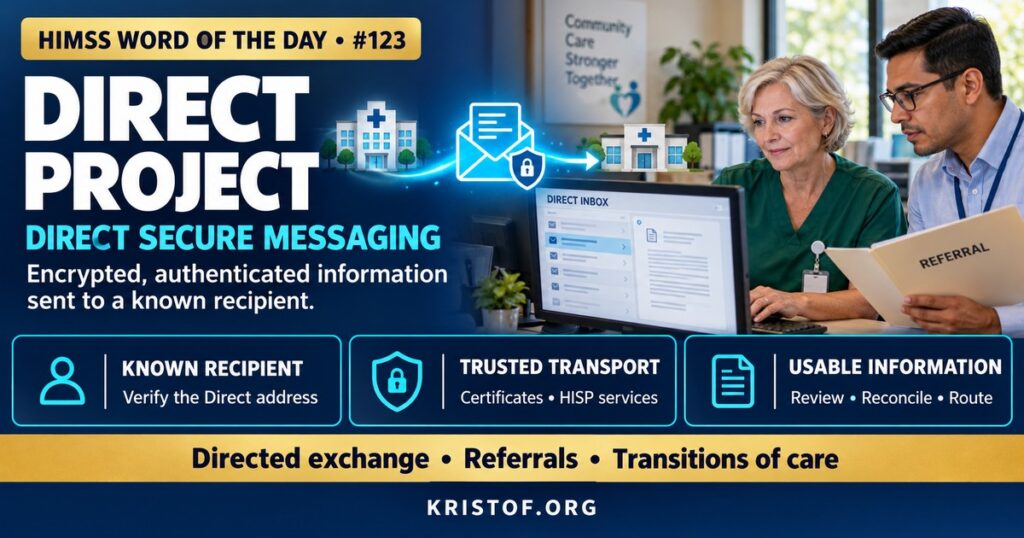
The Direct Project produced specifications for Direct secure messaging, a method for sending health information over the internet to known, trusted recipients in an encrypted, authenticated way. Direct works much like secure email between healthcare participants.
The HIMSS Dictionary explains that the Direct Project began in March 2010 as part of the Nationwide Health Information Network effort. Its goal was a simple, secure, scalable, standards-based approach for sending authenticated, encrypted health information to known, trusted recipients over the internet. The dictionary notes that participants included EHR and PHR vendors, healthcare organizations, federal and state agencies, and HIE organizations, and it names two core specifications: the Applicability Statement for Secure Health Transport, plus a companion specification covering XDR and XDM packaging for Direct.
| Direct Concept | What It Means | Example |
|---|---|---|
| Direct Address | An email-style address for a provider or organization | A practice’s address used to receive referrals |
| HISP (Health Information Service Provider) | The service that sends and receives Direct messages | An EHR vendor or HIE operating the messaging service |
| Certificates | Digital credentials used to encrypt and sign messages | Confirming that a message came from a trusted hospital |
| Trust Anchor / Trust Bundle | Shared lists of trusted certificate authorities | Allowing HISPs in a trust community to exchange messages |
| Attachments | Clinical documents carried in messages | A C-CDA discharge summary sent to a primary care office |
⚠️ Exam Alert: Direct is push-based directed exchange: a sender sends information to a known recipient. Query-based exchange lets a provider search for and retrieve records. FHIR APIs allow applications to request specific data. Direct messages are not regular email; they require Direct addresses and trusted certificates.
🌐 Why It Matters: Real-World Healthcare IT Context
For years, care transitions often depended on fax and phone. A hospital discharging a patient might fax a summary to a primary care office, where it could be misfiled or never reach the clinician. Direct offered a secure electronic alternative that most organizations could adopt without building complex infrastructure.
ONC describes directed exchange as the ability to send information such as laboratory orders and results, referrals, and discharge summaries directly to another care professional. Direct became the most common way to perform directed exchange because its model is familiar: one participant sends, another receives.
Federal programs drove adoption. The ONC Health IT Certification Program includes a Direct Project criterion, and earlier EHR incentive program requirements encouraged providers to send summary of care documents electronically during transitions. As a result, Direct capability became standard in certified EHRs.
Trust is central to Direct. Each organization needs certificates, and HISPs must agree to trust one another. Trust frameworks and accreditation programs, including those operated by the nonprofit DirectTrust, help organizations establish confidence that participants are verified and secure, so messages can flow across vendors and networks.
Direct has limits. It depends on knowing the recipient’s Direct address, and provider directories have often been incomplete or outdated. Attachments may arrive as documents that recipients must review and reconcile manually. Direct does not let a clinician search for records on a patient they have not received information about, which is where query-based exchange and networks such as those under TEFCA help.
Patients can participate too. Some patient-facing applications and personal health records have supported Direct addresses, allowing individuals to receive copies of their records or forward them to new providers, although portal downloads and FHIR-based apps are now more common ways for patients to access their information.
Even as FHIR APIs and national networks grow, Direct remains useful for referrals, transitions of care, public health reporting in some programs, and communication with organizations that lack other connections.
Security practices still matter. Because Direct uses encryption and certificates, it protects messages in transit, but organizations must still manage who can send from each address, monitor for misdirected messages, and maintain certificates before they expire.
Common Direct challenges:
- Missing or outdated Direct addresses in directories
- Messages routed to general inboxes instead of the right clinician
- Large attachments that are hard to review
- Manual reconciliation of incoming information
- Confusion between Direct and regular email
- Varying adoption among post-acute and community providers
Strengths of Direct:
- Secure, encrypted, authenticated transport
- Familiar push-based model
- Wide availability in certified EHRs
- Supports structured documents such as C-CDA
- Trust frameworks spanning vendors and organizations
- Useful where other exchange options are unavailable
🏥 The Nurse’s Perspective: Clinical, Bedside, & Workflow
Nurses often send and receive the information that Direct carries during transitions of care.
At the Bedside
When patients move from the hospital to skilled nursing facilities, home health, or primary care, nurses rely on timely information about medications, wound care, and follow-up needs. A discharge summary sent by Direct can arrive faster and more reliably than a fax, helping the receiving nurse prepare for the patient.
Receiving nurses should still verify key information with patients and families, especially medications. Electronic delivery improves speed but does not guarantee completeness or accuracy.
In Clinical Workflow
In clinics, care coordination and referral nurses frequently manage Direct messages arriving in EHR inboxes. Reviewing, filing, and reconciling incoming information, such as updating medication lists or problem lists, turns a received message into usable information.
Nurses may also send Direct messages for referrals or to share updates with outside providers. Using the correct Direct address and attaching the right documents helps ensure that information reaches the intended clinician.
When messages do not arrive, outdated Direct addresses or directory problems are common causes. Reporting failures helps informatics teams correct addresses and routing rules.
Post-acute nurses receiving many messages benefit from clear naming of attachments and summaries that highlight changes, such as new medications, wound care instructions, and pending test results.
In EHR Implementation (Go-Live Perspective)
During an Epic Go-Live, teams configure Direct addresses, routing rules, and inbox workflows, and test sending and receiving with key partners such as nearby skilled nursing facilities and physician practices. Communicating new Direct addresses to partners avoids lost messages.
At-the-elbow support analysts help nurses find incoming Direct messages, reconcile attached documents, and send outbound referrals correctly. Early attention to routing problems prevents important information from sitting unread in the wrong inbox.
🎓 CAHIMS / CPHIMS & HIMSS Perspective
CAHIMS Exam Domain Mapping
The Direct Project appears in interoperability and exchange questions:
| CAHIMS Domain | How the Direct Project Appears |
|---|---|
| Healthcare & Technology Environments | ONC certification; history of the Nationwide Health Information Network; directed exchange |
| Clinical Informatics | Transitions of care; referrals; reconciliation of incoming information |
| Healthcare Information & Systems Management | HISPs, certificates, Direct addresses, provider directories, C-CDA |
| Management & Leadership | Partner connectivity, trust frameworks, exchange strategy |
Key Terms to Know Alongside Direct Project
- Directed Exchange — sending information to a known recipient
- Query-Based Exchange — searching for and retrieving information from other providers
- HISP — the health information service provider that handles Direct messaging
- Direct Address — the email-style address used to send and receive Direct messages
- C-CDA — the HL7 document standard often attached to Direct messages
- Provider Directory — a listing of providers and their electronic addresses
HIMSS Organizational Position
HIMSS supports secure, standards-based health information exchange through its interoperability education and policy work, including the many methods organizations use to share data during care transitions. Members can find related education and research through the HIMSS Resource Center.
🔗 Explore Further: External References
- ONC — What Is HIE? (Directed, Query-Based, and Consumer-Mediated Exchange) https://healthit.gov/health-it-basics/hie/
- ONC — Certification Test Method: Direct Project, 170.315(h)(1) https://healthit.gov/test-method/direct-project/
- ONC — Trusted Exchange Framework and Common Agreement (TEFCA) https://healthit.gov/policy/tefca/
- HL7 International — C-CDA https://www.hl7.org/implement/standards/product_brief.cfm?product_id=492
- ONC — Certified Health IT Product List (CHPL) https://chpl.healthit.gov/
- HIMSS — Public Policy & Advocacy https://www.himss.org/public-policy-advocacy-overview
Term source: HIMSS Dictionary of Health Information and Technology Terms, Acronyms, and Organizations, 6th Edition (2025). All definitions in this series are paraphrased for editorial purposes. Readers are encouraged to consult the primary source for exact language.
Eric Andrew Kristof, RN, CAHIMS is a Healthcare IT professional and HIMSS Arkansas Chapter member based in Hot Springs Village, AR, with hands-on Epic Go-Live experience and a diverse healthcare and IT background. He writes at kristof.org at the intersection of clinical care and healthcare technology.
Leave a Reply