By Eric Andrew Kristof, RN, CAHIMS | Healthcare IT Professional | HIMSS Arkansas Chapter Member
About This Series: The HIMSS Word of the Day is a running blog series drawing from the HIMSS Dictionary of Health Information and Technology Terms, Acronyms, and Organizations, 6th Edition (2025) — the authoritative reference for healthcare IT professionals and the primary study resource for CAHIMS and CPHIMS certification. Each post paraphrases the term in plain language, grounds it in real-world healthcare IT context, and adds a bedside nursing perspective you won’t find in a textbook.
📖 The Term: Implementation
Source: HIMSS Dictionary of Health Information and Technology Terms, Acronyms, and Organizations, 6th Edition (2025)
🔍 Plain-Language Definition
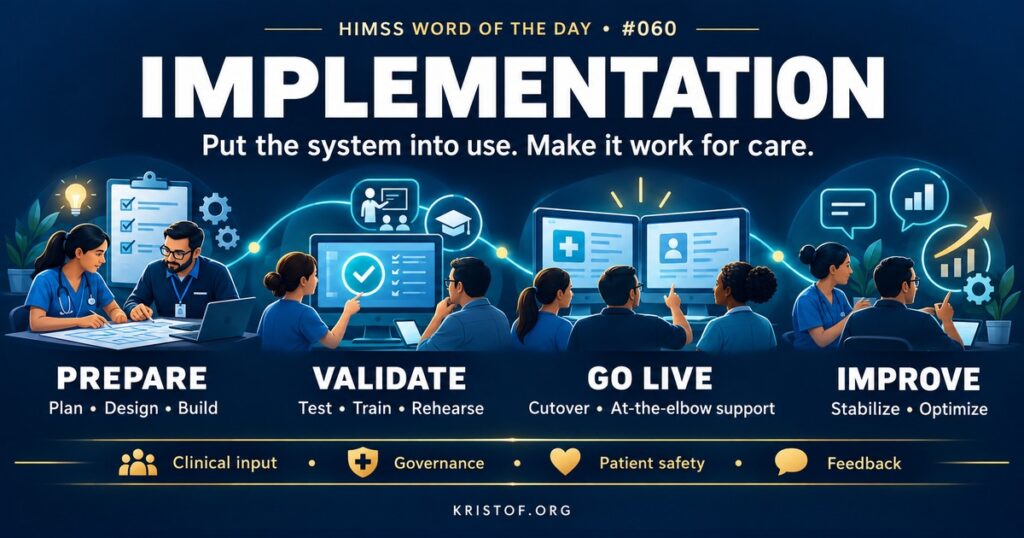
In healthcare IT, implementation is the work of putting a new system into use and making sure it actually works where people depend on it. It covers far more than installing software: configuration, testing, training, cutover from the old system, support during Go-Live, and the stabilization period afterward.
The HIMSS Dictionary describes implementation, in an IT context, as installing and maintaining new hardware or software and confirming that it functions properly in the setting where the organization will actually use it.
That last point is the key. A system can pass every technical test and still fail if it does not fit the unit, the shift, the staffing, and the patients it is meant to serve.
| Implementation Phase | Main Activities | Healthcare Example |
|---|---|---|
| Readiness and Planning | Scope, governance, staffing, timeline, risk assessment | Choosing a big-bang or phased Go-Live strategy |
| Design and Build | Workflow decisions and system configuration | Nursing flowsheets, order sets, and documentation templates |
| Testing | Unit, integrated, interface, and user acceptance testing | Walking a patient from ED triage to discharge in the test system |
| Training | End-user classes, proficiency checks, super user preparation | Role-based classes for nurses, providers, and unit clerks |
| Cutover | Moving data and activity from the old system to the new | Converting active orders and allergies before the first shift |
| Go-Live | Turning the new system on with intensive support | At-the-elbow analysts and super users on every unit |
| Stabilization and Optimization | Fixing issues, refining build, measuring adoption | Adjusting a confusing screen after nurses report problems |
⚠️ Exam Alert: Implementation is a phase of the system development life cycle, following design, build, and testing and preceding maintenance. A big-bang implementation turns everything on at once; a phased implementation rolls out by module, site, or unit; a pilot tests the system in one area first; parallel operation runs old and new systems side by side for a period. Questions often ask which strategy carries the most risk (big bang) or the most cost and workload (parallel).
🌐 Why It Matters: Real-World Healthcare IT Context
Implementations are among the most expensive and disruptive events a healthcare organization undertakes. An EHR replacement touches nearly every employee, every workflow, and every patient, and the organization must keep delivering care while it happens.
The risks are not only financial. A 2004 paper in the Journal of the American Medical Informatics Association by Joan Ash and colleagues described “silent” errors that patient care information systems can introduce. Drawing on studies in the United States, the Netherlands, and Australia, the authors grouped these errors into two broad categories: problems in entering and retrieving information, and problems in the communication and coordination the system was supposed to support. Their work helped establish that implementation is a patient safety activity, not just an IT project.
Implementation also continues after the first weeks. Organizations that plan dedicated optimization phases, revisiting design with the benefit of real use data and clinician feedback, are better positioned to recover the efficiency lost at Go-Live than those that treat the project as finished once the system is on.
Governance holds an implementation together. Successful programs have executive sponsorship, clinical leadership, clear decision rights for design choices, and a disciplined process for tracking issues. ONC’s SAFER Guides offer self-assessment checklists that organizations can use to evaluate safety practices before and after Go-Live.
Why implementations struggle:
- Design decisions made without frontline clinical input
- Testing compressed to protect a fixed Go-Live date
- Training delivered too early, too generically, or without proficiency checks
- Underestimating data conversion and interface work
- Too little support during the first weeks
- No budget or plan for optimization after stabilization
What successful implementations share:
- Visible executive and clinical leadership
- Workflow-driven design validated by the people who will use it
- Multiple rounds of integrated testing with realistic scenarios
- Role-based training, super users, and dress rehearsals
- A detailed cutover plan with rollback criteria
- A command center, rapid issue triage, and planned optimization
🏥 The Nurse’s Perspective: Clinical, Bedside, & Workflow
Nurses are the largest group of users in most clinical systems, which makes nursing readiness one of the strongest predictors of a smooth implementation.
At the Bedside
On Go-Live day, every familiar task becomes new: finding the patient list, documenting vitals, scanning medications, and writing a note. Experienced nurses can suddenly feel like novices, and tasks take longer for a while. Planning for that reality, with adjusted assignments, extra staff, and visible support on every unit, protects patients during the most vulnerable hours.
Patient safety checks matter most during the first shifts. Medication administration, allergies, isolation flags, and code status should be verified carefully after conversion, because errors introduced during cutover may not be obvious at first glance.
In Clinical Workflow
Nurses shape the system long before Go-Live. Workflow validation sessions, user acceptance testing, and dress rehearsals depend on nurses walking through real scenarios and pointing out where the design does not match the work. Super users, often nurses selected from each unit, become the first line of peer support and a steady source of feedback.
After Go-Live, nurses’ reports of friction, workarounds, and safety concerns drive the optimization backlog. A clear, responsive process for those reports builds trust in the new system.
In EHR Implementation (Go-Live Perspective)
During an Epic Go-Live, at-the-elbow support analysts work side by side with clinicians, guiding them through new workflows in real time. The most useful support combines system knowledge with clinical understanding: knowing not just where a button is, but why a nurse needs that information at that moment.
Analysts also serve as the eyes of the command center. Capturing issues clearly, including the role, the patient context, the screen, and the expected result, helps teams separate training gaps from build problems and fix the most important issues first. The days of stabilization that follow are when an implementation either earns clinicians’ confidence or loses it.
🎓 CAHIMS / CPHIMS & HIMSS Perspective
CAHIMS Exam Domain Mapping
Implementation is one of the most heavily tested topics in CAHIMS and CPHIMS:
| CAHIMS Domain | How Implementation Appears |
|---|---|
| Healthcare & Technology Environments | Regulatory drivers for system change; vendor relationships; organizational readiness |
| Clinical Informatics | Workflow redesign, clinician engagement, safety during Go-Live, unintended consequences |
| Healthcare Information & Systems Management | Testing types, data conversion, cutover, Go-Live strategies, support models |
| Management & Leadership | Governance, project management, change management, training strategy, optimization |
Key Terms to Know Alongside Implementation
- Go-Live — the point at which a new system becomes the system of record for real work
- Cutover — the planned transition of data and activity from the legacy system to the new system
- Big-Bang Implementation — turning on all components or sites at the same time
- Phased Implementation — rolling out a system in stages by module, location, or user group
- Super User — an end user with extra training who supports peers and gathers feedback
- Stabilization — the period after Go-Live focused on fixing issues and restoring normal performance
HIMSS Organizational Position
HIMSS views implementation as the start of a digital maturity journey rather than an end point. Its maturity models, such as EMRAM, reflect how organizations progress after Go-Live, and the CPHIMS credential tests knowledge of systems analysis, implementation, and management. Members can find related education and research through the HIMSS Resource Center.
🔗 Explore Further: External References
- Ash, Berg, and Coiera (2004), JAMIA — Some Unintended Consequences of Information Technology in Health Care https://pubmed.ncbi.nlm.nih.gov/14633936/
- ONC — SAFER Guides https://healthit.gov/clinical-quality-and-safety/safer-guides/
- AHRQ PSNet — Human Factors Engineering https://psnet.ahrq.gov/primer/human-factors-engineering
- NIST — SP 800-37 Rev. 2, Risk Management Framework (System Life Cycle) https://csrc.nist.gov/pubs/sp/800/37/r2/final
- HIMSS — Electronic Medical Record Adoption Model (EMRAM) https://www.himss.org/maturity-models/emram
- HIMSS — Certifications (CAHIMS and CPHIMS) https://www.himss.org/certifications
Term source: HIMSS Dictionary of Health Information and Technology Terms, Acronyms, and Organizations, 6th Edition (2025). All definitions in this series are paraphrased for editorial purposes. Readers are encouraged to consult the primary source for exact language.
Eric Andrew Kristof, RN, CAHIMS is a Healthcare IT professional and HIMSS Arkansas Chapter member based in Hot Springs Village, AR, with hands-on Epic Go-Live experience and a diverse healthcare and IT background. He writes at kristof.org at the intersection of clinical care and healthcare technology.
Leave a Reply