By Eric Andrew Kristof, RN, CAHIMS | Healthcare IT Professional | HIMSS Arkansas Chapter Member
About This Series: The HIMSS Word of the Day is a running blog series drawing from the HIMSS Dictionary of Health Information and Technology Terms, Acronyms, and Organizations, 6th Edition (2025) — the authoritative reference for healthcare IT professionals and the primary study resource for CAHIMS and CPHIMS certification. Each post paraphrases the term in plain language, grounds it in real-world healthcare IT context, and adds a bedside nursing perspective you won’t find in a textbook.
📖 The Term: Authorization (Access Control)
Source: HIMSS Dictionary of Health Information and Technology Terms, Acronyms, and Organizations, 6th Edition (2025)
🔍 Plain-Language Definition
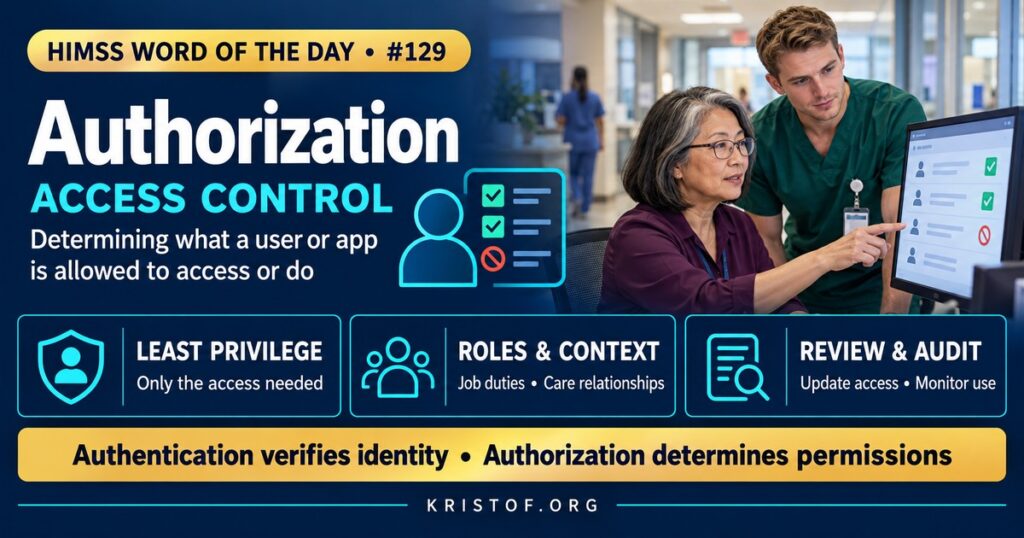
Authorization, in information security, is the process of determining what an authenticated user, device, or application is permitted to access or do, such as viewing a record, entering an order, or reading data through an API.
The HIMSS Dictionary describes authorization as a security mechanism for determining the privileges or access levels a user or client has to system resources, including programs, files, services, data, and application features. It notes that authentication, which verifies identity, normally comes first.
| Concept | Question It Answers | Healthcare Example |
|---|---|---|
| Identification | Who claims to be accessing? | A nurse enters a username |
| Authentication | Is this really that person? | Password plus a badge tap or one-time code |
| Authorization | What is this person allowed to do? | The nurse can document and administer medications but not sign physician orders |
| Accountability (Auditing) | What did this person actually do? | Audit logs record each chart opened and action taken |
| HIPAA Authorization | Has the patient given written permission for a use or disclosure? | A signed form allowing release of records to an employer |
⚠️ Exam Alert: Authentication verifies identity; authorization grants permissions. Authentication comes first. A HIPAA authorization is a patient’s signed permission for certain uses and disclosures of PHI, a different concept from security authorization. Prior authorization is a payer approval process, also unrelated to access control.
🌐 Why It Matters: Real-World Healthcare IT Context
Every clinical system must decide, many times a second, whether a request should be allowed. Authorization rules determine which records a user can open, which functions appear on the screen, which orders can be signed, and which data an application can retrieve. Getting those rules right supports both care and privacy.
HIPAA’s Security Rule requires access controls that allow only authorized persons or software programs to access ePHI, and the Privacy Rule’s minimum necessary standard expects organizations to limit access to what workforce members need for their jobs. Authorization is how those requirements are carried out in systems.
Several models are used. Role-based access control assigns permissions according to job roles, such as registered nurse, pharmacist, or physician. Attribute-based access control, described in NIST’s SP 800-162, evaluates attributes of the user, resource, action, and environment, such as department, patient relationship, location, or time. Many EHRs combine approaches: roles define baseline permissions, while context, like an active care relationship or a sensitive record flag, adjusts access.
Healthcare needs flexibility. Emergencies require clinicians to access records they might not normally see. Break-the-glass features allow access with a stated reason, then generate audit review. Sensitive information, such as substance use disorder treatment records protected under 42 CFR Part 2, behavioral health notes, or records of employees and VIPs, may require additional restrictions.
Applications and APIs need authorization too. Standards such as OAuth 2.0, used in SMART on FHIR, let a user or organization grant an app limited access through scopes, such as permission to read medications but not write orders. This approach avoids sharing passwords and allows access to be revoked.
Authorization must be maintained over time. People change jobs, take on temporary roles, or leave the organization, and their access should change accordingly. Periodic access reviews help remove permissions that are no longer needed.
Auditing completes the picture. Authorization decides what users may do, but audit trails show what they actually did, allowing organizations to detect inappropriate access such as snooping in records without a work-related reason.
Common authorization problems:
- Excessive permissions accumulated over time
- Generic or shared accounts that blur accountability
- Roles that do not match real workflows, prompting workarounds
- Break-the-glass access without timely review
- Apps granted broader scopes than needed
- Slow removal of access after role changes or departures
Practices for strong authorization:
- Least privilege as the default
- Role definitions developed with clinical input
- Context-aware rules for sensitive records
- Regular access reviews and recertification
- Narrow, revocable scopes for apps and APIs
- Audit monitoring tied to authorization decisions
🏥 The Nurse’s Perspective: Clinical, Bedside, & Workflow
Authorization rules shape what nurses see and can do in clinical systems every shift.
At the Bedside
Nursing roles typically allow documentation, medication administration, and order review, while restricting functions such as signing provider orders. When a needed function is unavailable, the right step is to request appropriate access or follow an approved workflow rather than borrowing another person’s login.
Break-the-glass prompts appear when a nurse tries to access a restricted record. Providing an accurate reason and accessing only what is needed for care supports both patient care and privacy, since these accesses are reviewed.
In Clinical Workflow
Floating, charge nurse, and float pool assignments may require different access. Organizations increasingly use context, such as current unit assignment or care team membership, to adjust what nurses can see without granting broad access to every patient.
Nurses should open only the records they need for their work. Curiosity about a neighbor, coworker, or public figure is not a work-related reason, and audit monitoring is designed to detect such access.
When patients ask who can see their records, nurses can explain that access is limited by role and need and that activity is monitored. Requests for an accounting of disclosures or concerns about privacy can be routed to the privacy office.
Nurse informaticists often help define what each nursing role needs, balancing efficient workflow with the minimum necessary principle.
In EHR Implementation (Go-Live Perspective)
During an Epic Go-Live, security teams build user roles, templates, and access rules, and test them with real workflows. Missing permissions are one of the most common early issues, such as a nurse unable to document in a specific flowsheet or see a needed report.
At-the-elbow support analysts help identify whether a problem is training or a true security gap, then route access requests through the proper approval process. Quick, documented fixes keep care moving without granting excessive permissions.
🎓 CAHIMS / CPHIMS & HIMSS Perspective
CAHIMS Exam Domain Mapping
Authorization appears in security and privacy questions:
| CAHIMS Domain | How Authorization Appears |
|---|---|
| Healthcare & Technology Environments | HIPAA access control and minimum necessary requirements; Part 2 protections |
| Clinical Informatics | Role design, break-the-glass workflows, sensitive record access |
| Healthcare Information & Systems Management | RBAC, ABAC, OAuth scopes, identity and access management, audit logs |
| Management & Leadership | Access review processes, sanctions, privacy and security governance |
Key Terms to Know Alongside Authorization
- Authentication — verifying the identity of a user, device, or application
- Least Privilege — granting only the access necessary to perform a task
- Role-Based Access Control (RBAC) — assigning permissions according to job roles
- Attribute-Based Access Control (ABAC) — granting access based on attributes of users, resources, and context
- OAuth Scope — a defined permission granted to an application
- Break the Glass — emergency access to restricted information with reason and audit
HIMSS Organizational Position
HIMSS addresses identity and access management through its cybersecurity and privacy education, research, and Healthcare Cybersecurity Community, encouraging least privilege, strong authentication, and audit practices. Members can find related education and research through the HIMSS Resource Center.
🔗 Explore Further: External References
- eCFR — 45 CFR 164.312, HIPAA Technical Safeguards (Access Control) https://www.ecfr.gov/current/title-45/subtitle-A/subchapter-C/part-164/subpart-C/section-164.312
- NIST — SP 800-162, Guide to Attribute Based Access Control (ABAC) https://csrc.nist.gov/pubs/sp/800/162/upd2/final
- HHS — Minimum Necessary Requirement https://www.hhs.gov/hipaa/for-professionals/privacy/guidance/minimum-necessary-requirement/index.html
- eCFR — 45 CFR 164.508, Uses and Disclosures for Which an Authorization Is Required https://www.ecfr.gov/current/title-45/subtitle-A/subchapter-C/part-164/subpart-E/section-164.508
- HL7 — SMART App Launch https://hl7.org/fhir/smart-app-launch/
- HIMSS — Healthcare Cybersecurity Community https://www.himss.org/networking/communities/healthcare-cybersecurity/
Term source: HIMSS Dictionary of Health Information and Technology Terms, Acronyms, and Organizations, 6th Edition (2025). All definitions in this series are paraphrased for editorial purposes. Readers are encouraged to consult the primary source for exact language.
Eric Andrew Kristof, RN, CAHIMS is a Healthcare IT professional and HIMSS Arkansas Chapter member based in Hot Springs Village, AR, with hands-on Epic Go-Live experience and a diverse healthcare and IT background. He writes at kristof.org at the intersection of clinical care and healthcare technology.
Leave a Reply