By Eric Andrew Kristof, RN, CAHIMS | Healthcare IT Professional | HIMSS Arkansas Chapter Member
About This Series: The HIMSS Word of the Day is a running blog series drawing from the HIMSS Dictionary of Health Information and Technology Terms, Acronyms, and Organizations, 6th Edition (2025) — the authoritative reference for healthcare IT professionals and the primary study resource for CAHIMS and CPHIMS certification. Each post paraphrases the term in plain language, grounds it in real-world healthcare IT context, and adds a bedside nursing perspective you won’t find in a textbook.
📖 The Term: Big Data
Source: HIMSS Dictionary of Health Information and Technology Terms, Acronyms, and Organizations, 6th Edition (2025)
🔍 Plain-Language Definition
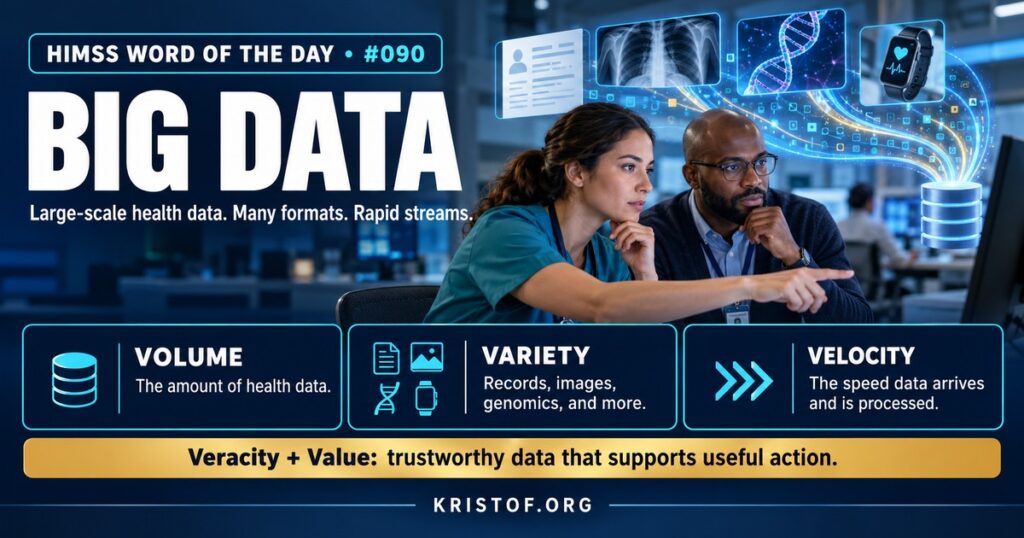
Big data describes collections of data so large, so varied, or arriving so quickly that ordinary databases and analysis tools cannot easily handle them. In healthcare, big data includes EHR records from millions of patients, medical images, continuous monitor and device streams, genomic sequences, claims, and data from wearables and apps.
The HIMSS Dictionary describes big data as very large collections of structured, semi-structured, and unstructured data from which information can be extracted. It characterizes big data by three features: the volume of data, the variety of data types, and the velocity at which data must be processed.
Many writers add further “V” words, such as veracity (how trustworthy the data is) and value (whether it leads to useful action). In healthcare, those two often matter most.
| Characteristic | What It Means | Healthcare Example |
|---|---|---|
| Volume | The sheer amount of data | Years of EHR data across a health system, or a national imaging archive |
| Variety | Many types and formats | Coded diagnoses, free-text notes, images, waveforms, genomic files |
| Velocity | Speed of data creation and processing | Streaming vital signs from ICU monitors or wearables |
| Veracity | Reliability and accuracy | Data affected by copy-forward, missing values, or billing incentives |
| Value | Usefulness for decisions | A model that actually changes care or operations for the better |
⚠️ Exam Alert: Big data describes the characteristics of the data. Analytics is the process of finding patterns in it. A data warehouse typically stores structured, cleaned data for reporting, while a data lake stores large volumes of raw data in many formats. Machine learning is a method often used on big data. Questions frequently ask you to match the three Vs to examples.
🌐 Why It Matters: Real-World Healthcare IT Context
Big data enables questions that small data cannot answer. With millions of records, researchers can study rare side effects, compare treatments in real-world populations, and detect patterns across hospitals. Health systems use large data sets to forecast admissions, manage staffing, identify patients at high risk, and evaluate the effect of new protocols. Public health agencies combine data from many sources to track outbreaks.
Artificial intelligence depends on big data. Deep learning models for images, language, and risk prediction learn from very large training sets, and their performance depends on the quality and representativeness of that data.
Technology has adapted to the challenge. Cloud platforms, data lakes, distributed processing, and common data models such as OMOP allow organizations to store and analyze far more data than a traditional reporting database could handle. NIST has published a Big Data Interoperability Framework to help organizations describe and design big data systems consistently.
Genomics and wearables are pushing volumes higher still. A single whole-genome sequence produces far more data than a typical patient’s EHR record, and continuous monitoring from wearables and bedside devices can generate readings every second. National research programs and biobanks combine these sources with EHR data to study how genes, environment, and behavior interact, which raises both scientific opportunity and new questions about consent and data sharing.
But bigger is not automatically better. Large data sets can amplify errors and biases. If a population is underrepresented, if documentation reflects billing more than clinical reality, or if data from different sources means different things, a large analysis can produce confident but wrong conclusions. Privacy risk also grows with scale, because combining many data sources can make individuals easier to re-identify.
Common big data pitfalls:
- Collecting data without a clear question or use
- Assuming large samples eliminate bias
- Combining sources without harmonizing definitions and codes
- Underestimating storage, security, and processing costs
- Weak governance over who can access and link data
- Models that perform well on historical data but poorly in practice
Characteristics of valuable big data programs:
- Clear use cases tied to clinical, operational, or research goals
- Data governance, stewardship, and documented definitions
- Data quality checks and harmonization across sources
- Privacy protections, including de-identification and access controls
- Scalable, secure infrastructure with cost management
- Validation of findings and models before they influence care
🏥 The Nurse’s Perspective: Clinical, Bedside, & Workflow
Nurses generate a large share of the clinical data that big data initiatives depend on, and increasingly see the results in their own work.
At the Bedside
Every set of vital signs, every assessment, and every medication administration adds to the data an organization collects. Device integration multiplies that volume: a monitor may send readings every few seconds, while a nurse validates and files selected values to the chart. Accurate, timely documentation and careful validation are what make that data trustworthy later.
Nurses also see big data in action through early warning scores, sepsis alerts, and fall risk predictions, many of which are built from large historical data sets. Understanding that these tools learn from past data helps nurses use them thoughtfully, especially when a patient does not fit the usual pattern.
Big data also supports workforce planning. Historical patterns of census, acuity, and admissions by hour and season help leaders anticipate busy periods, but the forecasts are only as good as the documentation of acuity and patient movement that feeds them.
In Clinical Workflow
Operational dashboards increasingly use large data sets to predict admissions, discharges, and staffing needs. Nurse leaders use these forecasts to plan assignments and float staff, while bringing clinical knowledge to situations the model may not anticipate.
Nurse researchers and quality specialists use large data sets to study outcomes such as pressure injuries, falls, and readmissions across many units and hospitals. Careful definitions and documentation consistency determine whether those studies produce reliable answers.
In EHR Implementation (Go-Live Perspective)
An Epic implementation changes the data foundation for years. Data from the legacy system must be converted or archived, new data flows must be connected to warehouses and analytics platforms, and documentation patterns shift. Big data projects that depend on long historical trends need careful mapping between old and new data.
At-the-elbow support analysts influence data quality on the first day by helping nurses document in the intended structured fields. Those small corrections shape the reliability of the large data sets that will be built from the new system over time.
🎓 CAHIMS / CPHIMS & HIMSS Perspective
CAHIMS Exam Domain Mapping
Big data appears in analytics, technology, and governance questions:
| CAHIMS Domain | How Big Data Appears |
|---|---|
| Healthcare & Technology Environments | Trends in AI, genomics, wearables, and real-world evidence |
| Clinical Informatics | Predictive tools at the bedside; documentation as a data source |
| Healthcare Information & Systems Management | Data lakes, cloud platforms, common data models, data integration |
| Management & Leadership | Data governance, privacy, cost, analytics strategy, ethical use |
Key Terms to Know Alongside Big Data
- Volume, Variety, Velocity — the three classic characteristics of big data
- Data Lake — a repository that stores large amounts of raw data in many formats
- Real-World Data — data about health and care collected outside traditional clinical trials
- Data Harmonization — aligning data from different sources so it has consistent meaning
- Machine Learning — methods that learn patterns from data to make predictions
- Data Governance — policies and decision rights for managing and using data
HIMSS Organizational Position
HIMSS addresses big data through its focus on analytics maturity, data governance, and AI. Its Analytics Maturity Assessment Model helps organizations assess whether they have the data foundation and governance needed to use large-scale data responsibly. Members can find related education and research through the HIMSS Resource Center.
🔗 Explore Further: External References
- NIST — Big Data at NIST https://www.nist.gov/itl/big-data-nist
- OHDSI — OMOP Common Data Model https://ohdsi.github.io/CommonDataModel/
- Hripcsak et al. (2015), Studies in Health Technology and Informatics — OHDSI: Opportunities for Observational Researchers https://pubmed.ncbi.nlm.nih.gov/26262116/
- Safran et al. (2007), JAMIA — Toward a National Framework for the Secondary Use of Health Data https://pubmed.ncbi.nlm.nih.gov/17077452/
- NIST — AI Risk Management Framework https://www.nist.gov/itl/ai-risk-management-framework
- HIMSS — Analytics Maturity Assessment Model (AMAM) https://www.himss.org/maturity-models/amam
Term source: HIMSS Dictionary of Health Information and Technology Terms, Acronyms, and Organizations, 6th Edition (2025). All definitions in this series are paraphrased for editorial purposes. Readers are encouraged to consult the primary source for exact language.
Eric Andrew Kristof, RN, CAHIMS is a Healthcare IT professional and HIMSS Arkansas Chapter member based in Hot Springs Village, AR, with hands-on Epic Go-Live experience and a diverse healthcare and IT background. He writes at kristof.org at the intersection of clinical care and healthcare technology.
Leave a Reply