By Eric Andrew Kristof, RN, CAHIMS | Healthcare IT Professional | HIMSS Arkansas Chapter Member
About This Series: The HIMSS Word of the Day is a running blog series drawing from the HIMSS Dictionary of Health Information and Technology Terms, Acronyms, and Organizations, 6th Edition (2025) — the authoritative reference for healthcare IT professionals and the primary study resource for CAHIMS and CPHIMS certification. Each post paraphrases the term in plain language, grounds it in real-world healthcare IT context, and adds a bedside nursing perspective you won’t find in a textbook.
📖 The Term: Zero-Day Attack
Source: HIMSS Dictionary of Health Information and Technology Terms, Acronyms, and Organizations, 6th Edition (2025)
🔍 Plain-Language Definition
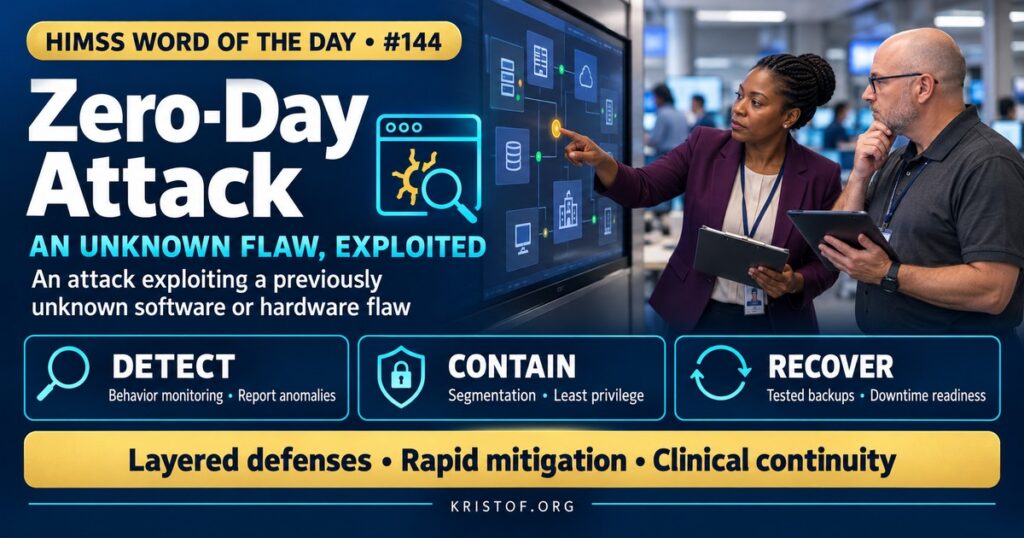
A zero-day attack is an attack that exploits a software or hardware vulnerability that is unknown to the vendor, or for which no fix is yet available. The name reflects that defenders have had “zero days” to prepare a patch before the flaw is used.
The HIMSS Dictionary describes a zero-day attack as a malicious actor’s exploitation of a vulnerability that the manufacturer does not know about.
| Concept | What It Means | Example |
|---|---|---|
| Zero-Day Vulnerability | A flaw unknown to the vendor or without a fix | A newly discovered flaw in a file transfer application |
| Zero-Day Exploit | Code or technique that takes advantage of the flaw | Malicious input that gives attackers access |
| Zero-Day Attack | Use of the exploit against targets | Attackers stealing data before a patch exists |
| N-Day Vulnerability | A known flaw with an available fix that has not been applied | An unpatched server months after a patch release |
| CVE | A public identifier assigned to a known vulnerability | A CVE number referenced in a vendor security bulletin |
⚠️ Exam Alert: A zero-day is unknown or unpatched by the vendor when exploited. An n-day or known vulnerability already has a fix available but has not been applied; most successful attacks exploit known vulnerabilities. Patching cannot prevent a true zero-day, so layered defenses and detection are essential.
🌐 Why It Matters: Real-World Healthcare IT Context
Zero-day attacks are difficult to prevent because there is no patch to apply when they begin. Attackers who discover or buy these vulnerabilities can compromise systems that are otherwise fully updated. Once a zero-day becomes public, vendors race to release fixes while organizations race to apply them and to determine whether they were already compromised.
Healthcare has been affected by zero-day exploitation, especially in widely used software. In 2023, criminals exploited a previously unknown vulnerability in a popular managed file transfer product to steal data from many organizations, including healthcare organizations and their vendors. Incidents like this show how a single flaw in common software can affect many hospitals at once, including through business associates.
Hospitals face particular exposure. They run hundreds of applications, many internet-facing systems, and large numbers of medical devices and operational technology. Some devices cannot be patched quickly because changes require vendor validation or regulatory considerations. Even after a fix is released, applying it can take time, effectively extending the window of risk.
Known vulnerabilities remain the bigger day-to-day problem. Many attacks use flaws that have had patches available for months or years. Public catalogs such as the CVE program and NIST’s National Vulnerability Database help organizations track and prioritize known vulnerabilities, and federal agencies publish lists of vulnerabilities known to be actively exploited.
Medical device regulation has evolved. Federal law now requires manufacturers of certain cyber devices to include plans to monitor, identify, and address postmarket cybersecurity vulnerabilities, along with a software bill of materials, in premarket submissions to the FDA. Software bills of materials help hospitals quickly identify which products contain an affected component when a new vulnerability is announced.
Because prevention is not guaranteed, defense in depth matters. Network segmentation limits how far an attacker can move. Least-privilege access reduces what a compromised account can reach. Endpoint detection and response tools look for suspicious behavior rather than known signatures. Logging and monitoring help detect intrusions. Tested backups and incident response plans support recovery.
Threat intelligence and information sharing help shorten response time. Health sector information sharing organizations, government alerts, and vendor bulletins notify defenders when a new zero-day is being exploited, often with indicators that help organizations search their own systems for signs of compromise. Organizations that monitor these sources and have practiced emergency change procedures can apply mitigations within hours rather than weeks.
Vendor relationships are part of the defense. Contracts and procurement processes can require timely security updates, vulnerability disclosure programs, and notification when products are affected.
Why zero-days are dangerous in healthcare:
- No patch exists when exploitation begins
- Widely used software can affect many organizations at once
- Medical devices may be slow or difficult to update
- Vendors and business associates expand exposure
- Detection may lag behind compromise
- Clinical downtime has direct patient safety impact
Defenses that limit zero-day damage:
- Network segmentation and isolation of critical systems
- Endpoint detection and response with behavioral monitoring
- Least-privilege access and multifactor authentication
- Asset inventories and software bills of materials
- Rapid emergency patching and mitigation procedures
- Tested backups, downtime plans, and incident response
🏥 The Nurse’s Perspective: Clinical, Bedside, & Workflow
Nurses do not patch software, but they help hospitals detect attacks and keep caring for patients when systems are affected.
At the Bedside
Unusual system behavior, such as unexpected pop-ups, devices that suddenly lose connectivity, or applications behaving strangely, may signal a security issue. Reporting it promptly with details about the device and time helps security teams investigate quickly.
When emergency patches or mitigations are applied, systems may restart, become temporarily unavailable, or behave differently. Following communications from IT and using downtime procedures when needed keeps care safe.
In Clinical Workflow
Medical devices are sometimes isolated or taken offline in response to a vulnerability. Clinical engineering and nursing leaders coordinate alternatives, such as replacement devices or manual monitoring, to avoid gaps in care.
Downtime readiness is essential. A zero-day attack can disable systems without warning, and nurses familiar with paper documentation, downtime medication records, and communication plans help maintain safe care during extended outages.
Following organizational guidance not to install unapproved software or browser extensions reduces the number of applications that could contain vulnerabilities.
Phishing remains a common delivery method even for zero-day exploits, so the same cautious email and browsing habits that protect against ordinary malware also reduce exposure to new, unknown threats.
In EHR Implementation (Go-Live Perspective)
During an Epic Go-Live, technical teams inventory software and devices, confirm patch processes, and establish monitoring for new systems and interfaces. Knowing exactly what is deployed helps respond quickly when a vulnerability is announced.
At-the-elbow support analysts may notice devices or workstations behaving abnormally. Escalating those observations to security, rather than treating them only as technical glitches, can help detect attacks early.
🎓 CAHIMS / CPHIMS & HIMSS Perspective
CAHIMS Exam Domain Mapping
Zero-day attacks appear in cybersecurity and risk management questions:
| CAHIMS Domain | How Zero-Day Attacks Appear |
|---|---|
| Healthcare & Technology Environments | Threat landscape; medical device cybersecurity regulation |
| Clinical Informatics | Downtime procedures; reporting unusual system behavior |
| Healthcare Information & Systems Management | Vulnerability and patch management, segmentation, monitoring, SBOMs |
| Management & Leadership | Vendor risk, incident response, business continuity |
Key Terms to Know Alongside Zero-Day Attack
- Vulnerability — a weakness that can be exploited to compromise a system
- Exploit — code or a technique that takes advantage of a vulnerability
- Patch Management — the process of identifying, testing, and applying software updates
- CVE — Common Vulnerabilities and Exposures, a public catalog of vulnerability identifiers
- Software Bill of Materials (SBOM) — a list of components included in software
- Defense in Depth — layering multiple security controls so one failure does not lead to compromise
HIMSS Organizational Position
HIMSS addresses vulnerability management and medical device security through its Healthcare Cybersecurity Community, research, and policy engagement, emphasizing layered defenses and preparedness. Members can find related education and research through the HIMSS Resource Center.
🔗 Explore Further: External References
- NIST — National Vulnerability Database https://nvd.nist.gov/
- CVE Program https://www.cve.org/
- FDA — Cybersecurity in Medical Devices: Quality Management System Considerations and Content of Premarket Submissions https://www.fda.gov/regulatory-information/search-fda-guidance-documents/cybersecurity-medical-devices-quality-management-system-considerations-and-content-premarket
- FDA — Medical Device Cybersecurity https://www.fda.gov/medical-devices/digital-health-center-excellence/cybersecurity
- HHS 405(d) Program — Health Industry Cybersecurity Practices https://405d.hhs.gov/
- HIMSS — Healthcare Cybersecurity Community https://www.himss.org/networking/communities/healthcare-cybersecurity/
Term source: HIMSS Dictionary of Health Information and Technology Terms, Acronyms, and Organizations, 6th Edition (2025). All definitions in this series are paraphrased for editorial purposes. Readers are encouraged to consult the primary source for exact language.
Eric Andrew Kristof, RN, CAHIMS is a Healthcare IT professional and HIMSS Arkansas Chapter member based in Hot Springs Village, AR, with hands-on Epic Go-Live experience and a diverse healthcare and IT background. He writes at kristof.org at the intersection of clinical care and healthcare technology.
Leave a Reply