By Eric Andrew Kristof, RN, CAHIMS | Healthcare IT Professional | HIMSS Arkansas Chapter Member
About This Series: The HIMSS Word of the Day is a running blog series drawing from the HIMSS Dictionary of Health Information and Technology Terms, Acronyms, and Organizations, 6th Edition (2025) — the authoritative reference for healthcare IT professionals and the primary study resource for CAHIMS and CPHIMS certification. Each post paraphrases the term in plain language, grounds it in real-world healthcare IT context, and adds a bedside nursing perspective you won’t find in a textbook.
📖 The Term: Standing Orders
Source: HIMSS Dictionary of Health Information and Technology Terms, Acronyms, and Organizations, 6th Edition (2025)
🔍 Plain-Language Definition
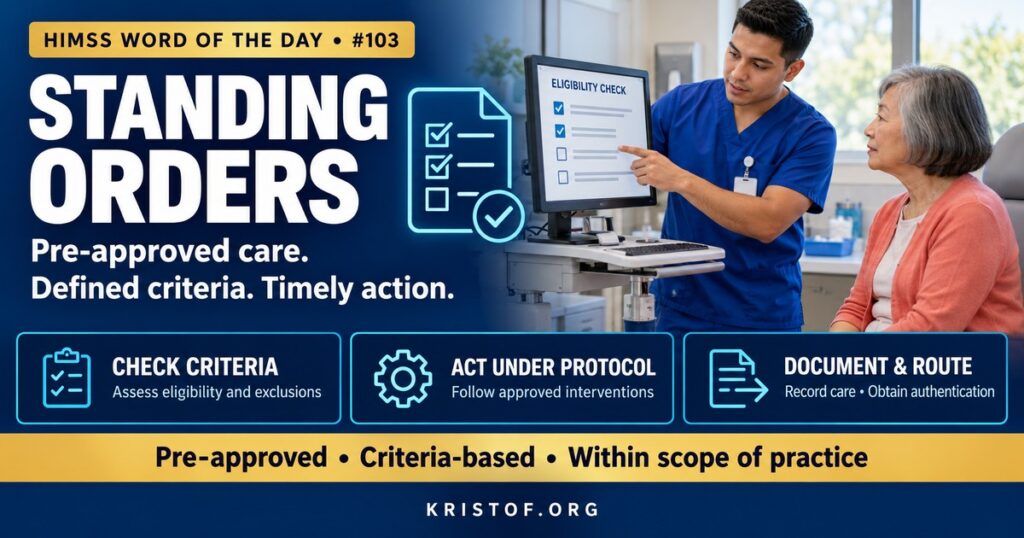
Standing orders are pre-approved orders or protocols that authorize nurses, pharmacists, medical assistants, therapists, or other team members to carry out specific interventions when a patient meets defined criteria, without obtaining a separate order for each patient.
The HIMSS Dictionary describes standing orders as physician orders or protocols that let other members of the care team provide care, such as medical assistants, therapists, and nurses. It notes that they frequently rest on national clinical guidelines and may be adapted for a specific patient population or care setting.
| Standing Order Example | Criteria | Action |
|---|---|---|
| Influenza or Pneumococcal Vaccination | Patient eligible by age or condition, no contraindications | Nurse screens and administers the vaccine |
| Urinary Catheter Removal Protocol | Catheter no longer meets indications | Nurse removes the catheter and monitors voiding |
| Hypoglycemia Protocol | Blood glucose below a set threshold | Nurse gives glucose per protocol and rechecks |
| Electrolyte Replacement Protocol | Lab value outside a defined range | Nurse or pharmacist initiates replacement per protocol |
| Preventive Screening in Primary Care | Patient due for a screening | Medical assistant or nurse orders or performs the screening |
⚠️ Exam Alert: A standing order is pre-approved and applies when criteria are met. An order set is a group of orders that a prescriber selects for a situation. A protocol is a defined sequence of actions, which may be authorized by standing order. A verbal order is given for a specific patient and must be authenticated. Standing orders must still be documented and authenticated in the record.
🌐 Why It Matters: Real-World Healthcare IT Context
Standing orders improve timeliness and reliability. Vaccinations, screenings, and evidence-based interventions are more likely to happen when the team member who sees the patient can act immediately rather than waiting for a provider. Nurse-driven protocols, such as those for removing urinary catheters or titrating oxygen, can reduce delays and complications.
Federal rules set conditions for hospitals. Medicare’s Conditions of Participation allow hospitals to use pre-printed and electronic standing orders, order sets, and protocols only if the hospital ensures they have been reviewed and approved by the medical staff and the hospital’s nursing and pharmacy leadership, that they are consistent with nationally recognized, evidence-based guidelines, that they are reviewed periodically for continued usefulness and safety, and that they are dated, timed, and authenticated promptly in the patient’s record by a responsible practitioner.
The EHR is central to doing this safely. Electronic standing orders can be built with clear criteria, decision support that identifies eligible patients, activation steps that record who initiated the order and why, and routing for provider co-signature. Reports can show how often protocols are used, whether criteria were met, and whether co-signatures are completed.
Standing orders also support population health. In primary care and public health, standing orders for vaccinations, cancer screenings, and diabetes monitoring let teams close care gaps during any visit, not only when the provider remembers. Combined with registries and decision support that identify patients who are due, they turn guideline recommendations into routine action.
Scope of practice still governs. State law and organizational policy determine which team members may act under which standing orders, and a standing order cannot authorize actions outside a clinician’s legal scope.
Common standing order problems:
- Criteria that are vague or hard to apply consistently
- Protocols not updated as guidelines change
- Activation not documented clearly in the record
- Missing or delayed authentication by a practitioner
- Staff unaware of available protocols
- Decision support that identifies too many or too few eligible patients
Characteristics of safe standing order programs:
- Medical staff, nursing, and pharmacy approval and regular review
- Clear, measurable criteria and exclusions
- Electronic activation with automatic routing for authentication
- Education and competency validation for staff using protocols
- Monitoring of use, outcomes, and adverse events
- Alignment with state scope-of-practice rules
🏥 The Nurse’s Perspective: Clinical, Bedside, & Workflow
Standing orders give nurses authority to act, and with that authority comes responsibility for assessment and judgment.
At the Bedside
Applying a standing order begins with assessment. Before giving a vaccine under protocol, the nurse screens for contraindications, reviews the immunization history, and provides education. Before removing a urinary catheter, the nurse confirms that indications are no longer met and plans monitoring afterward. Criteria guide the decision, but the nurse’s judgment determines whether the patient truly fits.
When a patient does not fit the protocol, or something seems wrong, the nurse contacts the provider rather than forcing the situation into the standing order.
Protocols should be easy to find. When nurses must search for a protocol or remember which ones exist, standing orders go unused. Building protocols into admission navigators, order sets, or decision support prompts makes them part of the normal workflow.
In Clinical Workflow
Standing orders reduce delays for common, well-defined situations. In primary care, nurses and medical assistants close gaps in vaccinations and screenings during visits. In hospitals, nurse-driven protocols support timely catheter removal, early mobility, and glucose management.
Documentation is essential. Activating the standing order in the EHR, recording the criteria that were met, documenting the intervention, and ensuring the order is routed for authentication keep the record complete and compliant.
In EHR Implementation (Go-Live Perspective)
During an Epic Go-Live, standing orders and protocols must be rebuilt, reapproved, and tested in the new system. Teams verify that criteria display clearly, that activation is straightforward, and that co-signature routing works for each department.
At-the-elbow support analysts often help nurses find and activate protocols in the new system and confirm that orders route correctly for signature. Feedback about protocols that are hard to find or use helps teams make them part of normal workflow.
🎓 CAHIMS / CPHIMS & HIMSS Perspective
CAHIMS Exam Domain Mapping
Standing orders appear in clinical workflow and regulatory questions:
| CAHIMS Domain | How Standing Orders Appear |
|---|---|
| Healthcare & Technology Environments | CMS Conditions of Participation; scope of practice; guideline-based care |
| Clinical Informatics | Nurse-driven protocols; decision support for eligibility; documentation |
| Healthcare Information & Systems Management | Electronic order build, activation, co-signature routing, reporting |
| Management & Leadership | Approval and review processes, policy, competency, outcome monitoring |
Key Terms to Know Alongside Standing Orders
- Nurse-Driven Protocol — a protocol that authorizes nurses to perform specific interventions when criteria are met
- Order Set — a predefined group of orders for a clinical situation, selected by a prescriber
- Authentication — confirmation, such as an electronic signature, that an order or entry is valid and attributable
- Scope of Practice — the activities a licensed professional is legally permitted to perform
- Clinical Practice Guideline — evidence-based recommendations for the care of specific conditions
- Co-Signature — a second practitioner’s authentication of an order or documentation
HIMSS Organizational Position
HIMSS supports the use of health IT to embed evidence-based protocols safely into workflow, and its Nursing Informatics Community highlights nurse-driven protocols as an example of technology enabling nursing practice. Members can find related education and research through the HIMSS Resource Center.
🔗 Explore Further: External References
- eCFR — 42 CFR 482.24, Condition of Participation: Medical Record Services https://www.ecfr.gov/current/title-42/chapter-IV/subchapter-G/part-482/subpart-C/section-482.24
- eCFR — 42 CFR 482.23, Condition of Participation: Nursing Services https://www.ecfr.gov/current/title-42/chapter-IV/subchapter-G/part-482/subpart-C/section-482.23
- Immunize.org — Vaccine Resources Including Standing Orders Templates https://www.immunize.org/
- AHRQ — Patient Safety and Quality Improvement https://www.ahrq.gov/patient-safety/index.html
- ONC — Clinical Decision Support https://healthit.gov/clinical-quality-and-safety/clinical-decision-support/
- HIMSS — Nursing Informatics Community https://www.himss.org/networking/communities/nursing-informatics/
Term source: HIMSS Dictionary of Health Information and Technology Terms, Acronyms, and Organizations, 6th Edition (2025). All definitions in this series are paraphrased for editorial purposes. Readers are encouraged to consult the primary source for exact language.
Eric Andrew Kristof, RN, CAHIMS is a Healthcare IT professional and HIMSS Arkansas Chapter member based in Hot Springs Village, AR, with hands-on Epic Go-Live experience and a diverse healthcare and IT background. He writes at kristof.org at the intersection of clinical care and healthcare technology.
Leave a Reply