By Eric Andrew Kristof, RN, CAHIMS | Healthcare IT Professional | HIMSS Arkansas Chapter Member
About This Series: The HIMSS Word of The Day is a running blog series drawing from the HIMSS Dictionary of Health Information and Technology Terms, Acronyms, and Organizations, 6th Edition (2025) — the authoritative reference for healthcare IT professionals and the primary study resource for CAHIMS and CPHIMS certification. Each post paraphrases the term in plain language, grounds it in real-world healthcare IT context, and adds a bedside nursing perspective you won’t find in a textbook.
📖 The Term: Uniform Data Standards
Source: HIMSS Dictionary of Health Information and Technology Terms, Acronyms, and Organizations, 6th Edition (2025)
🔍 Plain-Language Definition
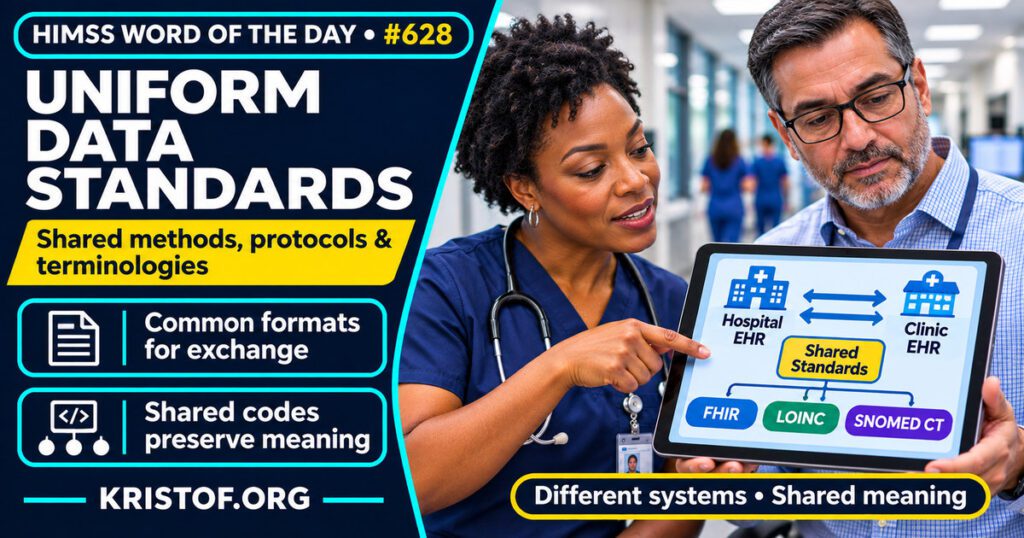
The HIMSS Dictionary describes uniform data standards as the methods, protocols, and terminologies that an industry has agreed on so that separate information systems can work together. The phrase covers three kinds of agreement. A method says how something is done, such as how a document is structured. A protocol says how two systems talk to each other. A terminology says which words or codes stand for which concepts, so that “systolic blood pressure” means the same thing in every system that uses it.
The word “uniform” carries the point. When every organization chooses its own field names and codes, each connection between two systems needs its own translation. When the industry agrees on common choices, a system can be built once and connected to many others. Agreement is never complete, and standards usually have versions, optional parts, and local variations, so uniform in practice means agreed enough to work, not identical everywhere.
| Kind of agreement | What it standardizes | Examples |
|---|---|---|
| Method | How content is organized or a task is performed | Document structures and implementation guides |
| Protocol | How systems exchange messages | HL7 messages, FHIR interfaces, X12 transactions |
| Terminology | The words and codes used for concepts | SNOMED CT, LOINC, RxNorm |
| Content set | Which data elements are expected | USCDI data classes and elements |
⚠️ Exam Alert: Uniform data standards is a general idea, and it is easy to confuse with two specific things. USCDI is a particular standardized set of health data classes and elements maintained by ONC. The Uniform Data System (UDS) is a separate, annual reporting system for health centers funded under HRSA’s Health Center Program. A data standard also differs from a standard of care, which describes clinical practice and not data exchange.
🌐 Why It Matters: Real-World Healthcare IT Context
Hospitals, clinics, laboratories, payers, and public health agencies each run different software, and the care of one patient crosses many of them. Without shared agreements about how data is structured and named, every exchange needs custom work, and meaning can be lost along the way. Uniform data standards are the shared layer that lets a result, a medication, or an allergy keep its meaning when it moves.
A concrete example: USCDI. The United States Core Data for Interoperability is a standardized set of health data classes and data elements for nationwide, interoperable exchange. ONC’s Standards Bulletin 2026-2 says ONC publishes a new version each year, with a draft for public comment in January and a final version in July, and that anyone can propose new data elements through an online submission system. ONC released USCDI version 7 on July 23, 2026. According to the bulletin, v7 adds 30 new data elements and substantially revises one more, and it adds two data classes, Adverse Events and Healthcare Information Attributes. The v7 document lists 24 data classes in total, from Allergies and Intolerances to Vital Signs.
Two cautions apply. First, versions change every year, so a statement about “the current USCDI” can go out of date quickly. The bulletin says USCDI v6 is among the approved standards in the 2026 Standards Version Advancement Process, which lets developers move certified health IT to a newer version, and that CMS’s Interoperability and Prior Authorization Final Rule and TEFCA call for the ability to exchange USCDI data elements. The bulletin does not state which version certification currently requires, so anyone planning an implementation should check the current regulation and certification criteria. Second, a standard describes a minimum common set. It does not limit what a system can store.
What studies show. The available studies are modest in size and scope, and each addresses data standards generally, not the dictionary phrase itself.
- Chou and Sockolow (2021) compared the data home health agencies collect at admission with USCDI, as part of a study of communication from home health to primary care. By their qualitative analysis, USCDI did not cover 74% of the 19 faxed home health data classes that mapped to primary care topics, or 95% of the 38 data classes that were not faxed. The abstract does not name the USCDI version assessed, and USCDI has been revised several times since, so the figures describe a gap at one point in time in one setting.
- Espinoza and colleagues (2023) argue, in a review and consensus plan, that the lack of continuous glucose monitor data integration into the electronic health record holds back use of patient-generated data, disrupts workflows, and removes the data from clinical context, and that many organizations are struggling with or delaying integration. This is an expert review, not a trial, and it makes the case that standards and implementation policies are needed.
- Chehab and colleagues (2026), a CDC team, assessed five national public health datasets on six quality metrics and checked how they aligned with USCDI. For a subset of USCDI-mapped elements, completeness and uniqueness were 100% across most datasets, while accuracy, timeliness, and conformity could not be assessed uniformly because of dataset characteristics and limited gold-standard reference values. The team released a toolkit for dataset quality checks. At the time of writing, the paper was listed as online ahead of print, so its citation details may change.
What I could not find. The exact phrase “uniform data standards” rarely appears in recent literature, and a PubMed search on it returned mostly unrelated hits. The studies above are about data standards in general. I did not find a recent evaluation that measures the overall effect of data standards on patient outcomes, so claims of that kind should be checked against a primary source.
Common uniform data standards problems:
- Treating one standard as if it covers every kind of agreement
- Assuming a standard version never changes
- Mapping local codes to standard terms inconsistently
- Capturing data in free text that cannot be exchanged in structured form
- Overlooking data that clinicians collect but that no standard element covers
- Confusing USCDI with the Uniform Data System
What supports good uniform data standards practice:
- A named owner for each standard and version in use
- Governance that tracks yearly updates and retires older versions on a plan
- Structured capture of the elements most often exchanged
- Terminology mapping that is reviewed by clinical staff
- Gap analysis against the data clinicians actually collect
- Testing exchanges end to end before and after upgrades
🏥 The Nurse’s Perspective: Clinical, Bedside, & Workflow
Nurses are the main source of many of the data elements that standards describe, which is why the standards matter at the bedside.
At the Bedside
A set of vital signs entered in a flowsheet becomes useful beyond the unit only if each value is captured in a structured field that maps to a standard concept. USCDI’s Vital Signs data class, for example, lists elements such as blood pressure, heart rate, respiratory rate, body temperature, and pulse oximetry. Free-text entries and locally invented rows are harder to exchange.
In Clinical Workflow
The home health study shows the workflow side. A small subset of admission data was sent to primary care, mostly by fax, and much of what nurses collected had no matching standard element. Nurse informaticists help close such gaps by identifying clinically important data that a standard does not yet cover and by reviewing mappings so that a local flowsheet row is tied to the right concept.
In EHR Implementation (Go-Live Perspective)
During an Epic Go-Live, analysts at the elbow field questions such as why a field is required, why a free-text note does not appear in an outside record, or why a value looks different in another system. Many of those answers trace back to how a build decision relates to a standard. This post does not claim that any specific go-live had a particular standards problem. It notes that data entry habits and standard terms are connected, and that nurse input during build helps keep them aligned.
🎓 CAHIMS / CPHIMS & HIMSS Perspective
CAHIMS Exam Domain Mapping
Uniform data standards touch every domain:
| CAHIMS Domain | How Uniform Data Standards Appear |
|---|---|
| Healthcare & Technology Environments | Standards organizations, regulations, and national frameworks such as USCDI |
| Clinical Informatics | Terminologies, structured documentation, and clinical data capture |
| Healthcare Information & Systems Management | Interfaces, mapping, versioning, and testing |
| Management & Leadership | Governance, vendor requirements, and upgrade planning |
Key Terms to Know Alongside Uniform Data Standards
- Data set — a defined collection of data elements gathered for a purpose
- Code set — a set of codes used to represent concepts consistently
- Semantic interoperability — exchange in which the receiving system understands the meaning of the data
- Structural interoperability — exchange that preserves the structure and format of the data
- Standards development organization — an organization that develops and maintains technical standards
- USCDI (United States Core Data for Interoperability) — a standardized set of health data classes and elements maintained by ONC
HIMSS Organizational Position
HIMSS offers education and research on health information and technology topics through its Resource Center. Members can find related information on the HIMSS Resource Center page.
🧭 More HIMSS Word of The Day Terms
Related terms in the Interoperability and Standards series:
- Application Programming Interface (API)
- Unicode
- CCDS (Common Clinical Data Set)
- Unique Device Identifier (UDI)
Browse all Interoperability and Standards terms or the A–Z glossary.
🔗 Explore Further: External References
- ONC — Standards Bulletin 2026-2 (USCDI Version 7) https://healthit.gov/standards-and-technology/onc-standards-bulletin/onc-standards-bulletin-2026-2/
- ASTP/ONC — United States Core Data for Interoperability, Version 7 (July 2026) https://isp.healthit.gov/sites/default/files/2026-07/USCDI-Version-7-July-2026.pdf
- HRSA — Health Center Program Uniform Data System (UDS) Data https://data.hrsa.gov/topics/health-centers/uds
- Chou and Sockolow (2021), AMIA Annual Symposium Proceedings — Transitions of Care: Completeness of the Interoperability Data Standard for Communication from Home Health Care to Primary Care https://pubmed.ncbi.nlm.nih.gov/35308934/
- Espinoza et al. (2023), Journal of Diabetes Science and Technology — The Need for Data Standards and Implementation Policies to Integrate CGM Data into the Electronic Health Record https://pubmed.ncbi.nlm.nih.gov/34802286/
- Chehab et al. (2026), Public Health Reports — Quality Assessment of Public Health Datasets and Their Alignment With the United States Core Data for Interoperability (USCDI) Data Elements https://pubmed.ncbi.nlm.nih.gov/42669163/
- HIMSS — Resource Center https://www.himss.org/resource-center
Term source: HIMSS Dictionary of Health Information and Technology Terms, Acronyms, and Organizations, 6th Edition (2025). All definitions in this series are paraphrased for editorial purposes. Readers are encouraged to consult the primary source for exact language.
Eric Andrew Kristof, RN, CAHIMS is a Healthcare IT professional and HIMSS Arkansas Chapter member based in Hot Springs Village, AR, with hands-on Epic Go-Live experience and a diverse healthcare and IT background. He writes at kristof.org at the intersection of clinical care and healthcare technology.
Leave a Reply