By Eric Andrew Kristof, RN, CAHIMS | Healthcare IT Professional | HIMSS Arkansas Chapter Member
About This Series: The HIMSS Word of the Day is a running blog series drawing from the HIMSS Dictionary of Health Information and Technology Terms, Acronyms, and Organizations, 6th Edition (2025) — the authoritative reference for healthcare IT professionals and the primary study resource for CAHIMS and CPHIMS certification. Each post paraphrases the term in plain language, grounds it in real-world healthcare IT context, and adds a bedside nursing perspective you won’t find in a textbook.
📖 The Term: QAPI (Quality Assurance and Performance Improvement)
Source: HIMSS Dictionary of Health Information and Technology Terms, Acronyms, and Organizations, 6th Edition (2025)
🔍 Plain-Language Definition
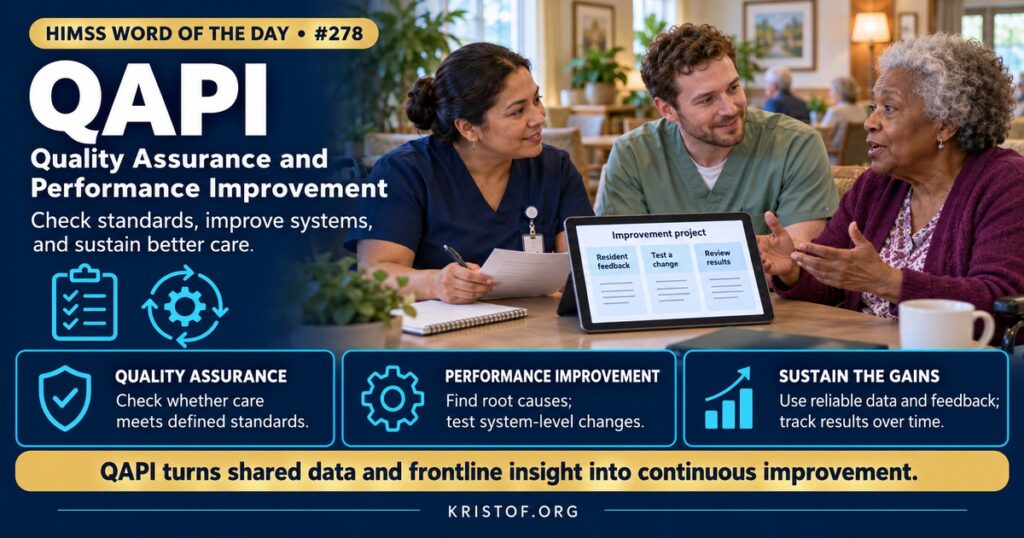
QAPI stands for quality assurance and performance improvement. The HIMSS Dictionary describes it as two parts of one quality management approach, applied together because each strengthens the other. Quality assurance (QA) checks whether care meets set standards. Performance improvement (PI) works proactively to improve processes and outcomes. The Dictionary adds that QAPI takes a systematic, comprehensive, data-driven approach to safety and quality in nursing homes and involves all nursing home caregivers in practical problem-solving. The term appears in the HIMSS Dictionary with the longer spelling “quality assessment performance improvement,” and federal regulations use “quality assurance and performance improvement.”
The requirement for nursing homes is in federal regulation at 42 CFR 483.75. A long-term care facility must develop, implement, and maintain an effective, comprehensive, data-driven QAPI program that focuses on indicators of the outcomes of care and quality of life.
| QAPI Element | What the Regulation Expects | Informatics Link |
|---|---|---|
| Design and scope | Ongoing, comprehensive, covering all systems of care | Data across departments |
| Feedback and data systems | Written policies for feedback, data collection, and monitoring | Reports, dashboards, resident and staff input |
| Adverse event monitoring | Systematically identify, report, track, and analyze events | Event reporting systems |
| Systematic analysis | Find underlying causes and develop system-level fixes | Root cause tools and data |
| Program activities | Set priorities and conduct improvement projects | Project tracking |
| Governance and leadership | Leadership accountable and resources provided | Committee reporting |
| Quality committee | Meets at least quarterly with defined members | Agenda and data packets |
⚠️ Exam Alert: QA checks compliance with standards; PI works to improve performance. QAPI combines them. In nursing homes the quality assessment and assurance committee must include the director of nursing, the medical director or designee, at least three other staff members including a leader, and the infection preventionist, and must meet at least quarterly.
🌐 Why It Matters: Real-World Healthcare IT Context
Nursing homes serve residents with complex needs, and care depends on many staff members across shifts and departments. A quality system built around inspections alone tends to catch problems after the fact. QAPI is meant to change that by making quality a continuous, shared activity.
The regulation is detailed. Under 42 CFR 483.75, the program must maintain documentation and demonstrate evidence of its ongoing operation, be designed to address all systems of care and management practices, and use the best available evidence to define and measure indicators of quality. Facilities must have written policies for feedback, data collection, and monitoring, including adverse event monitoring, and must use input from direct care staff, other staff, residents, and resident representatives to identify problems that are high risk, high volume, or problem-prone. They must act to improve performance and then measure success and track results to ensure improvements are sustained. They must use a systematic approach to find underlying causes and develop corrective actions designed to change systems, not just fix individual cases, and they must conduct distinct performance improvement projects, including at least one annually that focuses on a high-risk or problem-prone area. Governing bodies or executive leadership are accountable for maintaining the program, sustaining it through leadership and staffing changes, and resourcing it with staff time, equipment, and training. The regulation also states that good-faith attempts by the committee to identify and correct quality deficiencies will not be used as a basis for sanctions, an important protection for candid review.
Evidence shows that capability varies. A 2013 survey published in the Journal of the American Medical Directors Association, conducted when the Affordable Care Act first required QAPI, asked administrators at 3,000 nursing homes about their approaches (67 percent responded). On a scale of 1 to 10, homes rated themselves highest on quality assurance, at 7.2, and lowest on total quality management, at 4.1. Few used basic improvement tools: flow charts 23 percent, Plan-Do-Check-Act cycles 13 percent, and run charts 9 percent. The authors warned that the new regulations could be a challenge for administrators who lacked knowledge and technical expertise. The survey predates the current regulation and reflects self-assessment, but it shows the gap QAPI was designed to close.
More recent work shows how smaller steps can help. A 2026 article in the American Journal of Infection Control described small tests of change implemented by 24 nursing homes in a 12-month collaborative to reduce healthcare-associated infections. Small tests of change are small-scale projects designed to test an intervention quickly. With limited external support, facilities developed targeted tests, and the authors concluded that nursing homes can initiate such projects to improve infection prevention and control. The report is descriptive and does not establish effect sizes, but it fits the idea behind QAPI: test, learn, and adjust.
Informatics is the engine that makes QAPI practical. A committee cannot review data it cannot get. Nursing homes use their EHRs, minimum data set assessments, medication systems, incident reports, infection surveillance, and staffing and satisfaction data. Informatics staff can build reports that show falls, pressure injuries, weight loss, antipsychotic use, hospital transfers, and infections by unit and over time, with clear definitions. They can support event reporting that is easy and blame-free, create tracking tools for improvement projects, and help staff interpret run charts and control charts. Data quality matters: if documentation is inconsistent, the picture will mislead.
Common QAPI challenges:
- Data in many systems that cannot be combined easily
- Committees that review data but do not act
- Improvement projects without clear measures or owners
- Limited staff time and training in improvement methods
- Blame culture that discourages event reporting
- Programs that lapse when leaders or staff turn over
What supports effective QAPI:
- Leadership commitment and protected staff time
- Clear, shared definitions and reliable data
- Frontline staff and residents involved in identifying problems
- Simple improvement tools such as PDCA cycles and run charts
- Root cause analysis that leads to system-level change
- Tracking of projects until results are sustained
🏥 The Nurse’s Perspective: Clinical, Bedside, & Workflow
Nurses are central to QAPI because most quality indicators describe nursing care.
At the Bedside
Nurses and nursing assistants see problems first: a pattern of late-day falls, a rise in skin breakdown, medications arriving late. Reporting these observations, and taking part in small tests of change, such as a new toileting schedule on one unit, is the core of the program. Accurate documentation of assessments, incidents, and interventions makes the data trustworthy.
In Clinical Workflow
The director of nursing sits on the quality committee by regulation, and nurse leaders bring unit-level data and staff perspectives. Charge nurses and unit managers run improvement projects and share results at huddles. Infection preventionists, who must also sit on the committee, lead surveillance and prevention efforts.
Nurse informaticists help define indicators, build reports, set up event-reporting tools, and teach staff to read the data. They help ensure that new documentation workflows do not undermine the very indicators the facility is trying to improve.
In EHR Implementation (Go-Live Perspective)
An Epic Go-Live or other EHR implementation in long-term care changes how assessments and incidents are recorded, so quality reports must be rebuilt and validated early. At-the-elbow support analysts notice documentation patterns that will distort indicators, such as assessments entered in notes and not in structured fields, and they alert the quality team so definitions and training can be corrected quickly.
🎓 CAHIMS / CPHIMS & HIMSS Perspective
CAHIMS Exam Domain Mapping
QAPI appears in quality, regulation, and performance improvement questions:
| CAHIMS Domain | How QAPI Appears |
|---|---|
| Healthcare & Technology Environments | CMS regulations, long-term care, quality programs |
| Clinical Informatics | Indicators, documentation, event reporting, decision support |
| Healthcare Information & Systems Management | Reporting tools, dashboards, data quality, surveillance |
| Management & Leadership | Governance, committees, improvement methods, culture |
Key Terms to Know Alongside QAPI
- Quality Assurance (QA) — activities that check whether care meets standards
- Performance Improvement (PI) — proactive work to improve processes and outcomes
- PDCA Cycle — Plan-Do-Check-Act method for testing changes
- Root Cause Analysis — structured method to find underlying causes of problems
- Adverse Event Monitoring — systematic identification, tracking, and analysis of harmful events
- Run Chart — simple graph of a measure over time
HIMSS Organizational Position
HIMSS supports data-driven quality improvement across care settings through its research, education, and community work. Members can find related resources through the HIMSS Resource Center.
🔗 Explore Further: External References
- eCFR — 42 CFR 483.75, Quality Assurance and Performance Improvement https://www.ecfr.gov/current/title-42/chapter-IV/subchapter-G/part-483/subpart-B/section-483.75
- CMS — Nursing Home Quality Assurance and Performance Improvement https://www.cms.gov/medicare/health-safety-standards/quality-safety-oversight-general-information/nursing-home-quality-assurance-performance-improvement
- Smith et al. (2013), Journal of the American Medical Directors Association — Implementation of Quality Assurance and Performance Improvement Programs in Nursing Homes: A Brief Report https://pubmed.ncbi.nlm.nih.gov/23123004/
- Jones et al. (2026), American Journal of Infection Control — Applying Small Tests of Change to Advance Infection Prevention in Nursing Homes https://pubmed.ncbi.nlm.nih.gov/42202937/
- Bakerjian et al. (2013), Geriatric Nursing — Applying the Advancing Excellence in America’s Nursing Homes Circle of Success to Improving and Sustaining Quality https://pubmed.ncbi.nlm.nih.gov/23870372/
Term source: HIMSS Dictionary of Health Information and Technology Terms, Acronyms, and Organizations, 6th Edition (2025). All definitions in this series are paraphrased for editorial purposes. Readers are encouraged to consult the primary source for exact language.
Eric Andrew Kristof, RN, CAHIMS is a Healthcare IT professional and HIMSS Arkansas Chapter member based in Hot Springs Village, AR, with hands-on Epic Go-Live experience and a diverse healthcare and IT background. He writes at kristof.org at the intersection of clinical care and healthcare technology.
Leave a Reply