By Eric Andrew Kristof, RN, CAHIMS | Healthcare IT Professional | HIMSS Arkansas Chapter Member
About This Series: The HIMSS Word of the Day is a running blog series drawing from the HIMSS Dictionary of Health Information and Technology Terms, Acronyms, and Organizations, 6th Edition (2025) — the authoritative reference for healthcare IT professionals and the primary study resource for CAHIMS and CPHIMS certification. Each post paraphrases the term in plain language, grounds it in real-world healthcare IT context, and adds a bedside nursing perspective you won’t find in a textbook.
📖 The Term: Drug Interaction Database
Source: HIMSS Dictionary of Health Information and Technology Terms, Acronyms, and Organizations, 6th Edition (2025)
🔍 Plain-Language Definition
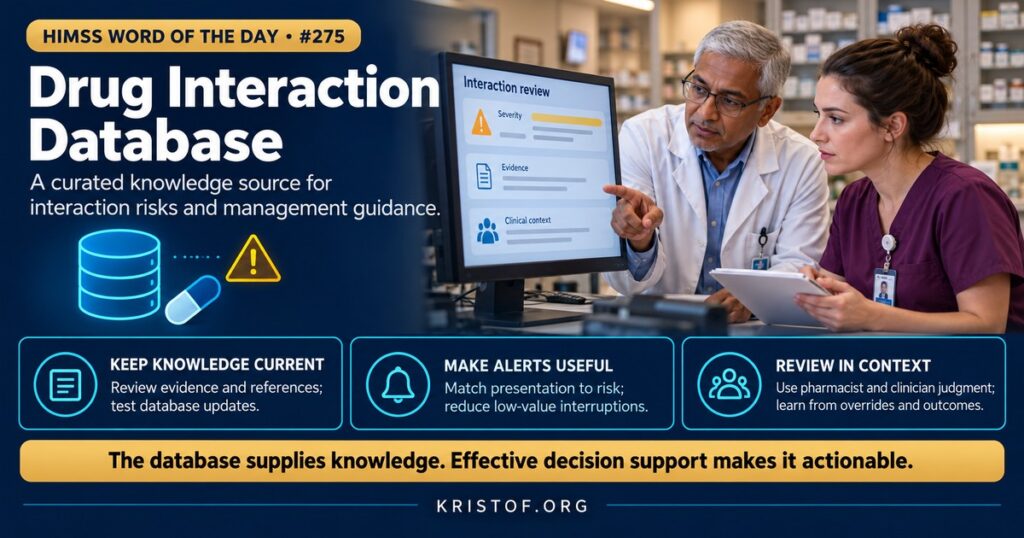
A drug interaction database is a database containing information about drug interactions. The HIMSS Dictionary gives it a short definition, but in practice it is a curated knowledge base, often licensed from a commercial vendor and embedded in the pharmacy, ordering, and medication administration systems. Each entry typically names the interacting drugs or drug classes, rates the severity, describes the effect and mechanism, and suggests management, such as monitoring, dose adjustment, or avoiding the combination.
Interactions come in several kinds: drug-drug, drug-food, drug-disease, and drug-allergy. A drug-drug interaction (DDI) occurs when one drug changes the effect or blood level of another. Some interactions are dangerous enough to prevent a combination; others call only for monitoring. Because the knowledge changes as new evidence and new drugs arrive, the database needs regular updates.
| Element | What It Provides | Why It Matters |
|---|---|---|
| Drug pairs and classes | Which combinations interact | Basis for alert logic |
| Severity rating | Contraindicated, major, moderate, minor | Drives alert tiers |
| Mechanism and effect | Why and how the interaction happens | Clinical reasoning |
| Management advice | Monitoring, dose change, alternatives | Actionable guidance |
| References | Evidence behind the entry | Trust and review |
| Local rules | Organization’s tailoring | Reduces noise |
⚠️ Exam Alert: A drug interaction database is the knowledge source; the alert is how the clinical decision support system presents it. Alert fatigue occurs when too many low-value alerts lead clinicians to override them all. Tiering shows only the most important interactions interruptively. Override rates alone do not prove an alert is ineffective.
🌐 Why It Matters: Real-World Healthcare IT Context
Medication errors and adverse drug events are a leading source of preventable harm, and interactions are one route. Computerized provider order entry with decision support was designed in part to catch them. The drug interaction database is the engine, and its value depends on accuracy, currency, and how its content is turned into alerts.
The main problem is volume. A 2024 systematic review and meta-analysis in Health Informatics Journal screened 1,873 records and included 16 articles. It found that the overall prevalence of DDI alerts generated by clinical decision support was 13 percent, and that physicians overrode 90 percent of the alerts. The pooled confidence intervals were wide and heterogeneity was extremely high, so the figures describe the scale of the problem and should not be read as a precise benchmark for any one hospital. The authors noted that overrides remained high even after systems were adjusted to reduce alerts, and concluded that alerts should be developed with attention to user experience to increase confidence and satisfaction. A broader systematic review of alerts in computerized physician order entry, covering 23 articles, found average override rates ranging from 46.2 to 96.2 percent. The share of overrides judged appropriate varied widely by alert type: for drug-drug interaction alerts it ranged from 0 to 95 percent. The most common override reasons were that the clinician would monitor the patient or that the patient had tolerated the combination before. These findings suggest that many overrides are reasonable, and that many alerts add little.
Design guidance exists. A 2015 consensus effort published in the Journal of the American Medical Informatics Association brought together a workgroup of 24 clinical, usability, and informatics experts from academia, vendors, health care organizations, and ONC, which met 12 times by web and twice in person. Its recommendations include consistent terminology, visual cues, minimal text, standard formatting and content, and reporting standards. It also advises that all clinicians involved in the medication-use process be able to view DDI alerts and the actions others took, that seven core elements be included in DDI decision support, and that override rates in their current form have limited capability to evaluate effectiveness. The group concluded that DDI decision support in its current form needs major improvement.
Alternatives to interruptive alerts have been tested. A retrospective analysis at University Hospital Zurich examined an on-demand DDI checker that clinicians could call when they chose. Over the treatment of 64,259 inpatients with 1,316,884 prescriptions, prescribers used it infrequently, about eight checks each, while nine consulting pharmacologists used it far more. The tool identified 16,553 interactions, fewer than 10 percent of the 169,192 that automatic triggering would have produced. On one medical ward, a visiting pharmacist recommended 128 adjustments to prevent interactions, and prescribers applied 76 percent of them, while automatic triggering would have produced about 45 times more alerts. The study is from one hospital and cannot show which approach prevents more harm, but it illustrates the trade-off between coverage and noise, and the value of pharmacist review.
Practical tuning includes limiting interruptive alerts to high-severity interactions, suppressing alerts for combinations already established on the patient’s profile, tailoring by patient factors such as kidney function when data exist, offering a quick path to alternatives, and making override reasons meaningful. Governance groups of pharmacists, physicians, nurses, and informaticists should review the database, local rules, alert statistics, and override reasons regularly. Updates from the vendor should be tested before release, since a change in severity or content can shift alert volume overnight.
Common drug interaction database problems:
- Too many low-value alerts, producing fatigue and blind overrides
- Severity ratings that differ between vendors and do not match local practice
- Alerts for interactions already known and being monitored
- Inconsistent alert display between ordering, pharmacy, and administration
- Slow or untested vendor updates
- Override reasons that are not reviewed
What supports effective interaction checking:
- Tiered alerts that interrupt only for the highest-risk combinations
- Governance by a multidisciplinary medication safety group
- Local tailoring informed by override and outcome data
- Consistent presentation across systems and roles
- Pharmacist review and on-demand checking to complement alerts
- Testing and monitoring around each knowledge base update
🏥 The Nurse’s Perspective: Clinical, Bedside, & Workflow
Nurses see interaction alerts at administration, and they often catch what ordering did not.
At the Bedside
At the point of medication administration, a nurse may see a warning about a combination that was ordered by different clinicians or that interacts with a recent dose. Pausing to understand the alert, checking the patient’s current status, and contacting the prescriber or pharmacist when the risk is real is core nursing practice. Nurses also watch for effects that the database cannot see, such as new confusion, bleeding, or low blood pressure.
In Clinical Workflow
Nurse managers listen to staff about which alerts are helpful and which are noise, and bring that to medication safety committees. Pharmacy and nursing together decide how to handle high-risk combinations on specific units, such as intensive care.
Nurse informaticists help evaluate alert design, review override data, and test changes with frontline staff. They advocate for alerts that appear at the right moment, in the right role, with a clear next step.
In EHR Implementation (Go-Live Perspective)
An Epic Go-Live turns on interaction checking with the organization’s chosen vendor knowledge base and local settings. At-the-elbow support analysts hear immediately which alerts nurses find unhelpful, and which they find essential. Those observations, gathered with pharmacy, feed the first round of tuning, which is often the most valuable for reducing alert fatigue.
🎓 CAHIMS / CPHIMS & HIMSS Perspective
CAHIMS Exam Domain Mapping
Drug interaction databases appear in decision support, medication safety, and knowledge management questions:
| CAHIMS Domain | How Drug Interaction Databases Appear |
|---|---|
| Healthcare & Technology Environments | Medication safety, knowledge sources, regulation of CDS |
| Clinical Informatics | Alert design, override analysis, workflow, evidence |
| Healthcare Information & Systems Management | Knowledge base updates, interfaces, testing, performance |
| Management & Leadership | Governance committees, vendor management, safety culture |
Key Terms to Know Alongside Drug Interaction Database
- Clinical Decision Support (CDS) — tools that provide knowledge and patient-specific information to guide care
- Alert Fatigue — reduced response to alerts because of volume
- Override — choice by a clinician to proceed despite an alert
- Drug-Drug Interaction (DDI) — change in a drug’s effect due to another drug
- Knowledge Base — curated collection of rules and content used by CDS
- Tiered Alert — alert design that varies presentation by severity
HIMSS Organizational Position
HIMSS supports medication safety and effective clinical decision support through its research, education, and community work. Members can find related resources through the HIMSS Resource Center.
🔗 Explore Further: External References
- Felisberto et al. (2024), Health Informatics Journal — Override Rate of Drug-Drug Interaction Alerts in Clinical Decision Support Systems: A Brief Systematic Review and Meta-Analysis https://pubmed.ncbi.nlm.nih.gov/38899788/
- Poly et al. (2020), JMIR Medical Informatics — Appropriateness of Overridden Alerts in Computerized Physician Order Entry: Systematic Review https://pubmed.ncbi.nlm.nih.gov/32706721/
- Payne et al. (2015), Journal of the American Medical Informatics Association — Recommendations to Improve the Usability of Drug-Drug Interaction Clinical Decision Support Alerts https://pubmed.ncbi.nlm.nih.gov/25829460/
- Beeler et al. (2013), Drug Safety — Use of an On-Demand Drug-Drug Interaction Checker by Prescribers and Consultants: A Retrospective Analysis in a Swiss Teaching Hospital https://pubmed.ncbi.nlm.nih.gov/23516005/
- FDA — Drug Development and Drug Interactions: Table of Substrates, Inhibitors and Inducers https://www.fda.gov/drugs/drug-interactions-labeling/drug-development-and-drug-interactions-table-substrates-inhibitors-and-inducers
Term source: HIMSS Dictionary of Health Information and Technology Terms, Acronyms, and Organizations, 6th Edition (2025). All definitions in this series are paraphrased for editorial purposes. Readers are encouraged to consult the primary source for exact language.
Eric Andrew Kristof, RN, CAHIMS is a Healthcare IT professional and HIMSS Arkansas Chapter member based in Hot Springs Village, AR, with hands-on Epic Go-Live experience and a diverse healthcare and IT background. He writes at kristof.org at the intersection of clinical care and healthcare technology.
Leave a Reply