By Eric Andrew Kristof, RN, CAHIMS | Healthcare IT Professional | HIMSS Arkansas Chapter Member
About This Series: The HIMSS Word of the Day is a running blog series drawing from the HIMSS Dictionary of Health Information and Technology Terms, Acronyms, and Organizations, 6th Edition (2025) — the authoritative reference for healthcare IT professionals and the primary study resource for CAHIMS and CPHIMS certification. Each post paraphrases the term in plain language, grounds it in real-world healthcare IT context, and adds a bedside nursing perspective you won’t find in a textbook.
📖 The Term: Foundational Interoperability
Source: HIMSS Dictionary of Health Information and Technology Terms, Acronyms, and Organizations, 6th Edition (2025)
🔍 Plain-Language Definition
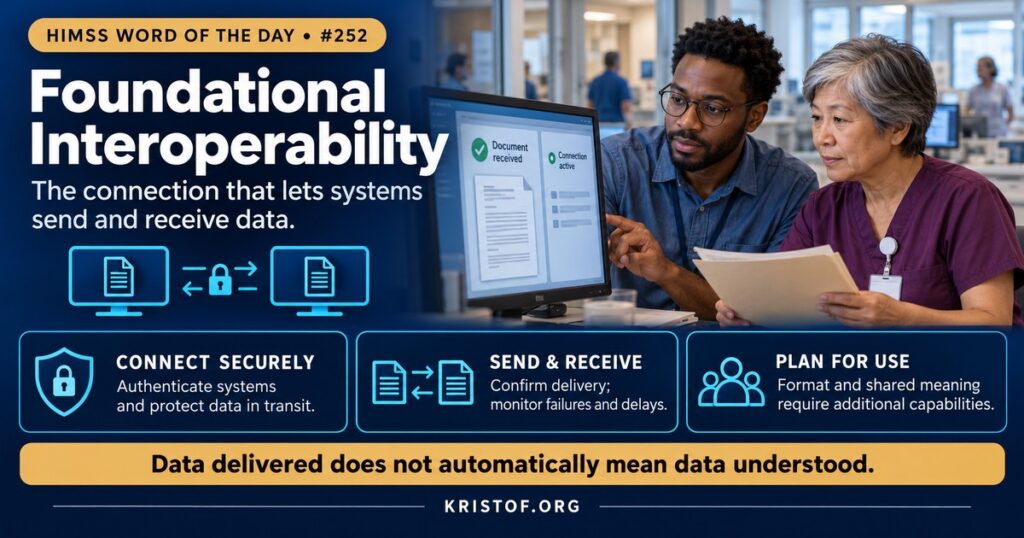
Foundational interoperability refers to the building blocks of information exchange: the connection requirements that allow one system or application to send data to, and receive data from, another. The HIMSS Dictionary points out an important limit. At this level, the receiving system is not expected to interpret the data on its own, without a person or other technology stepping in. In plain terms, foundational interoperability gets the data from here to there.
Think of it as the plumbing. It covers network connections, secure transport, authentication between systems, and agreements on how requests are made. It does not decide how the data are formatted or what they mean.
| Level | Question It Answers | Example |
|---|---|---|
| Foundational | Can the systems connect and exchange data? | Secure network link between two hospitals |
| Structural | Is the data format uniform so fields can be read? | HL7 or FHIR message with defined fields |
| Semantic | Do both sides share the same meaning? | Shared codes for diagnoses and lab tests |
| Organizational | Do policies, trust, and workflows support exchange? | Data sharing agreements and governance |
⚠️ Exam Alert: Foundational interoperability is the connection level, structural is the format level, and semantic is the meaning level. Foundational interoperability alone does not let the receiver interpret the data. Some frameworks call this level technical interoperability.
🌐 Why It Matters: Real-World Healthcare IT Context
Many of the visible failures of health information exchange are not about the connection. A fax is a connection. A PDF emailed over a secure link is a connection. The data arrive, and then a person reads them and re-enters what matters. That is foundational interoperability without the higher levels. It is better than nothing but leaves most of the burden on the receiver.
Researchers describe interoperability in layers. A 2025 scoping review of 24 publications from 2014 to 2023 on EHR interoperability described four levels visible in practice, technical or foundational, syntactic or structural, semantic, and process or organizational, compared with seven in the Levels of Conceptual Interoperability Model. The review found that semantic interoperability, preserving the meaning of exchanged data, is the main focus and the hardest problem, and that standardization of data structures, transfer protocols, terminologies, vocabularies, and ontologies is the most common approach, though there is a lack of consensus on standards. The authors also argued that a standardized data structure is not a prerequisite for useful interoperability and that focusing on the state of health records rather than full system integration can speed progress. For foundational interoperability, the practical lesson is that connection is necessary but a starting point.
Policy has pushed the foundation outward. The Office of the National Coordinator describes the Trusted Exchange Framework and Common Agreement, or TEFCA, as a nationwide framework for the interoperability of electronic health information, intended to connect providers, patients, public health agencies, and payers. TEFCA and the information blocking provisions came out of the 21st Century Cures Act. An ONC data brief on hospital interoperability as of 2021 presented trends in information exchange and the availability and use of information at the point of care, highlighted barriers, and described the methods hospitals use to exchange data and their participation in national networks and health information exchanges. The brief reflects a core principle: monitoring actual exchange is as important as building the capability.
Foundational work involves many technical decisions. Systems need secure transport, typically encrypted connections using current versions of Transport Layer Security as described in NIST guidance. They need authentication so that each side knows who is connecting, and authorization so that each side can only request what it is allowed to. They need agreed ways of making requests, such as web APIs and messaging protocols, and agreed ways of finding each other. They also need monitoring, because a connection that fails silently can delay results or orders without anyone knowing. Interface engines, API gateways, and health information exchange networks typically provide these functions.
For health systems, the lesson is to plan all levels together. Establishing a connection to an outside organization is only the first step. The team must also agree on formats, vocabularies, and workflows for using what arrives, and on governance for who may see what.
Common foundational interoperability problems:
- Connections that work in testing but fail under production volume
- Silent interface failures that nobody monitors
- Expired certificates or changed credentials that break exchange
- Data delivered as images or PDFs that require manual re-entry
- Multiple point-to-point links that are costly to maintain
- Assuming a connection means the data are usable
What supports a strong foundation:
- Standard, secure transport with current encryption
- Strong authentication and authorization between systems
- Interface monitoring with alerts and clear ownership
- Participation in health information exchange networks and frameworks
- Documentation of connections and certificate expirations
- Planning for structural and semantic needs from the start
🏥 The Nurse’s Perspective: Clinical, Bedside, & Workflow
Nurses experience foundational interoperability as the difference between waiting for information and having it.
At the Bedside
A transfer arrives from another facility. If the connection works, records can arrive before the patient. If not, nurses call, wait on hold, and receive faxes. Even when records arrive, if they are scanned images, nurses must read pages to find allergies or medications. Reporting what is missing, and how it arrived, helps teams see where the weak points are.
In Clinical Workflow
Case managers and transition nurses depend on records from other organizations. They can tell informatics teams which partners send timely information and which do not, and which documents are useful. Charge nurses notice the effects of interface downtime on lab results, orders, or admission feeds, and follow downtime procedures until service returns.
Nurse informaticists work with interface teams to define clinical requirements for connections, such as which events must trigger a message, and to test them with real scenarios.
In EHR Implementation (Go-Live Perspective)
An Epic Go-Live depends on dozens of connections to laboratory, imaging, pharmacy, devices, and outside networks. Teams test each one before go-live and monitor them closely afterward. At-the-elbow support analysts hear about missing results or delays first, and they relay specifics, such as the patient, time, and unit, so interface staff can trace the problem.
🎓 CAHIMS / CPHIMS & HIMSS Perspective
CAHIMS Exam Domain Mapping
Foundational interoperability appears in standards, networks, and infrastructure questions:
| CAHIMS Domain | How Foundational Interoperability Appears |
|---|---|
| Healthcare & Technology Environments | Levels of interoperability, national frameworks, regulation |
| Clinical Informatics | Clinical use cases, information availability at the point of care |
| Healthcare Information & Systems Management | Interfaces, APIs, secure transport, monitoring |
| Management & Leadership | Governance, participation in networks, vendor management |
Key Terms to Know Alongside Foundational Interoperability
- Structural Interoperability — uniform data format and syntax
- Semantic Interoperability — shared meaning of exchanged data
- TEFCA — nationwide framework for exchanging electronic health information
- Interface Engine — software that routes and translates messages between systems
- Transport Layer Security (TLS) — protocol that encrypts data in transit
- Health Information Exchange (HIE) — organization or network that moves health data between providers
HIMSS Organizational Position
HIMSS supports interoperability and health information exchange through its research, education, and public policy work. Members can find related resources through the HIMSS Resource Center and Public Policy and Advocacy pages.
🔗 Explore Further: External References
- HealthIT.gov — Interoperability https://healthit.gov/interoperability/
- HealthIT.gov — Trusted Exchange Framework and Common Agreement (TEFCA) https://healthit.gov/policy/tefca/
- NIST — SP 800-52 Rev. 2, Guidelines for the Selection, Configuration, and Use of TLS Implementations https://csrc.nist.gov/pubs/sp/800/52/r2/final
- El-Yafouri et al. (2025), Health Informatics Journal — A Scoping Review of Electronic Health Records Interoperability Levels, Expectations, Approaches, and Problems https://pubmed.ncbi.nlm.nih.gov/41134978/
- Pylypchuk and Everson (2023), ASTP Health IT Data Brief — Interoperability and Methods of Exchange among Hospitals in 2021 https://pubmed.ncbi.nlm.nih.gov/39475516/
Term source: HIMSS Dictionary of Health Information and Technology Terms, Acronyms, and Organizations, 6th Edition (2025). All definitions in this series are paraphrased for editorial purposes. Readers are encouraged to consult the primary source for exact language.
Eric Andrew Kristof, RN, CAHIMS is a Healthcare IT professional and HIMSS Arkansas Chapter member based in Hot Springs Village, AR, with hands-on Epic Go-Live experience and a diverse healthcare and IT background. He writes at kristof.org at the intersection of clinical care and healthcare technology.
Leave a Reply