By Eric Andrew Kristof, RN, CAHIMS | Healthcare IT Professional | HIMSS Arkansas Chapter Member
About This Series: The HIMSS Word of the Day is a running blog series drawing from the HIMSS Dictionary of Health Information and Technology Terms, Acronyms, and Organizations, 6th Edition (2025) — the authoritative reference for healthcare IT professionals and the primary study resource for CAHIMS and CPHIMS certification. Each post paraphrases the term in plain language, grounds it in real-world healthcare IT context, and adds a bedside nursing perspective you won’t find in a textbook.
📖 The Term: CDA (Clinical Document Architecture)
Source: HIMSS Dictionary of Health Information and Technology Terms, Acronyms, and Organizations, 6th Edition (2025)
🔍 Plain-Language Definition
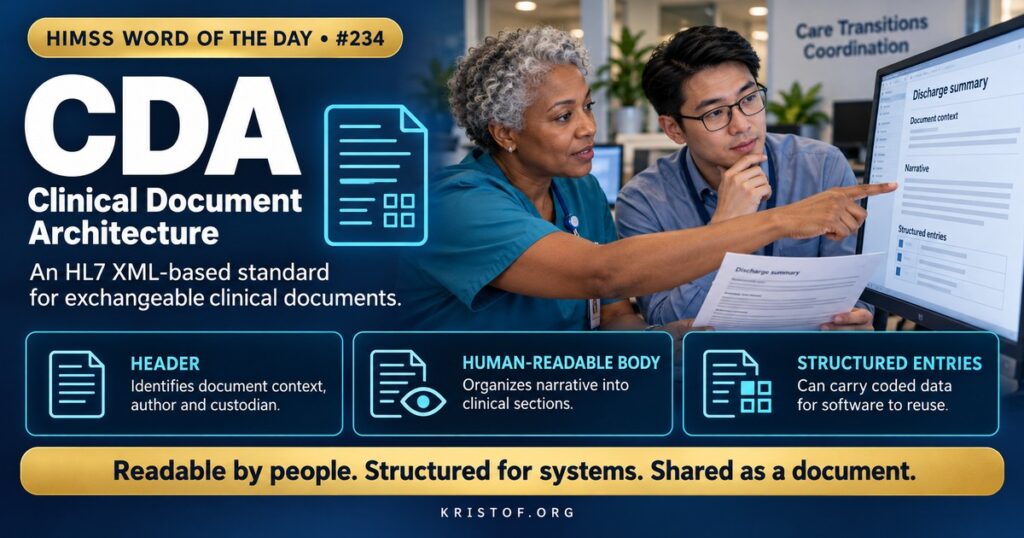
The Clinical Document Architecture (CDA) is an XML-based standard from HL7 that defines the structure and meaning of clinical documents so they can be exchanged. The HIMSS Dictionary notes that CDA was previously called the patient record architecture and that it covers items like discharge summaries and progress notes. By combining XML, the HL7 Reference Information Model, and coded vocabularies, CDA makes a document readable by software and readable by people.
HL7 describes CDA Release 2 as a document markup standard and defines a clinical document by six characteristics. The characteristics are what separate a legal, shareable record from a loose message or a screen view.
| Characteristic | Meaning |
|---|---|
| Persistence | The document continues to exist unaltered for a defined time |
| Stewardship | A custodian is responsible for maintaining it |
| Potential for authentication | It can be attested by a person or organization |
| Context | It establishes the setting for its contents |
| Wholeness | Authentication applies to the whole document, not to parts |
| Human readability | A person can read it |
⚠️ Exam Alert: CDA is the base standard; C-CDA is the US implementation guide that constrains CDA templates. A CDA is a document, so it is exchanged as a whole, while FHIR exchanges discrete resources through APIs. HL7 v2 is a message standard and is a different tool.
🌐 Why It Matters: Real-World Healthcare IT Context
Clinical care crosses organizations. A patient leaves one hospital with a discharge summary and arrives at a skilled nursing facility, a specialist, or a different emergency department. A document-based standard gives the receiving side a complete, attributable package: who wrote it, when, in what setting, and what it says. HL7 states that CDA can hold any type of clinical content, such as discharge summaries, imaging reports, admission and physical notes, and pathology reports, and that its most popular use is exchange between organizations, for example through health information exchanges. HL7 lists the current normative release as CDA R2.0, with an online edition published in 2024.
A CDA document has a header and a body. The header carries metadata: patient, author, custodian, encounter, and document type. The body is divided into sections, each with a human-readable narrative, and may include structured entries that carry coded data. This dual design is intentional. A receiving clinician who cannot process the coded data can still read the narrative, and a receiving system that can process the entries can reuse the data. The tradeoff is that the narrative and the entries can fall out of step if they are generated separately.
CDA by itself is a general framework. Interoperability in practice comes from templates that constrain it. In the United States, the Consolidated CDA, or C-CDA, defines document types such as the continuity of care document and discharge summary, along with section and entry templates, and it has been central to federal certification programs. Other countries and regions build their own CDA templates for summaries and reports.
Research shows both the value and the limits. A study of Consolidated CDA documents generated for 1,054 patients from a large US health system compared two sources: a regional health information exchange network and an EHR vendor network. Of the patients, 74 percent had at least one C-CDA document from either source, and among them, two-thirds had information in only one source. All documents contained demographics, but fewer than half of patients had data in clinical domains, and the data across networks were not concordant. The authors concluded that the networks hold different, likely complementary information and that integration and deduplication need to improve. A separate evaluation examined example documents from 52 certified health information technologies and found that although document exchange is prevalent, data quality barriers remain, which underscores the need to evaluate quality beyond schema conformance.
Where does this leave CDA relative to FHIR? Newer approaches expose individual resources through APIs, and many organizations support both. Documents remain valuable where a complete, signed snapshot is the point, and FHIR includes a document concept that can package resources in a similar way. Informaticists therefore need to understand CDA to read the existing exchange landscape, even as new work moves toward APIs.
Common CDA problems:
- Documents that pass validation but contain sparse or poorly coded content
- Narrative text that does not match the structured entries
- Receiving systems that display documents but do not import the data
- Inconsistent use of templates and vocabularies across vendors
- Duplicate data when documents from several sources are merged
- Limited testing with real clinical content before production
What supports effective document exchange:
- Agreed templates and vocabularies, with testing beyond schema validation
- Clinical review of sample documents from sending systems
- Clear rules for reconciliation of medications, allergies, and problems
- A readable narrative that stands on its own
- Monitoring of document quality after go-live
- Planning for FHIR alongside document exchange
🏥 The Nurse’s Perspective: Clinical, Bedside, & Workflow
Nurses are the readers and the sources of many CDA documents, even if the term never appears on screen.
At the Bedside
A transfer summary or discharge summary that arrives from another facility is often a CDA document. Nurses look for allergies, medications, lines and devices, skin status, and functional ability. If the document is cluttered or missing nursing information, that gap is a patient safety issue and should be reported for correction.
On the sending side, nursing documentation that is structured and complete flows into the outgoing summary. Free-text notes may not travel in a usable form.
In Clinical Workflow
Nurse case managers and transition coordinators depend on incoming documents to plan post-acute care. They notice quickly when a summary lacks the information a receiving facility needs. Nurse leaders help decide which sections matter to nursing and whether received data can be reconciled into the chart or only viewed.
Nurse informaticists review sample outgoing and incoming documents with clinicians, testing whether nursing content, such as care plans, pressure injury status, or fall risk, appears where expected and is understandable.
In EHR Implementation (Go-Live Perspective)
An Epic Go-Live includes the build and testing of outgoing summaries and incoming document display. Analysts compare test documents against the chart and check what happens when records arrive from outside systems. At-the-elbow support analysts hear where nurses cannot find outside information or where reconciliation workflows are unclear, and they bring those findings back to build teams.
🎓 CAHIMS / CPHIMS & HIMSS Perspective
CAHIMS Exam Domain Mapping
CDA appears in standards and exchange questions:
| CAHIMS Domain | How CDA Appears |
|---|---|
| Healthcare & Technology Environments | HL7 standards, document versus message standards |
| Clinical Informatics | Care summaries, transitions of care, reconciliation |
| Healthcare Information & Systems Management | Interface and document exchange, validation, templates |
| Management & Leadership | Certification requirements, vendor selection, data quality governance |
Key Terms to Know Alongside CDA
- C-CDA (Consolidated CDA) — US implementation guide of CDA templates
- HL7 RIM (Reference Information Model) — model underlying HL7 version 3 and CDA
- XML — markup language used to encode CDA documents
- Template — constraint pattern that defines how a section or entry is built
- HIE (Health Information Exchange) — network that moves documents and data between organizations
- FHIR — HL7 API-based standard built on discrete resources
HIMSS Organizational Position
HIMSS supports standards-based interoperability through its Interoperability and Health Information Exchange work, research, and education. Members can find related resources through the HIMSS Resource Center.
🔗 Explore Further: External References
- HL7 International — CDA Release 2 Product Brief https://www.hl7.org/implement/standards/product_brief.cfm?product_id=7
- HL7 International — C-CDA Product Brief https://www.hl7.org/implement/standards/product_brief.cfm?product_id=492
- HL7 — CDA R2.0 Online Edition 2024 https://hl7.org/cda/stds/online-navigation/index.html
- HealthIT.gov — Interoperability Standards Advisory https://isp.healthit.gov/
- Dixon et al. (2024), Studies in Health Technology and Informatics — Interoperability in the Wild: Comparison of Real-World Electronic C-CDA Documents from Two Sources https://pubmed.ncbi.nlm.nih.gov/38269762/
- D’Amore et al. (2018), AMIA Annual Symposium Proceedings — Interoperability Progress and Remaining Data Quality Barriers of Certified Health Information Technologies https://pubmed.ncbi.nlm.nih.gov/30815075/
Term source: HIMSS Dictionary of Health Information and Technology Terms, Acronyms, and Organizations, 6th Edition (2025). All definitions in this series are paraphrased for editorial purposes. Readers are encouraged to consult the primary source for exact language.
Eric Andrew Kristof, RN, CAHIMS is a Healthcare IT professional and HIMSS Arkansas Chapter member based in Hot Springs Village, AR, with hands-on Epic Go-Live experience and a diverse healthcare and IT background. He writes at kristof.org at the intersection of clinical care and healthcare technology.
Leave a Reply