By Eric Andrew Kristof, RN, CAHIMS | Healthcare IT Professional | HIMSS Arkansas Chapter Member
About This Series: The HIMSS Word of the Day is a running blog series drawing from the HIMSS Dictionary of Health Information and Technology Terms, Acronyms, and Organizations, 6th Edition (2025) — the authoritative reference for healthcare IT professionals and the primary study resource for CAHIMS and CPHIMS certification. Each post paraphrases the term in plain language, grounds it in real-world healthcare IT context, and adds a bedside nursing perspective you won’t find in a textbook.
📖 The Term: Access Control
Source: HIMSS Dictionary of Health Information and Technology Terms, Acronyms, and Organizations, 6th Edition (2025)
🔍 Plain-Language Definition
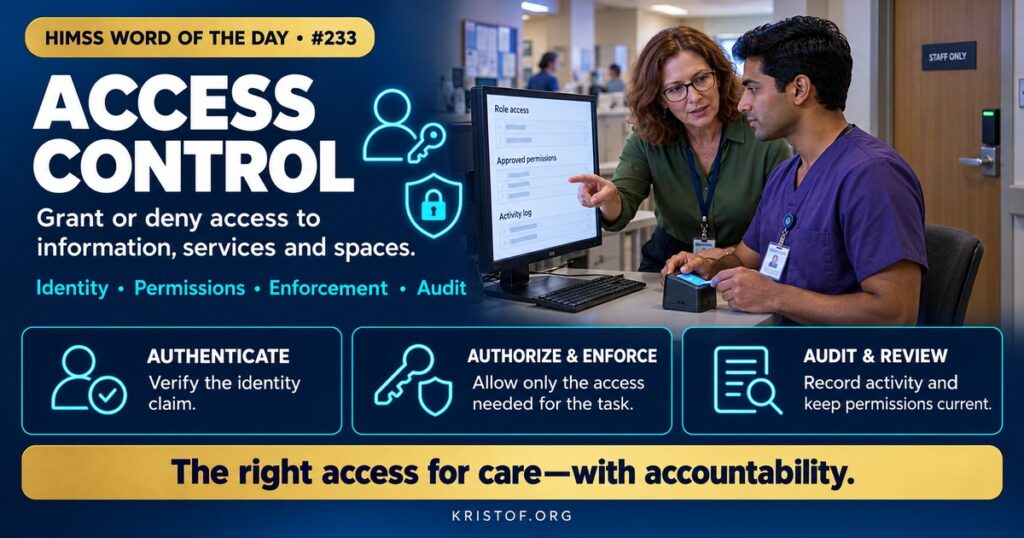
Access control is the process of deciding whether to grant or deny a request to use information and related services or to enter a physical facility. The HIMSS Dictionary describes both halves: logical access to data and systems, and physical access to buildings and rooms. In practice, access control answers three questions in sequence: who is this person or system, what are they allowed to do, and was the decision recorded?
Access control works through several layers. Identification and authentication establish identity. Authorization determines permissions, often through roles, attributes, or rules. Enforcement applies the decision at the point of access, and audit records what happened.
| Layer | What It Does | Clinical Example |
|---|---|---|
| Identification | Names the user or system | Unique login ID |
| Authentication | Verifies the claim | Password plus a second factor, badge tap |
| Authorization | Assigns permissions | Nurse role can chart but not prescribe |
| Enforcement | Applies the rule | System blocks a restricted report |
| Audit | Records activity for review | Log of who opened a chart |
| Physical Access | Controls entry to spaces | Badge access to medication rooms and data centers |
⚠️ Exam Alert: Authentication proves who you are; authorization decides what you may do; access control is the broader process that enforces both. Least privilege means granting only the access needed for the job. RBAC assigns access by role, while ABAC evaluates attributes and context.
🌐 Why It Matters: Real-World Healthcare IT Context
Patient information is valuable, sensitive, and used by many people for legitimate reasons. That combination requires access that is wide enough for care and narrow enough for privacy. Too much access exposes records to curiosity, theft, and misuse. Too little blocks care, which is why clinicians often work around controls that do not fit their work.
HIPAA addresses the technical side in the Security Rule at 45 CFR 164.312. The access control standard requires technical policies and procedures for electronic information systems that maintain electronic protected health information so that only persons or software programs that have been granted access rights may reach it. Required implementation specifications include unique user identification, meaning a unique name or number for identifying and tracking user identity, and an emergency access procedure for obtaining necessary information during an emergency. Addressable specifications include automatic logoff after a predetermined period of inactivity and encryption and decryption. The administrative safeguards in 45 CFR 164.308 add information access management, including policies for granting access and for establishing, documenting, reviewing, and modifying a user’s right of access. The physical safeguards address facility access and workstation security.
NIST’s control catalog in SP 800-53 gives the detail. The access control family includes account management, access enforcement, separation of duties, least privilege, limits on unsuccessful logon attempts, device lock, and remote access controls. Least privilege, in the catalog’s words, means allowing only authorized accesses that are necessary to accomplish assigned organizational tasks. Separation of duties means defining access authorizations so no single person can complete a sensitive process alone. Account management requires documenting account types, assigning account managers, and approving access.
Models for deciding who gets what vary. Role-based access control assigns permissions to roles such as registered nurse, pharmacist, or registration clerk, and users receive the roles they need. It is easy to administer, but roles tend to multiply and drift. Attribute-based access control, defined in NIST SP 800-162, determines authorization by evaluating attributes of the subject, the object, the requested operation, and sometimes environmental conditions against policy. That can express rules such as a clinician may view records only for patients on assigned units, or only during a shift, but it requires reliable attribute data.
Emergency access is where policy meets clinical reality. HIPAA requires a procedure for it because emergencies cannot wait for approvals. A common design is a break-the-glass feature in which a clinician can override a restriction after stating a reason, with the action logged and reviewed. For this to work, the override must be quick, the reasons must be meaningful, and reviews must happen. If it is too easy and unreviewed, it becomes a loophole.
Research reminds us that technical controls are only part of the story. A 2025 survey of 381 healthcare professionals in Riyadh hospitals found that 69.6 percent expressed confidence in safeguarding patient data from unauthorized access, 25.5 percent admitted to accessing colleagues’ electronic medical records without permission, and 24.6 percent were unaware or unsure of their organization’s privacy policies. The results come from self-reports in one city, but they illustrate why access control combines technology, policy, training, and monitoring. Another study analyzed three months of audit logs from a large hospital system with about 8,000 users and 140 roles to test whether roles could be predicted from actual access patterns, reporting that existing roles could be predicted with 50 percent accuracy and intelligent grouping could raise this to 65 percent. That finding suggests that formal roles and real behavior often diverge, which is a reason to review roles using usage data.
Common access control problems:
- Accounts kept after role changes or departures
- Shared or generic logins, especially on shared workstations
- Roles so broad that everyone has near-universal access
- Emergency access overrides that are never reviewed
- Controls that slow care and invite workarounds
- Access reviews done by managers who cannot tell what each user needs
What supports effective access control:
- Unique IDs for every user and system
- Least privilege with regular access reviews
- Role design informed by workflow and audit data
- Fast, logged emergency access with review
- Automatic provisioning and deprovisioning tied to HR events
- Training that explains the why, backed by consistent enforcement
🏥 The Nurse’s Perspective: Clinical, Bedside, & Workflow
Access control touches nursing practice constantly, from logging in to opening a chart to entering a medication room.
At the Bedside
Using only one’s own login, locking or logging out when leaving a workstation, and looking at charts only when care requires are daily habits that access control depends on. Nurses also need the access that care requires. If a float assignment or a new role lacks the right permissions, the safe response is to request access through the proper channel, not to borrow a colleague’s account.
Emergency access exists for urgent situations. Nurses who use it should give an accurate reason, since the entry will be reviewed.
In Clinical Workflow
Nurse managers request access for new staff, confirm role changes, and report departures. They take part in periodic access reviews, confirming whether each person still needs what they have. When a privacy audit flags access to a record without a clear reason, managers help investigate fairly.
Nurse informaticists design role templates with security teams so that nursing roles match real duties, including float pool, charge nurse, preceptor, and student roles. They also advise on usability problems such as session timeouts that interrupt care.
In EHR Implementation (Go-Live Perspective)
An Epic Go-Live involves provisioning hundreds or thousands of users into security classes before the first day. Teams test roles with real scenarios, set up emergency access, and plan for last-minute additions. At-the-elbow support analysts help with first logins and route permission problems to the security team the same day, reinforcing that sharing credentials is never the fix.
🎓 CAHIMS / CPHIMS & HIMSS Perspective
CAHIMS Exam Domain Mapping
Access control appears in security, privacy, and systems management questions:
| CAHIMS Domain | How Access Control Appears |
|---|---|
| Healthcare & Technology Environments | HIPAA Security Rule, privacy expectations, standards |
| Clinical Informatics | Role design, emergency access, workflow impact |
| Healthcare Information & Systems Management | Identity and access management, logging, provisioning, physical security |
| Management & Leadership | Policies, access reviews, sanctions, risk management |
Key Terms to Know Alongside Access Control
- Least Privilege — granting only the access necessary for a job
- Separation of Duties — dividing sensitive tasks among people
- RBAC (Role-Based Access Control) — permissions assigned through roles
- ABAC (Attribute-Based Access Control) — permissions determined by attributes and policy
- Emergency Access (Break-the-Glass) — logged override for urgent care
- Unique User Identification — individual ID that allows tracking of activity
HIMSS Organizational Position
HIMSS supports healthcare cybersecurity and privacy practices through its Healthcare Cybersecurity Community, research, and education. Members can find related resources through the HIMSS Resource Center.
🔗 Explore Further: External References
- eCFR — 45 CFR 164.312, Technical Safeguards (Access Control) https://www.ecfr.gov/current/title-45/subtitle-A/subchapter-C/part-164/subpart-C/section-164.312
- eCFR — 45 CFR 164.308, Administrative Safeguards (Information Access Management) https://www.ecfr.gov/current/title-45/subtitle-A/subchapter-C/part-164/subpart-C/section-164.308
- NIST — SP 800-53 Rev. 5, Security and Privacy Controls (Access Control Family) https://csrc.nist.gov/pubs/sp/800/53/r5/upd1/final
- NIST — SP 800-162, Guide to Attribute Based Access Control (ABAC) Definition and Considerations https://csrc.nist.gov/pubs/sp/800/162/upd2/final
- Qashqari et al. (2025), Saudi Medical Journal — Healthcare Professionals’ Perceptions of Electronic Medical Record Privacy and Its Impact on Work Quality in Riyadh Hospitals https://pubmed.ncbi.nlm.nih.gov/40096979/
- Zhang et al. (2011), AMIA Annual Symposium Proceedings — Role Prediction Using Electronic Medical Record System Audits https://pubmed.ncbi.nlm.nih.gov/22195144/
Term source: HIMSS Dictionary of Health Information and Technology Terms, Acronyms, and Organizations, 6th Edition (2025). All definitions in this series are paraphrased for editorial purposes. Readers are encouraged to consult the primary source for exact language.
Eric Andrew Kristof, RN, CAHIMS is a Healthcare IT professional and HIMSS Arkansas Chapter member based in Hot Springs Village, AR, with hands-on Epic Go-Live experience and a diverse healthcare and IT background. He writes at kristof.org at the intersection of clinical care and healthcare technology.
Leave a Reply