By Eric Andrew Kristof, RN, CAHIMS | Healthcare IT Professional | HIMSS Arkansas Chapter Member
About This Series: The HIMSS Word of the Day is a running blog series drawing from the HIMSS Dictionary of Health Information and Technology Terms, Acronyms, and Organizations, 6th Edition (2025) — the authoritative reference for healthcare IT professionals and the primary study resource for CAHIMS and CPHIMS certification. Each post paraphrases the term in plain language, grounds it in real-world healthcare IT context, and adds a bedside nursing perspective you won’t find in a textbook.
📖 The Term: ASC X12 Standard
Source: HIMSS Dictionary of Health Information and Technology Terms, Acronyms, and Organizations, 6th Edition (2025)
🔍 Plain-Language Definition
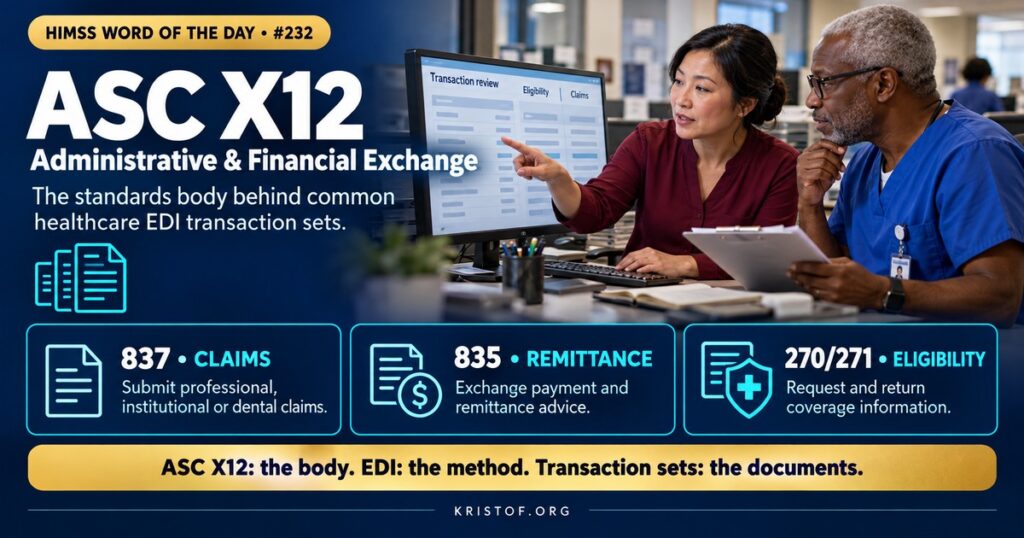
ASC X12 is the Accredited Standards Committee X12, a body under the American National Standards Institute (ANSI) charter that builds and maintains electronic data interchange (EDI) standards. The HIMSS Dictionary notes that X12 standards support business transactions across many industries, including finance, insurance, transportation, supply chains, and government, using a common, uniform business language. X12 describes its standards as consensus-based, interoperable, and syntax-neutral, drawing on more than 40 years of cross-industry development.
In health care, the best-known X12 products are the transaction sets named in HIPAA‘s Administrative Simplification rules. Each transaction set has a number and a defined purpose, and each is broken into segments and data elements so that two organizations can exchange the same business document without custom agreements.
| X12 Transaction | Purpose | Typical Sender and Receiver |
|---|---|---|
| 837 | Health care claim (professional, institutional, dental) | Provider to health plan |
| 835 | Payment and remittance advice | Health plan to provider |
| 270/271 | Eligibility inquiry and response | Provider to plan and back |
| 276/277 | Claim status inquiry and response | Provider to plan and back |
| 278 | Referral certification and authorization | Provider to plan and back |
| 834 | Benefit enrollment and maintenance | Sponsor to health plan |
⚠️ Exam Alert: ASC X12 is the standards body, EDI is the method, and 837 or 835 are transaction sets. Retail pharmacy transactions use NCPDP standards rather than X12. HL7 standards generally serve clinical exchange, while X12 serves administrative and financial exchange.
🌐 Why It Matters: Real-World Healthcare IT Context
Before standard transactions, every payer could require its own claim layout, and providers paid for custom interfaces or paper. HIPAA’s Administrative Simplification provisions directed HHS to adopt national standards for electronic exchange of administrative and financial information. The regulations in 45 CFR Part 162 name the standards for each transaction. For the health care claims or equivalent encounter information transaction, the adopted standards are the X12 version 5010 837 implementation guides for professional, institutional, and dental claims, and the pharmacy equivalent from NCPDP. The payment and remittance advice transaction uses the X12 835. The eligibility, claim status, referral certification, and enrollment transactions have their own sections in the same regulation.
The numbers matter because they identify versions as well as purposes. Version 5010 replaced the earlier 4010 family, and the rule text shows the transition periods that moved the industry from one version to the next. Version 5010 also accommodated the larger code fields needed for ICD-10, which is one reason the version change was a prerequisite for the diagnosis coding transition. More recently, HHS amended the same regulation to update the retail pharmacy standard to a newer NCPDP version with a transition window that ends in April 2028, while the X12 claim standards identified in the amended text remain 5010. Revenue cycle and interface teams track those dates because they affect testing and vendor upgrades.
A standard format is not enough for smooth exchange, because two systems can follow the standard and still disagree about what is required in a given field. That is the purpose of operating rules. CMS defines operating rules as the necessary business rules and guidelines for the electronic exchange of information that are not defined by a standard or its implementation specifications. The Affordable Care Act required their adoption, and CAQH CORE is the authoring entity of the operating rules currently adopted by HHS. CMS lists compliance dates of January 1, 2013, for eligibility and claim status operating rules, and January 1, 2014, for electronic funds transfers and remittance advice. Together, standards and operating rules aim to make the electronic route faster and more predictable than phone calls and portals.
Practically, an X12 file is a structured text stream. A transaction is wrapped in envelopes that identify the sender, the receiver, and the control numbers. Inside, repeating segments, each with positional data elements and separators, carry the facts: patient and subscriber identifiers, provider identifiers, diagnosis and procedure codes, charges, and dates. Because the structure is rigid, errors are caught by edits. A clearinghouse or payer returns acknowledgments and rejections, and denials come back in the remittance advice with reason codes. Understanding that flow helps analysts find where a problem started.
Where does clinical data come in? The claim is built from the clinical and registration record. Diagnoses, procedures, dates of service, rendering provider, referring provider, and authorization numbers all originate in documentation and scheduling. If those are wrong or missing, the claim file will be wrong or rejected, no matter how well the X12 translation is built. This is why clinical informatics and revenue cycle teams need a shared understanding of what the transaction requires.
Common X12 and EDI problems:
- Claims rejected for missing or invalid data elements
- Eligibility responses not read or acted on at registration
- Differences between payer companion guides and the standard
- Version or code set changes not tested before they take effect
- Remittance advice not posted automatically, leaving manual work
- No monitoring of acknowledgments between the practice and the clearinghouse
What supports reliable X12 exchange:
- A current inventory of trading partners and the transactions each uses
- Testing with each payer and clearinghouse before version changes
- Edits at the point of registration and charge capture
- Clear ownership of rejection and denial work queues
- Alignment with operating rules and companion guides
- Shared definitions between clinical, coding, and billing teams
🏥 The Nurse’s Perspective: Clinical, Bedside, & Workflow
Nurses rarely see an X12 file, but its edits shape what the unit is asked to document and what patients experience at the front desk.
At the Bedside
Complete documentation of procedures, supplies, times, and clinical findings supports accurate coding and billing. When a claim rejects because required information is missing, queries come back to clinical units. Understanding that the request traces to a claim edit helps nurses answer precisely instead of guessing.
Eligibility checks happen before care, and failed or delayed checks can postpone scheduled procedures. Nurses on procedural units often relay these delays to patients.
In Clinical Workflow
Nurse case managers and utilization review nurses work with authorization requests that travel through referral certification transactions. Knowing which clinical details a payer needs for an authorization speeds approval and reduces denials. Charge nurses and managers see the effects of denials on supply and procedure workflows.
Nurse informaticists help design documentation so that data needed for billing are captured once, as part of care, in structured form. They also join denial review groups where patterns show which clinical details are missing.
In EHR Implementation (Go-Live Perspective)
An Epic Go-Live includes interface testing for charges, claims, and eligibility. Revenue cycle analysts run claim files through the clearinghouse and watch rejection and denial patterns closely in the first weeks. At-the-elbow support analysts hear the clinical questions behind those patterns, such as where to document a required element, and pass them along so build and training can be corrected.
🎓 CAHIMS / CPHIMS & HIMSS Perspective
CAHIMS Exam Domain Mapping
X12 appears in standards, HIPAA administrative simplification, and revenue cycle questions:
| CAHIMS Domain | How X12 Appears |
|---|---|
| Healthcare & Technology Environments | HIPAA transaction standards, standards development organizations |
| Clinical Informatics | Documentation that supports claims, authorization and eligibility workflows |
| Healthcare Information & Systems Management | EDI, clearinghouses, interfaces, version transitions, companion guides |
| Management & Leadership | Compliance dates, trading partner management, revenue cycle governance |
Key Terms to Know Alongside X12
- EDI (Electronic Data Interchange) — structured electronic exchange of business documents
- Transaction Set — defined X12 document type, such as an 837 or 835
- Companion Guide — payer document describing its specific requirements within a standard
- Operating Rules — business rules that make standard transactions work consistently
- NCPDP — standards body for retail pharmacy transactions
- Clearinghouse — organization that converts and routes standard transactions
HIMSS Organizational Position
HIMSS supports standards-based exchange and administrative simplification through its education, research, and public policy work. Members can find related resources through the HIMSS Resource Center and Public Policy and Advocacy pages.
🔗 Explore Further: External References
- X12 — About X12 https://x12.org/about
- eCFR — 45 CFR 162.1102, Standards for Health Care Claims or Equivalent Encounter Information Transaction https://www.ecfr.gov/current/title-45/subtitle-A/subchapter-C/part-162/subpart-K/section-162.1102
- eCFR — 45 CFR Part 162, Administrative Requirements https://www.ecfr.gov/current/title-45/subtitle-A/subchapter-C/part-162
- CMS — Administrative Simplification: Transactions https://www.cms.gov/priorities/key-initiatives/burden-reduction/administrative-simplification/transactions
- CMS — Administrative Simplification: Operating Rules https://www.cms.gov/priorities/key-initiatives/burden-reduction/administrative-simplification/operating-rules
- CMS — Administrative Simplification https://www.cms.gov/priorities/key-initiatives/burden-reduction/administrative-simplification
Term source: HIMSS Dictionary of Health Information and Technology Terms, Acronyms, and Organizations, 6th Edition (2025). All definitions in this series are paraphrased for editorial purposes. Readers are encouraged to consult the primary source for exact language.
Eric Andrew Kristof, RN, CAHIMS is a Healthcare IT professional and HIMSS Arkansas Chapter member based in Hot Springs Village, AR, with hands-on Epic Go-Live experience and a diverse healthcare and IT background. He writes at kristof.org at the intersection of clinical care and healthcare technology.
Leave a Reply