By Eric Andrew Kristof, RN, CAHIMS | Healthcare IT Professional | HIMSS Arkansas Chapter Member
About This Series: The HIMSS Word of the Day is a running blog series drawing from the HIMSS Dictionary of Health Information and Technology Terms, Acronyms, and Organizations, 6th Edition (2025) — the authoritative reference for healthcare IT professionals and the primary study resource for CAHIMS and CPHIMS certification. Each post paraphrases the term in plain language, grounds it in real-world healthcare IT context, and adds a bedside nursing perspective you won’t find in a textbook.
📖 The Term: ETL (Extract, Transform, Load)
Source: HIMSS Dictionary of Health Information and Technology Terms, Acronyms, and Organizations, 6th Edition (2025)
🔍 Plain-Language Definition
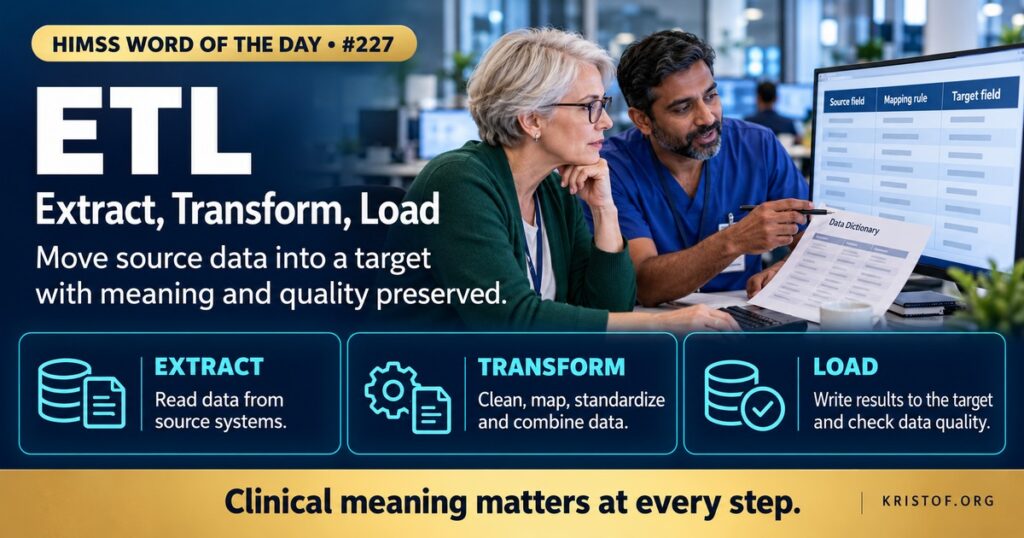
ETL, short for extract, transform, load, is a data process that combines three functions to move data from one database into another. According to the HIMSS Dictionary, extraction reads the data from a source, transformation converts the extracted data into the form the destination requires using rules, lookup tables, or combination with other data, and loading writes the result to the destination. Common uses include migrating data between databases, building data marts and data warehouses, and changing a database’s format or platform.
ETL is typically a batch or scheduled process, unlike a real-time interface that passes each message as it happens. Both move data, but they serve different goals: interfaces keep operational systems in step, while ETL prepares data for reporting, analysis, and archiving.
| Step | What Happens | Example |
|---|---|---|
| Extract | Read data from source systems | Pull vital signs and lab results from the EHR database |
| Transform | Clean, map, standardize, and combine | Convert local lab codes to a standard code; fix units |
| Load | Write the result to the target | Populate warehouse tables or a research data model |
| Quality Control | Check that the result is complete and correct | Compare counts and distributions with the source |
| Maintenance | Update the process as sources and standards change | Adjust mappings after an EHR upgrade |
⚠️ Exam Alert: In ETL, the transform step applies mapping, cleaning, and standardization. In ELT, the data are loaded first and transformed inside the target. ETL differs from an interface engine that routes individual messages in near real time. A data warehouse is often the destination.
🌐 Why It Matters: Real-World Healthcare IT Context
Operational systems are built to run care and billing, not to answer analytic questions across years of data. ETL extracts data from those systems and reshapes it for reporting and research. The result might be an enterprise data warehouse, a quality registry, a cohort discovery tool, or a copy of the data in a common data model that supports multi-site studies.
The transform step is where most of the risk and value lies. Source systems use local codes, free-text labels, different units, and different conventions for missing values. A good ETL maps local concepts to standard terminologies, harmonizes units, handles nulls explicitly, resolves duplicate patients, and documents every rule. Poor transformation silently changes meaning. A potassium result stored in the wrong unit or a smoking status mapped to the wrong category can distort a measure or a model while looking perfectly normal on the dashboard.
The OHDSI community, which maintains the OMOP common data model for observational research, describes ETL in its online book as a four-step process: design the ETL, create the code mappings, implement the ETL, and perform quality control. Its design step uses tools to scan source data and to map source tables and fields to the target, the mapping step uses a tool to match local codes to standard vocabularies, and the book also covers conventions and the ongoing maintenance that ETL requires. The sequence is useful for any ETL, not just research ones: understand the source, define the mappings with clinical input, build the process, and test it against the source before anyone relies on it.
Evidence from real conversions shows both feasibility and the need for checking. A Korean tertiary teaching hospital converted EHR data on 2.07 million patients who had visited between 1994 and 2014 into the OMOP common data model. After loading, an open-source data characterization program flagged 36 errors and 13 warnings, and the team reviewed and corrected 28 of the errors. The authors concluded the conversion let the hospital join an international distributed research network, and the exercise shows why automated quality checks belong in every ETL. A Mayo Clinic team built an open-source ETL tool to convert data from one research data model into another to help integrate COVID-19 data. In a test on 1,000 patients, records from 18 source tables were transformed into 12 target tables, with information loss in concept mapping below 0.61 percent. That level of loss was measured and reported, which is exactly the habit that builds trust.
Governance matters because ETL outputs become the source of truth for many decisions. When a metric changes after an upgrade, the first question should be whether the clinical practice changed or the ETL did. Version control, test data, reconciliation reports, and change management for ETL code reduce surprises. So do documented data lineage and owners who can explain, in clinical language, what each field means.
ETL is also central to migrations. When an organization moves to a new EHR, historical data may be converted into the new system or into an archive. The same questions apply: what is mapped, what is dropped, and who verified the result?
Common ETL problems:
- Mappings built by technical staff without clinical review
- Local codes mapped loosely, losing meaning
- Source system changes that silently break the process
- No reconciliation of counts or distributions against the source
- Undocumented business rules in code
- Slow or failing jobs that leave reports stale
What supports trustworthy ETL:
- Clinical and technical collaboration on mapping
- Automated data quality checks after each load
- Version control and documented transformation rules
- Reconciliation reports reviewed by data owners
- Change management tied to source system upgrades
- Monitoring that alerts when jobs fail or volumes shift
🏥 The Nurse’s Perspective: Clinical, Bedside, & Workflow
Nurses rarely see the ETL, but they see its results in dashboards, registries, and quality reports built from their documentation.
At the Bedside
Documentation choices affect what ETL can do. A pain score entered in a structured field can be mapped and trended. The same score typed into a note cannot. When nurses see a report that does not match what they remember, such as a fall rate that seems too low, specific examples help analysts trace the data back through the pipeline.
In Clinical Workflow
Nurse leaders and informaticists review mappings for nursing data, such as flowsheet rows, assessments, and interventions. Their knowledge decides whether two local rows should map to the same concept or stay separate. They also validate reports built on the warehouse by comparing counts to unit experience.
Nurse informaticists help set priorities for what the ETL should capture, argue for nursing concepts to be represented, and communicate changes in documentation practice to the data team so mappings stay current.
In EHR Implementation (Go-Live Perspective)
An Epic Go-Live changes where data come from. Reporting and warehouse teams update ETL jobs to match the new structures and compare outputs with legacy reports. At-the-elbow support analysts see early documentation patterns, such as new workarounds, and flag them so the data team can adjust mappings before bad data accumulate.
🎓 CAHIMS / CPHIMS & HIMSS Perspective
CAHIMS Exam Domain Mapping
ETL appears in data management, analytics, and migration questions:
| CAHIMS Domain | How ETL Appears |
|---|---|
| Healthcare & Technology Environments | Data standards, research networks, common data models |
| Clinical Informatics | Clinical review of mappings, nursing and clinical concepts |
| Healthcare Information & Systems Management | Data warehousing, migration, interfaces versus batch processing |
| Management & Leadership | Data governance, quality oversight, change control |
Key Terms to Know Alongside ETL
- Data Warehouse — integrated repository built for reporting and analysis
- Data Mart — subset of a warehouse focused on one area or audience
- Data Mapping — defining how source fields and codes correspond to target ones
- Common Data Model — standard structure for data from different sources
- Data Lineage — record of where data came from and how it was changed
- Data Quality Check — test that data are complete, valid, and consistent
HIMSS Organizational Position
HIMSS supports data-driven health care through its Analytics Maturity Assessment Model, research, and education. Members can find related resources through the HIMSS Resource Center and the AMAM page.
🔗 Explore Further: External References
- OHDSI — The Book of OHDSI: Extract Transform Load https://ohdsi.github.io/TheBookOfOhdsi/ExtractTransformLoad.html
- Yoon et al. (2016), Healthcare Informatics Research — Conversion and Data Quality Assessment of Electronic Health Record Data at a Korean Tertiary Teaching Hospital to a Common Data Model for Distributed Network Research https://pubmed.ncbi.nlm.nih.gov/26893951/
- Yu et al. (2022), Journal of Biomedical Informatics — Developing an ETL Tool for Converting the PCORnet CDM into the OMOP CDM to Facilitate the COVID-19 Data Integration https://pubmed.ncbi.nlm.nih.gov/35077901/
- HIMSS — Analytics Maturity Assessment Model (AMAM) https://www.himss.org/maturity-models/amam
- OHDSI — The Book of OHDSI: The Common Data Model https://ohdsi.github.io/TheBookOfOhdsi/CommonDataModel.html
- OHDSI — The Book of OHDSI: Standardized Vocabularies https://ohdsi.github.io/TheBookOfOhdsi/StandardizedVocabularies.html
Term source: HIMSS Dictionary of Health Information and Technology Terms, Acronyms, and Organizations, 6th Edition (2025). All definitions in this series are paraphrased for editorial purposes. Readers are encouraged to consult the primary source for exact language.
Eric Andrew Kristof, RN, CAHIMS is a Healthcare IT professional and HIMSS Arkansas Chapter member based in Hot Springs Village, AR, with hands-on Epic Go-Live experience and a diverse healthcare and IT background. He writes at kristof.org at the intersection of clinical care and healthcare technology.
Leave a Reply