By Eric Andrew Kristof, RN, CAHIMS | Healthcare IT Professional | HIMSS Arkansas Chapter Member
About This Series: The HIMSS Word of the Day is a running blog series drawing from the HIMSS Dictionary of Health Information and Technology Terms, Acronyms, and Organizations, 6th Edition (2025) — the authoritative reference for healthcare IT professionals and the primary study resource for CAHIMS and CPHIMS certification. Each post paraphrases the term in plain language, grounds it in real-world healthcare IT context, and adds a bedside nursing perspective you won’t find in a textbook.
📖 The Term: Predictive Modeling
Source: HIMSS Dictionary of Health Information and Technology Terms, Acronyms, and Organizations, 6th Edition (2025)
🔍 Plain-Language Definition
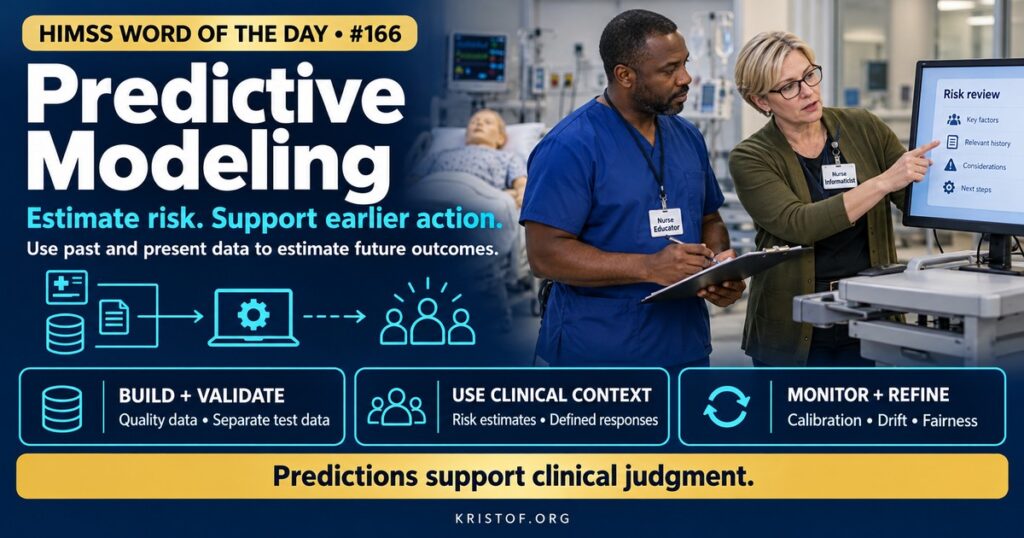
Predictive modeling is the use of statistical or machine learning techniques to analyze historical and current data and estimate the probability of future events or outcomes, such as clinical deterioration, readmission, no-shows, or high costs.
The HIMSS Dictionary describes predictive modeling as a common statistical technique for forecasting future behavior. It explains that predictive modeling solutions are a type of data mining technology that analyze past and present data to build a model that helps predict outcomes, and it outlines the process: collect data, formulate a statistical model, make predictions, and validate or revise the model as more data becomes available.
| Modeling Step | What Happens | Healthcare Example |
|---|---|---|
| Define the Outcome | Specify what will be predicted and when | Sepsis within the next 12 hours |
| Assemble Data | Gather relevant historical data | Vital signs, labs, diagnoses, medications |
| Build the Model | Fit a statistical or machine learning model | Logistic regression or gradient boosting |
| Validate | Test performance on separate data | Measuring discrimination and calibration |
| Deploy | Integrate predictions into workflow | Risk scores and alerts in the EHR |
| Monitor | Track performance over time | Detecting drift as practice or populations change |
⚠️ Exam Alert: Predictive modeling forecasts outcomes; descriptive analytics summarizes what happened; prescriptive analytics recommends what to do. Discrimination (such as AUC) measures how well a model ranks risk; calibration measures whether predicted probabilities match actual rates. External validation tests a model in a different population or setting.
🌐 Why It Matters: Real-World Healthcare IT Context
Predictive models promise earlier action. Identifying a patient at rising risk of sepsis, deterioration, or readmission can prompt timely assessment, treatment, or follow-up. Operationally, models can forecast census, staffing needs, and no-show rates. In population health, they identify patients who may benefit from care management.
Models range from simple scores to complex machine learning. Traditional early warning scores use a few vital signs and fixed thresholds. Modern models may use hundreds of variables from the EHR and be retrained periodically. Research using deep learning on EHR data has shown that models can predict outcomes such as in-hospital mortality and readmission across institutions.
Validation is essential. A widely cited 2021 external validation in JAMA Internal Medicine of a proprietary sepsis prediction model used in many hospitals found substantially lower performance than the developer reported, with many alerts and many missed cases. The study highlighted the need for independent evaluation before and after deployment.
Performance can change over time. Models trained on past data may drift as patient populations, documentation practices, treatments, and coding change. The COVID-19 pandemic illustrated how quickly conditions can shift. Ongoing monitoring and recalibration are part of responsible use.
Bias is a serious concern. If historical data reflects unequal access or treatment, models may underestimate risk for some groups. A well-known study of a commercial population health algorithm found that using health costs as a proxy for health needs led to racial bias in identifying patients for care management. Developers and health systems now examine performance across demographic groups.
Workflow integration determines value. Predictions that arrive too late, fire too often, or lack clear next steps contribute to alert fatigue and may be ignored. The most effective implementations pair predictions with defined responses, such as rapid response evaluation or nurse outreach.
Regulation and transparency are evolving. ONC’s HTI-1 rule introduced requirements for certified health IT to provide information about predictive decision support interventions, such as their intended use, development data, and validation, so users can judge whether a model fits their setting. FDA guidance addresses when clinical decision support software is regulated as a medical device.
Governance brings these elements together. Many health systems have established AI or algorithm governance committees to review models before deployment, monitor performance, and decide when to retire them.
Common predictive modeling problems:
- Performance that falls short in a new setting
- Drift as practice and populations change
- Bias that disadvantages some patient groups
- Too many alerts with too few actionable responses
- Lack of transparency about how models were built
- Predictions that use data unavailable in real time
Practices for responsible predictive modeling:
- Local validation before deployment
- Clear actions tied to predictions
- Monitoring of performance and fairness over time
- Transparency about data, intended use, and limitations
- Governance committees with clinical representation
- Retraining or retiring models when performance degrades
🏥 The Nurse’s Perspective: Clinical, Bedside, & Workflow
Nurses are often the first to see predictive scores and the ones expected to act on them.
At the Bedside
Deterioration and sepsis scores can prompt nurses to reassess patients, recheck vital signs, and escalate concerns. Scores should supplement, not replace, clinical judgment; a patient who looks unwell deserves attention even with a low score.
Accurate and timely documentation of vital signs and assessments matters because many models depend on nursing data. Delayed charting can delay predictions, and inaccurate entries can trigger false alerts.
In Clinical Workflow
Fall risk, pressure injury risk, and readmission risk predictions can guide prevention resources, such as targeted interventions or follow-up calls. Clear protocols tell nurses what to do for each risk level.
When alerts seem frequently wrong, nurses’ feedback helps governance teams evaluate model performance and adjust thresholds or workflows.
Nurse informaticists and clinical leaders participate in model governance, bringing knowledge of workflow and patient context to decisions about deployment.
Patients may ask about risk scores they see in portals or hear about. Nurses can explain that scores estimate likelihood and that the care team considers many factors.
In EHR Implementation (Go-Live Perspective)
During an Epic Go-Live, predictive models may be activated in the new system, sometimes after a silent period during which predictions are calculated but not shown, allowing performance to be checked locally.
At-the-elbow support analysts help nurses understand where scores appear and what actions are expected. Early feedback about alert volume helps teams tune settings before alert fatigue sets in.
🎓 CAHIMS / CPHIMS & HIMSS Perspective
CAHIMS Exam Domain Mapping
Predictive modeling appears in analytics, AI, and clinical decision support questions:
| CAHIMS Domain | How Predictive Modeling Appears |
|---|---|
| Healthcare & Technology Environments | AI trends; transparency requirements; FDA oversight of decision support |
| Clinical Informatics | Risk scores in workflow, alert fatigue, clinical judgment |
| Healthcare Information & Systems Management | Model development, validation, monitoring, data pipelines |
| Management & Leadership | AI governance, equity, resource allocation, vendor evaluation |
Key Terms to Know Alongside Predictive Modeling
- External Validation — testing a model in a population or setting different from where it was developed
- Calibration — agreement between predicted probabilities and observed outcomes
- Model Drift — declining performance as data or conditions change
- Algorithmic Bias — systematic errors that disadvantage certain groups
- Decision Support Intervention (DSI) — ONC’s term for decision support in certified health IT, including predictive models
- Early Warning Score — a score based on vital signs used to detect deterioration
HIMSS Organizational Position
HIMSS supports responsible AI and predictive analytics through education and resources emphasizing governance, transparency, validation, and equity. Members can find related education and research through the HIMSS Resource Center.
🔗 Explore Further: External References
- Wong et al. (2021), JAMA Internal Medicine — External Validation of a Widely Implemented Proprietary Sepsis Prediction Model in Hospitalized Patients https://pubmed.ncbi.nlm.nih.gov/34152373/
- Rajkomar et al. (2018), npj Digital Medicine — Scalable and Accurate Deep Learning With Electronic Health Records https://pubmed.ncbi.nlm.nih.gov/31304302/
- ONC — HTI-1 Final Rule https://healthit.gov/regulations/hti-rules/hti-1-final-rule/
- FDA — Clinical Decision Support Software Guidance https://www.fda.gov/regulatory-information/search-fda-guidance-documents/clinical-decision-support-software
- Obermeyer et al. (2019), Science — Dissecting Racial Bias in an Algorithm Used to Manage the Health of Populations https://pubmed.ncbi.nlm.nih.gov/31649194/
- HIMSS — Public Policy & Advocacy https://www.himss.org/public-policy-advocacy-overview
Term source: HIMSS Dictionary of Health Information and Technology Terms, Acronyms, and Organizations, 6th Edition (2025). All definitions in this series are paraphrased for editorial purposes. Readers are encouraged to consult the primary source for exact language.
Eric Andrew Kristof, RN, CAHIMS is a Healthcare IT professional and HIMSS Arkansas Chapter member based in Hot Springs Village, AR, with hands-on Epic Go-Live experience and a diverse healthcare and IT background. He writes at kristof.org at the intersection of clinical care and healthcare technology.
Leave a Reply