By Eric Andrew Kristof, RN, CAHIMS | Healthcare IT Professional | HIMSS Arkansas Chapter Member
About This Series: The HIMSS Word of the Day is a running blog series drawing from the HIMSS Dictionary of Health Information and Technology Terms, Acronyms, and Organizations, 6th Edition (2025) — the authoritative reference for healthcare IT professionals and the primary study resource for CAHIMS and CPHIMS certification. Each post paraphrases the term in plain language, grounds it in real-world healthcare IT context, and adds a bedside nursing perspective you won’t find in a textbook.
📖 The Term: Long-Term and Post-Acute Care (LTPAC)
Source: HIMSS Dictionary of Health Information and Technology Terms, Acronyms, and Organizations, 6th Edition (2025)
🔍 Plain-Language Definition
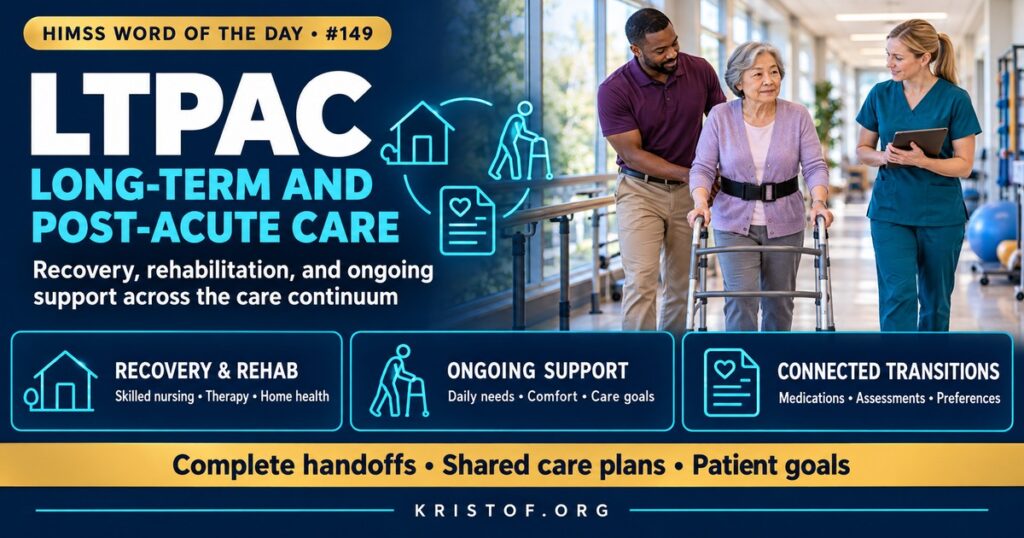
Long-term and post-acute care (LTPAC) refers to the range of healthcare and support services provided after or instead of acute hospital care, including recovery and rehabilitation after illness or surgery and ongoing care for people with chronic conditions or functional limitations.
The HIMSS Dictionary describes LTPAC as the part of the care continuum focused on comprehensive, longitudinal care for chronic conditions over extended periods. Its examples span nursing facilities that provide skilled care, care delivered in the home, end-of-life hospice services, hospitals for prolonged acute needs, rehabilitation units, assisted living, medication management services, the Program of All-Inclusive Care for the Elderly (PACE), and independent living support.
| LTPAC Setting | Typical Focus | Common Data or Assessment |
|---|---|---|
| Skilled Nursing Facility (SNF) | Short-term skilled care and rehabilitation; long-term nursing home care | Minimum Data Set (MDS) assessments |
| Home Health | Skilled nursing and therapy at home | OASIS assessments |
| Inpatient Rehabilitation Facility (IRF) | Intensive rehabilitation | Standardized functional assessments |
| Long-Term Care Hospital (LTCH) | Extended hospital-level care for complex patients | Standardized assessment data |
| Hospice | Comfort-focused end-of-life care | Hospice quality reporting data |
| PACE and Assisted Living | Community-based support for older adults | Care plans and service coordination |
⚠️ Exam Alert: Post-acute care typically follows a hospital stay and focuses on recovery; long-term care supports people with ongoing needs over extended periods. The IMPACT Act of 2014 required standardized patient assessment data across SNFs, home health, IRFs, and LTCHs. MDS is used in nursing facilities; OASIS in home health.
🌐 Why It Matters: Real-World Healthcare IT Context
LTPAC settings serve many of the most complex and vulnerable patients: older adults with multiple chronic conditions, people recovering from serious illness or surgery, and individuals at the end of life. Much of this care is delivered and coordinated by nurses, often with smaller staff and fewer resources than hospitals.
Health IT adoption in LTPAC has lagged behind hospitals and physician practices. LTPAC providers were generally not eligible for the federal EHR incentive programs that accelerated adoption in hospitals and practices, so many organizations adopted EHRs later and with fewer resources for interoperability. As a result, information exchange between hospitals and LTPAC providers has often relied on fax, phone, and paper.
Care transitions are high risk. Patients moving from a hospital to a skilled nursing facility or home health may arrive with incomplete medication lists, missing information about recent procedures, or unclear follow-up plans. Errors and omissions during these transitions can lead to adverse events and readmissions.
Policy has encouraged standardization. The IMPACT Act of 2014 required CMS to standardize patient assessment data elements across SNFs, home health agencies, IRFs, and LTCHs, enabling comparison and exchange. CMS quality reporting programs for these settings include measures addressing the transfer of health information to the next provider and to the patient.
Interoperability is improving. More LTPAC providers now use certified EHRs, participate in health information exchanges, receive admission and discharge notifications, and connect through national networks. Standards-based documents and FHIR APIs support sharing of medication lists, functional status, cognitive status, and care preferences.
Advance care planning is especially important in LTPAC. Advance directives, portable medical orders such as POLST forms, and documented goals of care must follow patients across settings so their wishes are honored, particularly during emergencies and hospital transfers.
Telehealth and remote monitoring are expanding in LTPAC. Virtual visits from physicians and specialists can reduce unnecessary transfers from nursing facilities, while home health agencies use remote monitoring to track vital signs and symptoms between visits. These tools depend on reliable connectivity, staff training, and clear escalation protocols.
Value-based payment raises the stakes. Bundled payments, accountable care organizations, and Medicare Advantage plans all depend on coordinated, efficient post-acute care. Hospitals increasingly build preferred networks of post-acute providers and share data to manage quality and cost across the episode.
Common LTPAC health IT challenges:
- Limited resources for EHR adoption and IT staff
- Fax-based transitions with incomplete information
- Missing or delayed discharge summaries and medication lists
- Advance directives that do not travel with patients
- Workforce turnover affecting training and documentation
- Inconsistent connections with hospitals and physicians
What strengthens LTPAC care and data exchange:
- Standardized assessment data across settings
- Electronic exchange of transition of care documents
- Admission, discharge, and transfer notifications
- Shared access to advance directives and care preferences
- Telehealth and remote monitoring support
- Partnerships between hospitals and post-acute providers
🏥 The Nurse’s Perspective: Clinical, Bedside, & Workflow
Nurses are the backbone of LTPAC, and nursing communication is central to safe transitions.
At the Bedside
In skilled nursing facilities and home health, nurses perform comprehensive assessments, manage medications, provide wound care, and monitor for changes in condition. Accurate assessment documentation, including MDS and OASIS data, drives care plans, quality reporting, and payment.
Receiving nurses depend on complete information from hospitals. Medication reconciliation at admission to a post-acute setting is one of the most important safety checks, catching discrepancies between hospital orders and the patient’s actual needs.
In Clinical Workflow
Hospital nurses preparing patients for transfer to LTPAC settings can improve safety by ensuring that discharge summaries, medication lists, recent results, and care instructions are complete and sent promptly. Nurse-to-nurse handoff calls supplement electronic documents.
Advance directives and goals-of-care discussions should be documented clearly and shared during transitions. Nurses often confirm that these documents accompany patients and are visible to the receiving team.
Home health nurses use telehealth and remote monitoring to track patients between visits, identifying early signs of decline that may prevent rehospitalization.
Turnover and staffing challenges in LTPAC make intuitive systems and efficient documentation especially important for nursing staff.
Families are frequent partners in LTPAC. Nurses who keep families informed, and who confirm who has authority to make decisions, help avoid confusion during changes in condition.
In EHR Implementation (Go-Live Perspective)
When hospitals implement new EHRs, connections with post-acute partners, such as electronic referrals, Direct messaging, and shared portals, must be tested and communicated. Changes in how discharge documents are sent can disrupt partners if they are not prepared.
At-the-elbow support analysts in hospitals can help case managers and nurses find referral tools and transition documents. Feedback from LTPAC partners after Go-Live helps identify information that is missing or arriving late.
🎓 CAHIMS / CPHIMS & HIMSS Perspective
CAHIMS Exam Domain Mapping
LTPAC appears in care continuum, interoperability, and policy questions:
| CAHIMS Domain | How LTPAC Appears |
|---|---|
| Healthcare & Technology Environments | Care settings; IMPACT Act; post-acute quality reporting; EHR adoption gaps |
| Clinical Informatics | Care transitions, medication reconciliation, advance directives, assessments |
| Healthcare Information & Systems Management | Transition documents, notifications, HIE, standardized assessment data |
| Management & Leadership | Post-acute networks, value-based care, workforce challenges |
Key Terms to Know Alongside LTPAC
- Skilled Nursing Facility (SNF) — a facility providing skilled nursing and rehabilitation services
- IMPACT Act — the 2014 law requiring standardized assessment data across post-acute settings
- Minimum Data Set (MDS) — the standardized assessment used in nursing facilities
- OASIS — the Outcome and Assessment Information Set used in home health
- Care Transition — the movement of a patient between settings or levels of care
- POLST — portable medical orders that communicate treatment wishes for seriously ill patients
HIMSS Organizational Position
HIMSS supports interoperability across the care continuum, including long-term and post-acute care, through its education, research, and public policy work. Members can find related education and research through the HIMSS Resource Center.
🔗 Explore Further: External References
- CMS — Skilled Nursing Facility Quality Reporting Program https://www.cms.gov/medicare/quality/snf-quality-reporting-program
- CMS — Home Health Quality Reporting Program https://www.cms.gov/medicare/quality/home-health
- CMS — OASIS Data Sets https://www.cms.gov/medicare/quality/home-health/oasis-data-sets
- Medicare.gov — PACE https://www.medicare.gov/health-drug-plans/health-plans/your-coverage-options/other-medicare-health-plans/PACE
- National POLST https://polst.org/
- National Institute on Aging — Advance Care Planning: Advance Directives for Health Care https://www.nia.nih.gov/health/advance-care-planning/advance-care-planning-advance-directives-health-care
Term source: HIMSS Dictionary of Health Information and Technology Terms, Acronyms, and Organizations, 6th Edition (2025). All definitions in this series are paraphrased for editorial purposes. Readers are encouraged to consult the primary source for exact language.
Eric Andrew Kristof, RN, CAHIMS is a Healthcare IT professional and HIMSS Arkansas Chapter member based in Hot Springs Village, AR, with hands-on Epic Go-Live experience and a diverse healthcare and IT background. He writes at kristof.org at the intersection of clinical care and healthcare technology.
Leave a Reply