By Eric Andrew Kristof, RN, CAHIMS | Healthcare IT Professional | HIMSS Arkansas Chapter Member
About This Series: The HIMSS Word of the Day is a running blog series drawing from the HIMSS Dictionary of Health Information and Technology Terms, Acronyms, and Organizations, 6th Edition (2025) — the authoritative reference for healthcare IT professionals and the primary study resource for CAHIMS and CPHIMS certification. Each post paraphrases the term in plain language, grounds it in real-world healthcare IT context, and adds a bedside nursing perspective you won’t find in a textbook.
📖 The Term: Anesthesia Information Management System (AIMS)
Source: HIMSS Dictionary of Health Information and Technology Terms, Acronyms, and Organizations, 6th Edition (2025)
🔍 Plain-Language Definition
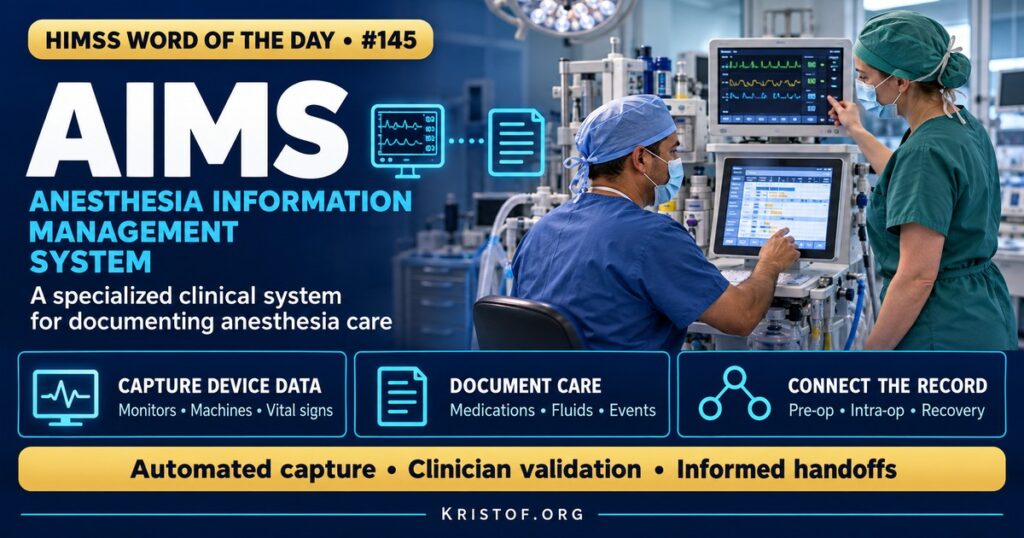
An anesthesia information management system (AIMS) is a specialized clinical information system that documents anesthesia care and captures patient data throughout the perioperative period, often by automatically collecting data from physiologic monitors, anesthesia machines, and other devices.
The HIMSS Dictionary describes an AIMS as an information system that communicates with other hospital and provider systems across the perioperative period, such as nursing clinical systems, clinical data repositories, and professional billing systems. It calls AIMS a specialized type of EHR that reliably and automatically collects, stores, and presents perioperative patient data. It adds that AIMS also support management, quality assurance, and research, usually combine hardware and software that connect to intraoperative monitors and often to the EHR, and, while focused on the intraoperative phase, can include preoperative and postoperative information.
| AIMS Function | What It Does | Example |
|---|---|---|
| Automated Data Capture | Records vital signs and device data from monitors and machines | Heart rate, blood pressure, oxygen saturation, ventilator settings |
| Medication and Fluid Documentation | Records drugs, infusions, fluids, and blood products | Induction medications and their times |
| Event Documentation | Captures key perioperative milestones | Anesthesia start, incision, intubation, emergence |
| Clinical Decision Support | Reminders and alerts during care | Prompts for antibiotic redosing |
| Billing and Compliance | Supports anesthesia time and documentation requirements | Accurate start and stop times for billing |
| Quality and Research Data | Structured data for analysis and registries | Submitting cases to national anesthesia registries |
⚠️ Exam Alert: An AIMS is a specialized EHR component for anesthesia care. Device integration allows automated capture of monitor data, but clinicians must still validate it. A perioperative information system may cover scheduling, nursing, and surgical documentation more broadly. Many organizations now use integrated EHR anesthesia modules rather than standalone AIMS.
🌐 Why It Matters: Real-World Healthcare IT Context
Anesthesia care generates large amounts of data in a short time, and decisions are made rapidly. Handwritten anesthesia records required providers to divide attention between the patient and the chart, and could be incomplete or hard to read. AIMS automate much of that recording, producing legible, time-stamped records.
AIMS have evolved from standalone record keepers in a few institutions to widely adopted systems integrated with hospital EHRs. A review in Anesthesia & Analgesia described how they now help manage and document the entire perioperative experience, with benefits for billing, research, and clinical care, while noting ongoing challenges.
Integration across the perioperative period matters. Preoperative assessments, allergies, home medications, and lab results flow into the anesthesia record, while intraoperative events, medications, and fluids flow out to recovery, inpatient units, and billing. When systems are not well integrated, information may be missed during handoffs.
Decision support is a growing benefit. AIMS can prompt for antibiotic redosing, flag abnormal values, remind providers about documentation requirements, and support protocols. A systematic review of near real-time decision support in AIMS found strong evidence that it improves compliance with perioperative antibiotic prophylaxis and clinical documentation, while calling for more research in other areas.
Data quality remains a challenge. Automatically captured data can include artifacts, such as a falsely low blood pressure when a cuff is disturbed or erroneous readings during patient movement. Providers must review and annotate artifacts so the legal record reflects reality. Default medication doses and templates must be designed carefully to avoid documentation errors.
AIMS data supports quality improvement and research. Structured anesthesia data can be aggregated to study outcomes, monitor practice patterns, and participate in national registries, such as the Anesthesia Quality Institute’s National Anesthesia Clinical Outcomes Registry. Multi-institutional collaborations use AIMS data to answer questions that single sites cannot.
AIMS increasingly extend beyond the operating room. Anesthesia care in endoscopy suites, interventional radiology, cardiac catheterization labs, and obstetric units also benefits from electronic documentation, though these locations bring challenges such as mobile equipment, different monitors, and varied workflows that require careful configuration.
Billing accuracy is another driver. Anesthesia billing depends on accurate times and documentation, and AIMS help capture this information consistently.
Common AIMS challenges:
- Artifacts in automatically captured data
- Alert fatigue in a high-workload environment
- Integration gaps with preoperative and postoperative systems
- Default doses or templates that introduce errors
- Device connectivity failures during cases
- Training needs for rotating anesthesia staff
Benefits of well-implemented AIMS:
- Legible, complete, time-stamped anesthesia records
- Automated vital sign capture that frees attention for the patient
- Decision support for timely interventions
- Better handoff information for recovery and inpatient teams
- Accurate billing and compliance documentation
- Structured data for quality improvement and research
🏥 The Nurse’s Perspective: Clinical, Bedside, & Workflow
Certified registered nurse anesthetists (CRNAs) and perioperative nurses work closely with AIMS and the data they produce.
At the Bedside
CRNAs use AIMS to document anesthesia care, medications, and events, relying on automated vital sign capture while validating data and annotating artifacts. A literature review in the AANA Journal summarized anesthesia personnel’s experiences with digital AIMS, including both benefits and frustrations.
Circulating nurses document intraoperative nursing care, positioning, counts, and specimens, often in systems connected to the anesthesia record. Consistent documentation across anesthesia and nursing records supports a complete picture of the procedure.
In Clinical Workflow
Post-anesthesia care unit nurses receive handoffs informed by the anesthesia record, including medications given, fluids, blood loss, airway management, and intraoperative events. Clear, complete AIMS documentation improves the quality of these handoffs.
Preoperative nurses gather allergies, medication histories, and assessments that flow into the anesthesia record. Accurate preoperative documentation helps anesthesia providers plan safe care.
Nurse informaticists in perioperative areas help configure documentation, device integration, and reports, balancing the needs of anesthesia, surgery, and nursing.
Medication safety in the operating room depends on accurate documentation. Labeling syringes, scanning medications where barcode systems are available, and recording doses promptly in the AIMS reduce the risk of errors in a fast-paced environment.
In EHR Implementation (Go-Live Perspective)
During an Epic Go-Live, perioperative and anesthesia modules require extensive testing of device integration, medication documentation, and handoff workflows. Rehearsals in operating rooms with real devices help identify connectivity and workflow problems before patients are involved.
At-the-elbow support in operating rooms requires specialized staff who understand both anesthesia workflows and sterile environment expectations. Quick resolution of device or documentation problems keeps cases on schedule and records accurate.
🎓 CAHIMS / CPHIMS & HIMSS Perspective
CAHIMS Exam Domain Mapping
AIMS appear in specialty system and device integration questions:
| CAHIMS Domain | How AIMS Appear |
|---|---|
| Healthcare & Technology Environments | Specialty clinical systems; national quality registries |
| Clinical Informatics | Anesthesia documentation, decision support, perioperative handoffs |
| Healthcare Information & Systems Management | Device integration, interfaces, data validation, EHR integration |
| Management & Leadership | Billing accuracy, quality programs, implementation planning |
Key Terms to Know Alongside AIMS
- Device Integration — automated transfer of data from medical devices into clinical systems
- Perioperative — the period before, during, and after surgery
- CRNA — certified registered nurse anesthetist, an advanced practice registered nurse providing anesthesia care
- Artifact — inaccurate data caused by interference or movement rather than patient physiology
- Handoff — the transfer of responsibility and information between clinicians
- Clinical Data Registry — an organized collection of standardized data for quality and research
HIMSS Organizational Position
HIMSS supports specialty clinical systems and device integration through its interoperability education and collaboration with IHE, which includes patient care device integration work. Members can find related education and research through the HIMSS Resource Center.
🔗 Explore Further: External References
- Simpao et al. (2018), Anesthesia & Analgesia — Anesthesia Information Management Systems https://pubmed.ncbi.nlm.nih.gov/29049075/
- Leonardsen et al. (2021), AANA Journal — Anesthesia Personnel’s Experiences With Digital Anesthesia Information Management Systems: A Literature Review https://pubmed.ncbi.nlm.nih.gov/34809756/
- Simpao et al. (2017), Journal of Clinical Monitoring and Computing — A Systematic Review of Near Real-Time and Point-of-Care Clinical Decision Support in Anesthesia Information Management Systems https://pubmed.ncbi.nlm.nih.gov/27530457/
- Anesthesia Quality Institute (ASA) https://www.asahq.org/aqi
- IHE International https://www.ihe.net/
- HIMSS — Nursing Informatics Community https://www.himss.org/networking/communities/nursing-informatics/
Term source: HIMSS Dictionary of Health Information and Technology Terms, Acronyms, and Organizations, 6th Edition (2025). All definitions in this series are paraphrased for editorial purposes. Readers are encouraged to consult the primary source for exact language.
Eric Andrew Kristof, RN, CAHIMS is a Healthcare IT professional and HIMSS Arkansas Chapter member based in Hot Springs Village, AR, with hands-on Epic Go-Live experience and a diverse healthcare and IT background. He writes at kristof.org at the intersection of clinical care and healthcare technology.
Leave a Reply