By Eric Andrew Kristof, RN, CAHIMS | Healthcare IT Professional | HIMSS Arkansas Chapter Member
About This Series: The HIMSS Word of the Day is a running blog series drawing from the HIMSS Dictionary of Health Information and Technology Terms, Acronyms, and Organizations, 6th Edition (2025) — the authoritative reference for healthcare IT professionals and the primary study resource for CAHIMS and CPHIMS certification. Each post paraphrases the term in plain language, grounds it in real-world healthcare IT context, and adds a bedside nursing perspective you won’t find in a textbook.
📖 The Term: National Provider Identifier (NPI)
Source: HIMSS Dictionary of Health Information and Technology Terms, Acronyms, and Organizations, 6th Edition (2025)
🔍 Plain-Language Definition
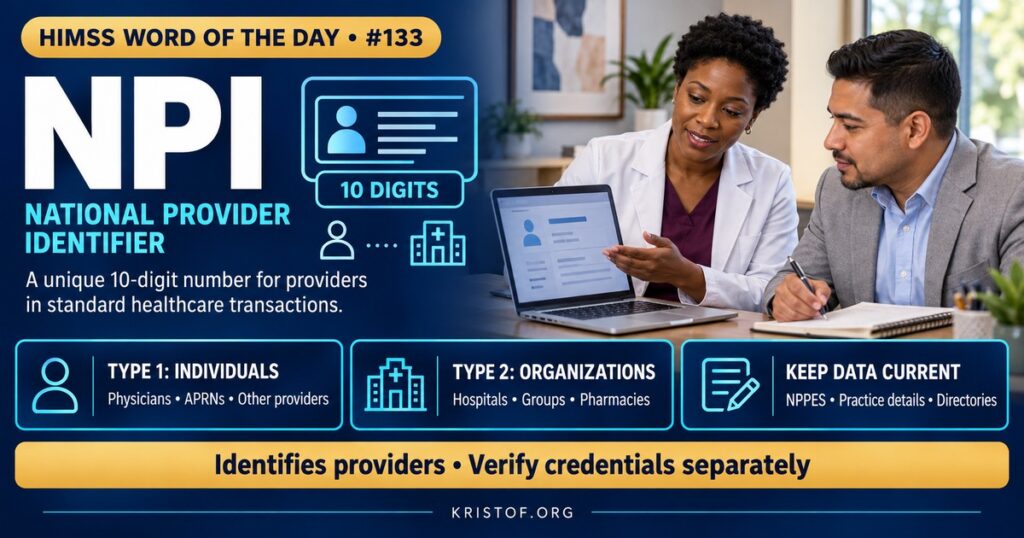
The National Provider Identifier (NPI) is a unique 10-digit number assigned to healthcare providers in the United States and used to identify them in HIPAA standard electronic transactions, such as claims and eligibility inquiries.
The HIMSS Dictionary describes the NPI as a system for uniquely identifying providers of healthcare services, supplies, and equipment, and as a HIPAA Administrative Simplification standard. It explains that covered providers, health plans, and clearinghouses must use NPIs in HIPAA administrative and financial transactions, that the number is a 10-digit numeric identifier carrying no information about the provider, such as location or specialty, and that it replaced earlier legacy identifiers in standard transactions.
| NPI Concept | What It Means | Example |
|---|---|---|
| Type 1 NPI | Assigned to individual providers | A physician, nurse practitioner, or pharmacist |
| Type 2 NPI | Assigned to organizations | A hospital, clinic group, pharmacy, or home health agency |
| NPPES | The CMS system that assigns NPIs and stores provider data | A provider applies online for an NPI |
| NPI Registry | Public lookup of NPI information | Verifying a referring provider’s NPI |
| Intelligence-Free | The number contains no embedded meaning | Moving to another state does not change the NPI |
⚠️ Exam Alert: The NPI identifies providers in HIPAA transactions. It is not a license number, a DEA number (which relates to controlled substance prescribing), or a Tax Identification Number. An individual keeps the same NPI for life, even when changing jobs or states. NPPES is the system that assigns NPIs.
🌐 Why It Matters: Real-World Healthcare IT Context
Before the NPI, providers often had different identifiers for each health plan, which complicated billing and data sharing. HIPAA’s Administrative Simplification provisions called for a standard unique identifier, and the NPI Final Rule established it, with most covered entities required to use NPIs by May 2007 and small health plans by May 2008.
Today the NPI appears throughout healthcare transactions. Claims identify billing, rendering, referring, and ordering providers by NPI. E-prescriptions include the prescriber’s NPI. Eligibility checks, referrals, prior authorizations, and remittances rely on NPIs to match providers across organizations.
NPIs are assigned through the National Plan and Provider Enumeration System (NPPES), which CMS maintains. Providers or their organizations apply, and the public NPI Registry allows anyone to look up basic NPI information, such as name, practice location, and taxonomy code describing specialty.
Data quality is a persistent issue. Providers are responsible for updating their NPPES information, but addresses, phone numbers, and practice locations often become outdated. Inaccurate provider data contributes to claim denials, misdirected communications, and unreliable provider directories that frustrate patients trying to find in-network care.
NPIs also support analytics and program integrity. Researchers, payers, and regulators use NPIs to link claims, quality data, and prescribing patterns to providers, and federal programs use them in enrollment and fraud prevention activities.
Directory accuracy has drawn regulatory attention. Federal law now requires many health plans to maintain accurate provider directories and to verify information regularly, and CMS has explored ways to improve national provider directory data. Because NPIs are the common key linking provider records across systems, they are central to these efforts, even though the NPI alone does not keep addresses or network status current.
The NPI is an identifier, not a credential. Having an NPI does not mean a provider is licensed, enrolled with a payer, or credentialed at a facility. Organizations must still verify licenses and credentials separately.
Organizational structure adds complexity. A large health system may hold many Type 2 NPIs for different hospitals, clinics, and service lines, and choosing the correct one on each claim depends on accurate configuration of billing locations and provider relationships in the EHR and billing system.
Common NPI-related problems:
- Outdated addresses and contact information in NPPES
- Confusing individual and organizational NPIs on claims
- Missing ordering or referring provider NPIs
- Mismatched provider data across systems
- Assuming an NPI confirms licensure or enrollment
- Duplicate or incorrect provider records in EHRs
Practices that support accurate NPI use:
- Centralized provider master data management
- Regular NPPES updates by providers and organizations
- Claim edits that check NPI formatting and roles
- Credentialing processes that verify NPIs alongside licenses
- Integration of NPI data with provider directories
- Clear ownership of provider data quality
🏥 The Nurse’s Perspective: Clinical, Bedside, & Workflow
Nurses encounter NPIs in ordering, referral, and billing workflows, and advanced practice nurses have their own.
At the Bedside
Advanced practice registered nurses, such as nurse practitioners, clinical nurse specialists, certified nurse-midwives, and certified registered nurse anesthetists, obtain individual NPIs to bill, order, prescribe, and refer. Registered nurses may also apply for NPIs, although many do not need them for their roles.
Orders entered on behalf of providers under protocols must identify the correct ordering provider. When the wrong provider is selected, claims may be denied or results routed to the wrong clinician.
In Clinical Workflow
Referral and care coordination nurses often verify that referring and receiving providers are correctly identified. The NPI Registry can confirm a provider’s information when records conflict.
Home health, durable medical equipment, and some services require documentation of the ordering or certifying provider’s NPI. Nurses coordinating these services help prevent delays by ensuring that orders include complete provider information.
Nurses who move into advanced practice should apply for an NPI early and keep NPPES information current as they change employers or practice locations.
Students and new graduates in advanced practice programs often need NPIs for clinical rotations or early employment, so applying through NPPES as soon as eligible avoids onboarding delays.
In EHR Implementation (Go-Live Perspective)
During an Epic Go-Live, provider records, including NPIs, taxonomy codes, and practice locations, are loaded into the new system. Errors in provider master data can cause claim failures, misrouted results, and e-prescribing problems from the first day.
At-the-elbow support analysts may see issues such as a provider missing from an ordering list or a prescription rejected because of provider data. Escalating these quickly to provider data teams prevents widespread downstream errors.
🎓 CAHIMS / CPHIMS & HIMSS Perspective
CAHIMS Exam Domain Mapping
The NPI appears in HIPAA, revenue cycle, and data management questions:
| CAHIMS Domain | How the NPI Appears |
|---|---|
| Healthcare & Technology Environments | HIPAA Administrative Simplification; CMS; NPPES |
| Clinical Informatics | Ordering and referring provider identification; APRN practice |
| Healthcare Information & Systems Management | Provider master data, claims transactions, directories, identifiers |
| Management & Leadership | Revenue cycle, credentialing, data governance, program integrity |
Key Terms to Know Alongside NPI
- NPPES — the National Plan and Provider Enumeration System that assigns NPIs
- Administrative Simplification — HIPAA provisions establishing standards for transactions, code sets, and identifiers
- Taxonomy Code — a code describing a provider’s type and specialty
- DEA Number — a registration number for prescribing controlled substances
- Provider Directory — a listing of providers and their contact and network information
- Credentialing — verifying a provider’s qualifications, licensure, and history
HIMSS Organizational Position
HIMSS supports standard identifiers and accurate provider data as building blocks for interoperability and administrative simplification through its education and policy work. Members can find related education and research through the HIMSS Resource Center.
🔗 Explore Further: External References
- CMS — National Provider Identifier Standard (NPI) https://www.cms.gov/Regulations-and-Guidance/Administrative-Simplification/NationalProvIdentStand
- CMS — National Plan and Provider Enumeration System (NPPES) https://nppes.cms.hhs.gov/
- CMS — NPI Registry https://npiregistry.cms.hhs.gov/
- CMS — Administrative Simplification https://www.cms.gov/priorities/key-initiatives/burden-reduction/administrative-simplification
- HHS — Covered Entities and Business Associates https://www.hhs.gov/hipaa/for-professionals/covered-entities/index.html
- HIMSS — Public Policy & Advocacy https://www.himss.org/public-policy-advocacy-overview
Term source: HIMSS Dictionary of Health Information and Technology Terms, Acronyms, and Organizations, 6th Edition (2025). All definitions in this series are paraphrased for editorial purposes. Readers are encouraged to consult the primary source for exact language.
Eric Andrew Kristof, RN, CAHIMS is a Healthcare IT professional and HIMSS Arkansas Chapter member based in Hot Springs Village, AR, with hands-on Epic Go-Live experience and a diverse healthcare and IT background. He writes at kristof.org at the intersection of clinical care and healthcare technology.
Leave a Reply