By Eric Andrew Kristof, RN, CAHIMS | Healthcare IT Professional | HIMSS Arkansas Chapter Member
About This Series: The HIMSS Word of the Day is a running blog series drawing from the HIMSS Dictionary of Health Information and Technology Terms, Acronyms, and Organizations, 6th Edition (2025) — the authoritative reference for healthcare IT professionals and the primary study resource for CAHIMS and CPHIMS certification. Each post paraphrases the term in plain language, grounds it in real-world healthcare IT context, and adds a bedside nursing perspective you won’t find in a textbook.
📖 The Term: Radiology Information System (RIS)
Source: HIMSS Dictionary of Health Information and Technology Terms, Acronyms, and Organizations, 6th Edition (2025)
🔍 Plain-Language Definition
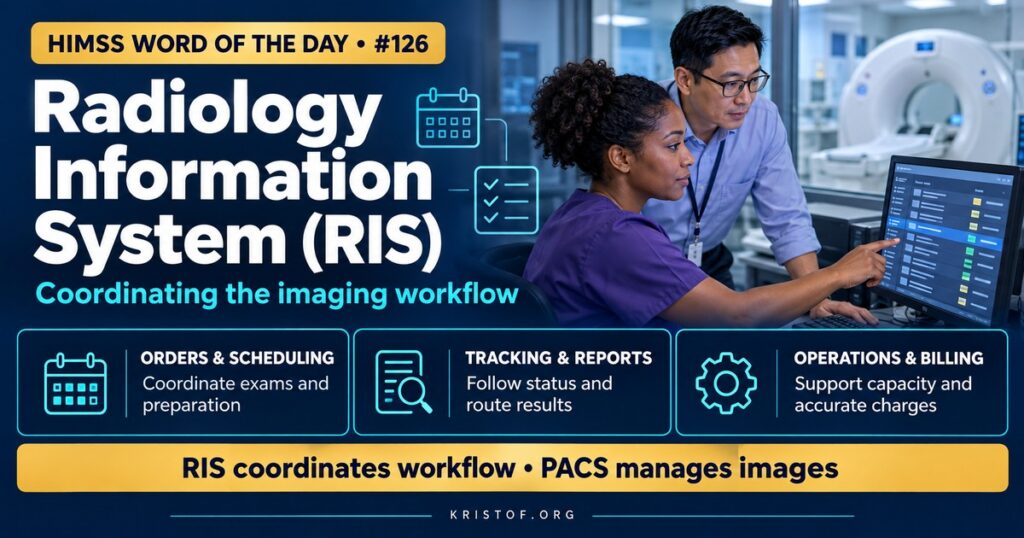
A radiology information system (RIS) is a departmental software system that manages the workflow and business processes of medical imaging, including orders, scheduling, patient tracking, technologist documentation, reporting, and billing.
The HIMSS Dictionary offers two related descriptions. It describes a RIS as networked software for managing medical images and related data, noting its particular value for tracking imaging orders and billing, and its frequent use alongside PACS and vendor neutral archives for image storage, records, and billing. It also describes a RIS as an information system for creating, storing, and managing radiology data and patient images.
| System | Primary Role | Example |
|---|---|---|
| EHR | Places orders and displays results to the care team | A clinician orders a chest CT |
| RIS | Manages orders, scheduling, tracking, reports, and billing | The CT is scheduled and the exam status is tracked |
| Modality | The imaging equipment that acquires images | The CT scanner receives the patient from a worklist |
| PACS | Stores, displays, and distributes images | The radiologist views the CT images |
| VNA (Vendor Neutral Archive) | Long-term, standards-based image storage across departments | Images archived for enterprise access |
⚠️ Exam Alert: A RIS manages workflow and data about imaging (orders, schedules, reports, billing). PACS manages the images themselves. DICOM is the standard for images and imaging communication; HL7 messages typically carry orders and results between the EHR and RIS. Many modern EHRs include integrated radiology modules that perform RIS functions.
🌐 Why It Matters: Real-World Healthcare IT Context
Imaging is central to diagnosis, and the imaging workflow involves many handoffs. An order must contain the right exam, clinical indication, and safety information. The exam must be scheduled, the patient prepared, the images acquired on the correct patient, the study read, and the report delivered to the right clinician. A RIS coordinates these steps.
Standards connect the pieces. Orders and results commonly move between the EHR and RIS using HL7 messages. The RIS provides a DICOM modality worklist to imaging equipment so technologists select the correct patient and exam rather than typing demographics manually, which reduces identification errors. IHE profiles, such as Scheduled Workflow, describe how these systems should work together.
Reporting is a core function. Radiologists dictate or use speech recognition to create reports, often with structured templates, and the RIS or integrated reporting system routes final reports back to the EHR. Critical and unexpected findings require timely, documented communication to the responsible clinician, and many organizations track this closely.
Appropriate imaging is another focus. Clinical decision support at ordering, often based on the American College of Radiology Appropriateness Criteria, helps clinicians choose the right exam and avoid unnecessary imaging and radiation exposure.
Many organizations have moved RIS functions into their enterprise EHR, replacing standalone systems. Integration reduces interfaces and gives clinicians a single view, though departments may still use specialized tools for reporting, dose tracking, and image management.
Radiation safety connects to these systems as well. Dose monitoring tools collect exposure information from imaging equipment and link it to the patient and exam, helping departments review protocols, identify outliers, and track cumulative exposure for patients who undergo frequent CT scans. Protocol management, meaning the standardized settings used for each exam type, is often coordinated through the same workflow.
Data from the RIS supports operations. Turnaround times, scanner utilization, no-show rates, and backlog reports help departments manage staffing and capacity, and billing data depends on accurate exam completion and coding.
Outside images are another challenge. Patients transferred from other facilities often arrive with images on discs or through image-sharing networks, and importing them, matching them to the correct patient, and making them available to radiologists and clinicians requires careful processes. Cloud-based image exchange has reduced reliance on physical media, but identity matching remains essential.
Common RIS workflow problems:
- Orders missing indications, allergies, or pregnancy status
- Exams performed on the wrong patient because of manual entry
- Duplicate or canceled orders not reconciled
- Delayed reports or unacknowledged critical results
- Interface failures between EHR, RIS, and PACS
- Mismatched exam codes affecting billing
What supports a safe imaging workflow:
- DICOM modality worklist and barcode patient identification
- Complete, structured imaging orders with safety screening
- Decision support for appropriate imaging
- Structured reports and critical result tracking
- Interface monitoring across EHR, RIS, and PACS
- Clear roles for patient preparation and transport
🏥 The Nurse’s Perspective: Clinical, Bedside, & Workflow
Nurses help patients get safely to, through, and back from imaging, and they often act on the results.
At the Bedside
Nurses prepare patients for imaging: confirming identity, checking allergies and kidney function before contrast, screening for implanted devices before MRI, asking about pregnancy, starting IVs, and coordinating sedation when needed. Accurate documentation of this screening in the EHR flows to the RIS and helps technologists proceed safely.
Patients often ask what to expect from a scan. Nurses can explain preparation, duration, and how results will be shared, reducing anxiety and cancellations.
In Clinical Workflow
Exam status updates from the RIS, such as scheduled, in progress, or completed, help nurses plan care, transport, and medication timing. Knowing when a patient will leave the unit for imaging prevents missed medications and treatments.
Critical imaging results may be communicated to nurses as well as physicians, depending on organizational policy. Prompt escalation and documentation of who was notified close the loop on findings that need urgent action.
In the emergency department and procedural areas, nurses often work closely with imaging staff to prioritize exams and coordinate patients who need monitoring during transport.
Portable imaging at the bedside adds coordination needs. Nurses help position patients, manage lines and monitoring, and ensure that portable exams are completed on the correct patient, especially in intensive care units where many patients have similar studies each day.
In EHR Implementation (Go-Live Perspective)
During an Epic Go-Live, organizations often convert from a standalone RIS to an integrated radiology module or rebuild interfaces between the EHR, RIS, and PACS. Teams test orders, scheduling, worklists, image links, and report routing end to end.
At-the-elbow support analysts help nurses and unit staff find imaging orders, screening questionnaires, exam status, and reports in the new system. Watching for lost orders or unmatched images in the first days allows rapid fixes before delays affect patient care.
🎓 CAHIMS / CPHIMS & HIMSS Perspective
CAHIMS Exam Domain Mapping
The RIS appears in clinical systems and interoperability questions:
| CAHIMS Domain | How the RIS Appears |
|---|---|
| Healthcare & Technology Environments | Departmental systems; imaging appropriateness; regulatory reporting |
| Clinical Informatics | Imaging orders, safety screening, critical results, decision support |
| Healthcare Information & Systems Management | HL7 and DICOM interfaces, modality worklist, PACS and VNA integration |
| Management & Leadership | Department operations, turnaround times, system consolidation |
Key Terms to Know Alongside RIS
- PACS — the picture archiving and communication system that stores and displays images
- DICOM — the standard for medical imaging data and communication
- Modality Worklist — a DICOM service that sends scheduled exam information to imaging equipment
- VNA — a vendor neutral archive for long-term, standards-based image storage
- Structured Reporting — reports created with standardized templates and fields
- Critical Results Communication — timely, documented reporting of urgent findings
HIMSS Organizational Position
HIMSS supports imaging informatics through education, research, and interoperability work, including its collaboration with IHE on standards-based integration profiles. Members can find related education and research through the HIMSS Resource Center.
🔗 Explore Further: External References
- DICOM Standard https://www.dicomstandard.org/
- IHE International — Radiology Domain https://www.ihe.net/ihe_domains/radiology/
- American College of Radiology — Appropriateness Criteria https://www.acr.org/Clinical-Resources/Clinical-Tools-and-Reference/Appropriateness-Criteria
- HL7 International — HL7 Version 2 Product Suite https://www.hl7.org/implement/standards/product_brief.cfm?product_id=185
- ONC — SAFER Guides https://healthit.gov/clinical-quality-and-safety/safer-guides/
- HIMSS — Nursing Informatics Community https://www.himss.org/networking/communities/nursing-informatics/
Term source: HIMSS Dictionary of Health Information and Technology Terms, Acronyms, and Organizations, 6th Edition (2025). All definitions in this series are paraphrased for editorial purposes. Readers are encouraged to consult the primary source for exact language.
Eric Andrew Kristof, RN, CAHIMS is a Healthcare IT professional and HIMSS Arkansas Chapter member based in Hot Springs Village, AR, with hands-on Epic Go-Live experience and a diverse healthcare and IT background. He writes at kristof.org at the intersection of clinical care and healthcare technology.
Leave a Reply