By Eric Andrew Kristof, RN, CAHIMS | Healthcare IT Professional | HIMSS Arkansas Chapter Member
About This Series: The HIMSS Word of the Day is a running blog series drawing from the HIMSS Dictionary of Health Information and Technology Terms, Acronyms, and Organizations, 6th Edition (2025) — the authoritative reference for healthcare IT professionals and the primary study resource for CAHIMS and CPHIMS certification. Each post paraphrases the term in plain language, grounds it in real-world healthcare IT context, and adds a bedside nursing perspective you won’t find in a textbook.
📖 The Term: Chief Nursing Informatics Officer (CNIO)
Source: HIMSS Dictionary of Health Information and Technology Terms, Acronyms, and Organizations, 6th Edition (2025)
🔍 Plain-Language Definition
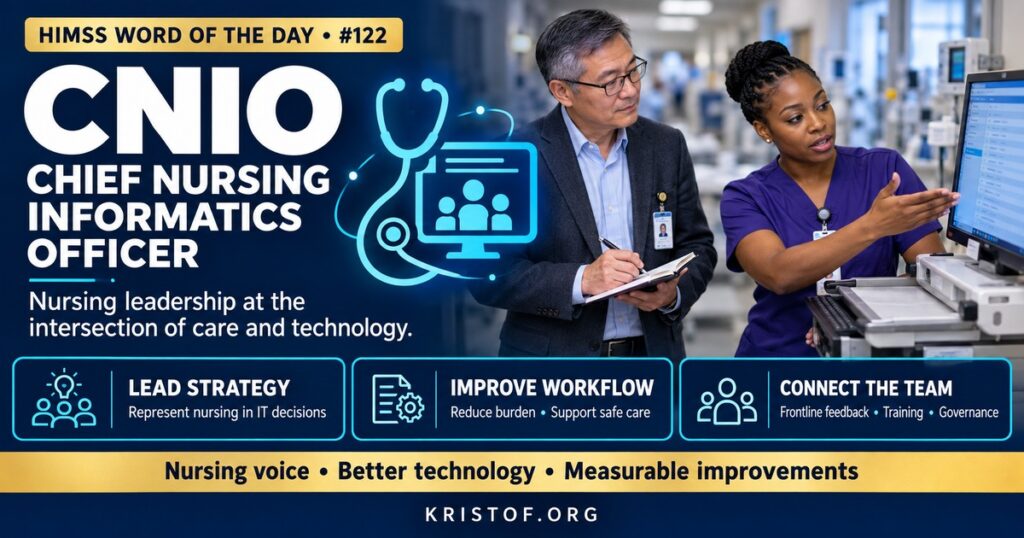
A chief nursing informatics officer (CNIO), sometimes called a chief nursing information officer, is a senior nurse leader responsible for the strategy, design, and use of information technology that supports nursing practice and patient care.
The HIMSS Dictionary describes the CNIO as the leader of strategy, development, and implementation of technology that supports nursing, nursing practice, and clinical applications. It adds that the CNIO works with the chief nursing officer on clinical and administrative decisions.
| Leadership Role | Primary Focus | How It Relates to the CNIO |
|---|---|---|
| CNO (Chief Nursing Officer) | Nursing practice, workforce, and quality | The CNIO partners closely with, and often reports to, the CNO |
| CIO (Chief Information Officer) | Enterprise IT strategy and operations | The CNIO brings nursing requirements to IT priorities |
| CMIO (Chief Medical Information Officer) | Physician use of clinical systems | The CNIO and CMIO often co-lead clinical informatics governance |
| CHIO / CCIO | Overall clinical informatics leadership | Some organizations combine roles under one clinical informatics executive |
| Nurse Informaticist | Analysis, design, training, and optimization | Informaticists often report to or work closely with the CNIO |
⚠️ Exam Alert: The CNIO represents nursing in informatics leadership; the CMIO represents physicians; the CIO leads enterprise IT. Reporting relationships vary by organization: a CNIO may report to the CNO, the CIO, or both. Nursing informatics is a recognized nursing specialty integrating nursing, information, and computer sciences.
🌐 Why It Matters: Real-World Healthcare IT Context
Nurses document more, scan more, and respond to more alerts than almost any other group of EHR users. Decisions about flowsheets, assessments, care plans, medication administration, and alerts shape nursing work every shift. Without informed nursing leadership, those decisions can be made by people who do not understand the bedside, leading to wasted time and safety risks.
The CNIO role grew as hospitals adopted comprehensive EHRs and recognized that nursing needed executive representation in technology decisions. Organizations such as the American Organization for Nursing Leadership (AONL), along with HIMSS and its Nursing Informatics Community, have supported the development of nursing informatics leadership.
CNIOs typically lead or co-lead clinical informatics governance, setting priorities for build requests and optimization work. They advocate for nursing in system selection, implementation, and upgrades, and they help balance requests from many departments against limited analyst capacity.
Documentation burden is a major focus. Nurses frequently report that EHR documentation takes time away from patients, and CNIOs lead efforts to remove redundant fields, streamline flowsheets, and measure how much time nurses spend in the record. National initiatives on documentation burden have given these efforts more visibility.
CNIOs also connect technology to quality and safety. They work with patient safety and quality leaders on medication administration scanning, fall and pressure injury prevention tools, sepsis alerts, and nurse-sensitive quality measures, ensuring that tools support both practice and reporting.
The role increasingly includes emerging technology. CNIOs evaluate virtual nursing models, remote monitoring, ambient documentation, and AI-based tools, considering how they affect workflow, safety, and the nursing workforce.
Measuring value is part of the job. CNIOs are often asked to show that informatics work pays off, so they track outcomes such as reduced documentation time, improved scanning compliance, fewer alert overrides, or better quality measure performance after a change. Those results help justify continued investment in nursing informatics staff and tools.
Preparation varies. Many CNIOs hold graduate degrees in nursing informatics or related fields and informatics certification, such as the ANCC informatics nursing certification, combined with years of clinical and implementation experience.
The CNIO also shapes workforce development. Training new graduates on clinical systems, supporting nurses through technology changes, and building informatics competencies across nursing are part of making technology sustainable.
Common challenges for CNIOs:
- Too many requests for too few analysts
- Documentation burden and alert fatigue
- Balancing standardization with unit-specific needs
- Limited budget authority in some reporting structures
- Keeping frontline nurses engaged in governance
- Evaluating new technologies amid vendor enthusiasm
What makes the CNIO role effective:
- A clear seat in executive and IT governance
- Strong partnership with the CNO, CMIO, and CIO
- A team of nurse informaticists and super users
- Data on documentation time and system usability
- Visible presence on clinical units
- Commitment to measuring outcomes of changes
🏥 The Nurse’s Perspective: Clinical, Bedside, & Workflow
The CNIO role exists to make technology work for nurses and patients, and its success depends on frontline nursing input.
At the Bedside
Bedside nurses feel the effects of CNIO decisions every shift: how many clicks it takes to document an assessment, which alerts interrupt the medication pass, and whether information is easy to find during handoff. Reporting problems through governance or informatics channels gives the CNIO the evidence needed to prioritize fixes.
Nurses who serve on informatics councils or as super users influence how systems evolve. Their examples of real workflow problems are often the most persuasive arguments for change.
In Clinical Workflow
CNIOs and their teams translate clinical practice changes into system changes, such as updating assessments to match new evidence, adding screening tools, or adjusting care plans. Nurses benefit when these changes are tested with frontline users before release.
Many organizations track documentation time and EHR usage data. CNIOs use these metrics to find units or workflows where nurses spend unusual amounts of time in the record and to measure whether optimization efforts actually help.
For nurses interested in informatics careers, the CNIO represents one path among many. Super user roles, informatics council participation, analyst positions, graduate education, and certification such as CAHIMS or informatics nursing certification build the skills that lead toward informatics leadership.
Nurses who participate in validation sessions or usability testing help catch problems before they reach every unit, and their involvement builds trust that changes reflect real practice.
In EHR Implementation (Go-Live Perspective)
During an Epic Go-Live, the CNIO typically leads nursing readiness: training plans, super user programs, workflow validation, and command center representation. Clear nursing leadership helps resolve design questions quickly when issues arise.
At-the-elbow support analysts and super users feed observations to the CNIO’s team during Go-Live. Patterns, such as repeated confusion about a flowsheet or medication workflow, can drive rapid fixes and targeted tip sheets, demonstrating that frontline feedback leads to action.
🎓 CAHIMS / CPHIMS & HIMSS Perspective
CAHIMS Exam Domain Mapping
The CNIO appears in leadership and clinical informatics questions:
| CAHIMS Domain | How the CNIO Appears |
|---|---|
| Healthcare & Technology Environments | Health IT leadership roles; nursing informatics as a specialty |
| Clinical Informatics | Nursing workflows, documentation burden, clinical decision support for nursing |
| Healthcare Information & Systems Management | System selection, implementation, optimization priorities |
| Management & Leadership | Governance, executive partnerships, workforce development, strategy |
Key Terms to Know Alongside CNIO
- Nursing Informatics — the specialty integrating nursing science with information and computer sciences
- CMIO — the chief medical information officer, representing physicians in informatics leadership
- CNO — the chief nursing officer, responsible for nursing practice and workforce
- Clinical Informatics Governance — the structure for prioritizing and approving clinical system changes
- Documentation Burden — the time and effort clinicians spend on documentation relative to its value
- Super User — a clinician trained to support peers and provide feedback on a system
HIMSS Organizational Position
HIMSS supports nursing informatics leadership through its Nursing Informatics Community, education, and certifications such as CAHIMS and CPHIMS, which help nurses build informatics careers. Members can find related education and research through the HIMSS Resource Center.
🔗 Explore Further: External References
- HIMSS — Nursing Informatics Community https://www.himss.org/networking/communities/nursing-informatics/
- American Organization for Nursing Leadership (AONL) https://www.aonl.org/
- ANCC — Informatics Nursing Certification https://www.nursingworld.org/our-certifications/informatics-nurse/
- American Nurses Association — Official Position Statements https://www.nursingworld.org/practice-policy/nursing-excellence/official-position-statements/
- ONC — SAFER Guides https://healthit.gov/clinical-quality-and-safety/safer-guides/
- HIMSS — Certifications (CAHIMS and CPHIMS) https://www.himss.org/certifications
Term source: HIMSS Dictionary of Health Information and Technology Terms, Acronyms, and Organizations, 6th Edition (2025). All definitions in this series are paraphrased for editorial purposes. Readers are encouraged to consult the primary source for exact language.
Eric Andrew Kristof, RN, CAHIMS is a Healthcare IT professional and HIMSS Arkansas Chapter member based in Hot Springs Village, AR, with hands-on Epic Go-Live experience and a diverse healthcare and IT background. He writes at kristof.org at the intersection of clinical care and healthcare technology.
Leave a Reply