By Eric Andrew Kristof, RN, CAHIMS | Healthcare IT Professional | HIMSS Arkansas Chapter Member
About This Series: The HIMSS Word of the Day is a running blog series drawing from the HIMSS Dictionary of Health Information and Technology Terms, Acronyms, and Organizations, 6th Edition (2025) — the authoritative reference for healthcare IT professionals and the primary study resource for CAHIMS and CPHIMS certification. Each post paraphrases the term in plain language, grounds it in real-world healthcare IT context, and adds a bedside nursing perspective you won’t find in a textbook.
📖 The Term: Precision Medicine
Source: HIMSS Dictionary of Health Information and Technology Terms, Acronyms, and Organizations, 6th Edition (2025)
🔍 Plain-Language Definition
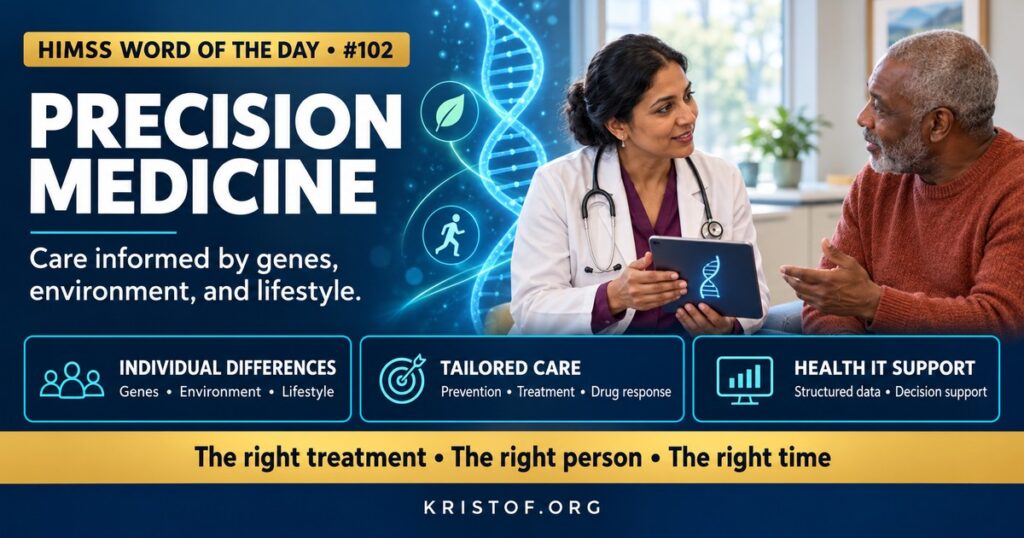
Precision medicine is an approach to preventing and treating disease that considers individual differences in genes, environment, and lifestyle, rather than relying only on what works for the average patient.
The HIMSS Dictionary describes precision medicine as an emerging approach to disease treatment and prevention that accounts for individual variability in genes, environment, and lifestyle, with the goal of delivering the right treatment to the right person at the right time. It points to the All of Us Research Program, led by the National Institutes of Health, which seeks to enroll a research cohort of one million people, with an emphasis on engaged participants, responsible data sharing, and privacy protection.
| Precision Medicine Area | What It Involves | Example |
|---|---|---|
| Pharmacogenomics | How genetic variation affects drug response | Choosing an antiplatelet drug based on CYP2C19 status |
| Tumor Genomic Profiling | Identifying mutations that guide cancer therapy | Targeted therapy for a tumor with a specific mutation |
| Hereditary Risk Testing | Identifying inherited risk for disease | Testing for inherited cancer risk variants and adjusting screening |
| Rare Disease Diagnosis | Sequencing to find causes of unexplained conditions | Genome sequencing for a critically ill infant |
| Environment and Lifestyle | Considering exposures, behaviors, and social factors | Tailoring prevention based on risk factors and social needs |
⚠️ Exam Alert: Precision medicine emphasizes individual variability in genes, environment, and lifestyle. Personalized medicine is an older, overlapping term. Pharmacogenomics is a subset focused on drug response. Population health focuses on groups. Precision medicine depends on health IT to store, interpret, and act on genetic and other individual data at the point of care.
🌐 Why It Matters: Real-World Healthcare IT Context
The U.S. Precision Medicine Initiative, announced in 2015, aimed to accelerate this approach. In a 2015 New England Journal of Medicine article, NIH director Francis Collins and Harold Varmus described the initiative’s near-term focus on cancer and its longer-term goal of building a large national research cohort, which became the All of Us Research Program.
Pharmacogenomics is one of the most practical applications today. Some drug labels include pharmacogenomic information, and FDA maintains a table of pharmacogenomic biomarkers in drug labeling. The Clinical Pharmacogenetics Implementation Consortium (CPIC) publishes guidelines that translate genetic test results into prescribing recommendations. When genetic results are stored as structured data, clinical decision support can alert prescribers at the moment they order a medication affected by the patient’s genotype.
Health IT faces real challenges. Genetic test results often arrive as PDF reports rather than structured data. Variant interpretations change as science advances, which may require updating stored results. Genetic information is relevant across a lifetime and to family members, raising questions about storage, privacy, and sharing. Standards for representing genomic data, including HL7 work on genomics reporting, are still maturing.
Cost and access shape adoption. Genetic testing has become far less expensive over time, but coverage varies, and results are only useful if clinicians can interpret them and act. Many health systems start with focused pharmacogenomic programs, such as testing before prescribing certain cardiovascular, psychiatric, or pain medications, where guidelines and decision support are mature, before expanding to broader genomic medicine.
Equity is a concern as well. Many genomic data sets have historically overrepresented people of European ancestry, which can make genetic risk predictions less accurate for others. Programs such as All of Us emphasize diverse participation to address that gap. Privacy protections matter too; the Genetic Information Nondiscrimination Act limits the use of genetic information in health insurance and employment decisions, though not in every type of insurance.
Common precision medicine challenges in health IT:
- Genetic results stored as unstructured documents
- Decision support that cannot recognize genotype data
- Updating variant interpretations over time
- Limited clinician familiarity with interpreting results
- Privacy concerns and appropriate access to genetic data
- Uneven representation in research data
Characteristics of effective precision medicine programs:
- Structured storage of genetic results in the EHR
- Pharmacogenomic decision support linked to ordering
- Access to genetic counselors and pharmacists
- Processes to update interpretations as knowledge changes
- Clear consent and privacy policies for genetic data
- Inclusive research participation and equity monitoring
🏥 The Nurse’s Perspective: Clinical, Bedside, & Workflow
Nurses support precision medicine through education, consent, specimen collection, and safe medication administration.
At the Bedside
Patients may have questions about genetic testing: what it will show, how results will be used, and who can see them. Nurses help explain the process, support informed consent, and direct patients to genetic counselors when deeper discussion is needed. Respecting patients’ values and concerns about genetic information is part of that conversation.
Pharmacogenomic results can affect medications nurses administer. When a medication is changed because of a patient’s genotype, nurses can reinforce the reason in patient education so the patient understands why a familiar drug was replaced.
Medication reconciliation can surface pharmacogenomic issues as well. When a patient reports that a medication never worked or caused unusual side effects, that history may prompt a pharmacist or provider to consider testing.
In Clinical Workflow
Oncology nurses frequently work with targeted therapies chosen based on tumor genomic profiling. Understanding why a therapy was selected, and the specific monitoring it requires, supports safe administration and symptom management.
Family history documentation remains a foundational precision medicine tool. Accurate, structured family history captured by nurses during intake helps identify patients who may benefit from genetic testing or enhanced screening.
Specimen handling matters for genetic tests too. Collecting the correct sample type, labeling it accurately, and documenting consent where required help ensure that results, which may follow a patient for life, belong to the right person.
In EHR Implementation (Go-Live Perspective)
During an Epic implementation, genetic results, pharmacogenomic decision support, and genomic indicators may be configured, often in phases. Organizations decide where results display, how alerts fire, and who can view genetic information.
At-the-elbow support analysts may help clinicians find genetic test results and understand pharmacogenomic alerts. Feedback on confusing or poorly timed alerts helps teams refine decision support so it supports rather than interrupts prescribing and administration.
🎓 CAHIMS / CPHIMS & HIMSS Perspective
CAHIMS Exam Domain Mapping
Precision medicine appears in technology trend and clinical informatics questions:
| CAHIMS Domain | How Precision Medicine Appears |
|---|---|
| Healthcare & Technology Environments | Precision Medicine Initiative; All of Us; genomics and research trends |
| Clinical Informatics | Pharmacogenomic decision support; family history; patient education |
| Healthcare Information & Systems Management | Structured genetic data, standards, storage, privacy controls |
| Management & Leadership | Program strategy, genetic counseling resources, equity, ethics |
Key Terms to Know Alongside Precision Medicine
- Genomics — the study of an organism’s complete set of DNA and its functions
- Pharmacogenomics — the study of how genes affect a person’s response to drugs
- Biomarker — a measurable indicator of a biological state or condition
- Genetic Counseling — guidance that helps people understand genetic risks and test results
- GINA (Genetic Information Nondiscrimination Act) — a federal law limiting genetic discrimination in health insurance and employment
- Clinical Decision Support — tools that provide knowledge and patient-specific information at the point of care
HIMSS Organizational Position
HIMSS addresses precision medicine through its focus on data, interoperability, and decision support needed to bring genomic information into clinical care. Members can find related education and research through the HIMSS Resource Center.
🔗 Explore Further: External References
- Collins and Varmus (2015), New England Journal of Medicine — A New Initiative on Precision Medicine https://pubmed.ncbi.nlm.nih.gov/25635347/
- FDA — Table of Pharmacogenomic Biomarkers in Drug Labeling https://www.fda.gov/drugs/science-and-research-drugs/table-pharmacogenomic-biomarkers-drug-labeling
- CPIC — Clinical Pharmacogenetics Implementation Consortium https://www.clinpgx.org/cpic
- National Human Genome Research Institute https://www.genome.gov/
- HL7 International — FHIR https://hl7.org/fhir/
- HIMSS — Resource Center https://www.himss.org/resource-center
Term source: HIMSS Dictionary of Health Information and Technology Terms, Acronyms, and Organizations, 6th Edition (2025). All definitions in this series are paraphrased for editorial purposes. Readers are encouraged to consult the primary source for exact language.
Eric Andrew Kristof, RN, CAHIMS is a Healthcare IT professional and HIMSS Arkansas Chapter member based in Hot Springs Village, AR, with hands-on Epic Go-Live experience and a diverse healthcare and IT background. He writes at kristof.org at the intersection of clinical care and healthcare technology.
Leave a Reply