By Eric Andrew Kristof, RN, CAHIMS | Healthcare IT Professional | HIMSS Arkansas Chapter Member
About This Series: The HIMSS Word of The Day is a running blog series drawing from the HIMSS Dictionary of Health Information and Technology Terms, Acronyms, and Organizations, 6th Edition (2025) — the authoritative reference for healthcare IT professionals and the primary study resource for CAHIMS and CPHIMS certification. Each post paraphrases the term in plain language, grounds it in real-world healthcare IT context, and adds a bedside nursing perspective you won’t find in a textbook.
📖 The Term: BioSense Platform
Source: HIMSS Dictionary of Health Information and Technology Terms, Acronyms, and Organizations, 6th Edition (2025)
🔍 Plain-Language Definition
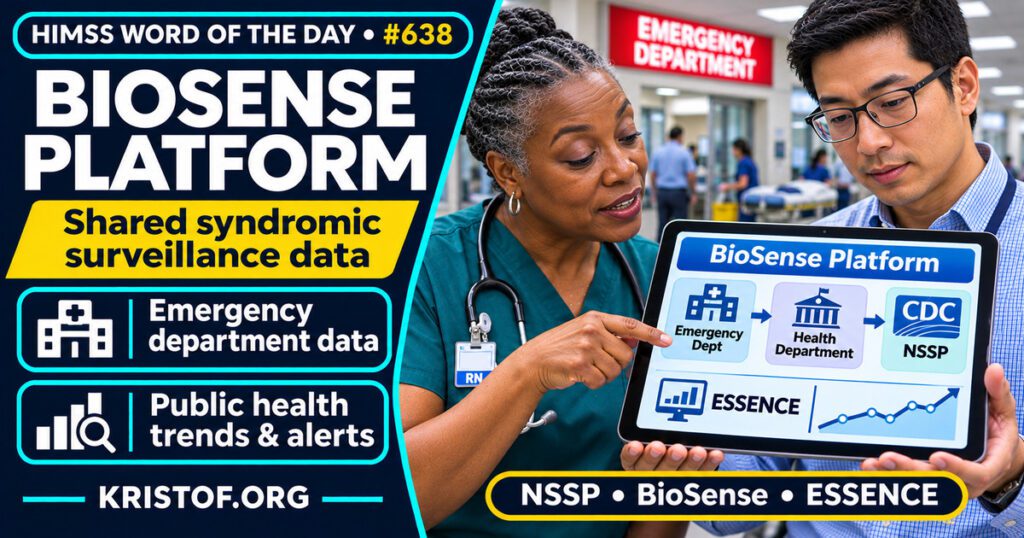
The HIMSS Dictionary describes the BioSense Platform as the central component of the National Syndromic Surveillance Program (NSSP) run by the Centers for Disease Control and Prevention (CDC). It is a shared, cloud-based information system that gives public health officials common tools and procedures for gathering, analyzing, exchanging, and storing syndromic data, so they can build a shared picture of health threats across regions. The dictionary adds that the platform came out of joint work between CDC and several kinds of partners: other federal agencies, public health departments at the state and local levels, and additional public health collaborators.
Syndromic surveillance, in CDC’s description, tracks groups of related symptoms that can point to a condition, injury, or threat before a confirmed diagnosis exists. CDC says the BioSense Platform is a product of CDC but a shared resource, because the facilities and vendors that send data and the users who analyze it are central to how it works.
| Element | What CDC’s pages describe |
|---|---|
| Data sources | Emergency department and other health care data, commercial laboratory data, mortality data, Department of Defense and Veterans Affairs medical center data, and several non-clinical feeds such as weather and air quality |
| Data path | Facility, then state or local health department or health information exchange, then the platform |
| Privacy approach | Facilities send de-identified data that include items such as chief complaint, diagnosis codes, patient characteristics, and location |
| Tools | ESSENCE for analysis and visualization, Posit Workbench for analysis in R, dashboards, and a tool for information sharing between NSSP and sites |
| People | Site administrators who grant access, set data-sharing rules, and onboard facilities |
| Standards | Syndromic surveillance messaging specifications aligned with Public Health Information Network standards |
The table is a simplified summary of two CDC web pages.
⚠️ Exam Alert: The BioSense Platform is the system. The National Syndromic Surveillance Program is the CDC program that runs it. ESSENCE is one analysis tool hosted on the platform. PHIN is a broader public health information framework, and NEDSS is a different surveillance system built around reportable disease cases. In Gould and colleagues’ 2017 article, “BioSense” is also the name of the program that is now NSSP, so older articles may use the name differently from current CDC pages.
🌐 Why It Matters: Real-World Healthcare IT Context
The BioSense Platform matters because it shows how routine clinical data can become public health intelligence. A visit that starts as an entry in an emergency department record can, after de-identification and transmission, become one data point in a regional or national trend. That only works when clinical documentation, interfaces, health information exchanges, and health departments all do their parts.
What studies show. Gould and colleagues (2017), in Public Health Reports, describe the program’s evolution. BioSense launched in 2003 to detect illness from bioterrorism and has matured from a CDC-centered effort into one focused on building syndromic surveillance capacity at the state and local level. The authors say uses have broadened from bioterrorism alerts to situational awareness and response for many hazardous events and outbreaks, and they name data quality as a near-term priority. This is a program history and a statement of direction, not a measurement of outcomes.
Coates and colleagues (2016), in Disaster Medicine and Public Health Preparedness, examined how representative the NSSP emergency department data were, using hospital data submitted in October 2014. About 60.4 million of 134.6 million emergency department visits nationwide, roughly 45 percent, were reported to have been submitted. Visits in 5 of 10 regions and in most states were substantially underrepresented, and visits at the smallest emergency departments, at rural trauma centers, and in hospitals serving populations with high percentages of Hispanic and Asian residents were underrepresented. The authors concluded that the data were representative for many hospital characteristics but not very representative nationally. These figures describe 2014 and should not be read as today’s coverage.
Schmit and colleagues (2023), in BMC Public Health, studied views on giving federal staff more access to state and local NSSP data. They used a virtual, modified nominal group technique in September 2021 with twenty epidemiologists in leadership roles and three representatives of national public health organizations. The authors report that existing data-sharing agreements limited federal access to multi-state regional aggregations, and that this was a significant challenge for the national COVID-19 response. Participants ranked improved cross-jurisdiction collaboration as the top benefit and federal use of jurisdictional data without notice as the top concern. With 23 participants in one exercise, this is a view from a small expert group, not a measure of how the platform performs.
Current CDC figures differ by page. One CDC overview page, dated January 12, 2026, says more than 6,900 facilities contribute data daily and that 84 percent of U.S. emergency departments send data. A second CDC page, shown as updated September 1, 2026, says more than 7,500 facilities and 85 percent. Both pages describe coverage of 50 states, the District of Columbia, and Guam. I did not find an explanation of the difference, so any current count should be checked on CDC’s site on the day it is cited. CDC’s percentage of emergency departments is also a different measure from Coates and colleagues’ share of visits, so the two should not be compared directly.
What I could not find. I did not find peer-reviewed evaluations of how often platform signals led to a public health response, and I did not find a recent study that repeats the Coates representativeness analysis with current data. I also did not verify how any particular hospital builds its feed.
Common BioSense Platform problems:
- Uneven participation across regions and hospital types, as documented for 2014 data
- Data quality that needs ongoing monitoring, which the 2017 article names as a priority and CDC addresses with data quality dashboards
- Data-sharing rules that differ across jurisdictions and limit what can be seen at the federal level
- Risk of misinterpreting syndromic data, a concern ranked high by participants in the 2023 study
- Onboarding effort for new facilities, vendors, and health department sites
- Chief complaint and diagnosis fields that depend on how clinicians and registration staff document
What supports effective use of the platform:
- Near real-time data availability, which CDC describes as data available as early as 24 hours after a visit
- De-identified data to reduce privacy exposure
- Shared analysis tools so jurisdictions use common methods
- Standard messaging specifications that support consistent feeds
- Site administrators who manage access and data-sharing rules
- Collaboration among CDC, health departments, and facilities, which the program’s history emphasizes
🏥 The Nurse’s Perspective: Clinical, Bedside, & Workflow
Nurses rarely open the BioSense Platform, but their documentation can feed it.
At the Bedside
CDC describes the data as including chief complaint, diagnosis codes, patient characteristics, and location. At triage, the reason for a visit is typically recorded in the emergency department record. Whether a particular triage field becomes the chief complaint in the outgoing message depends on how the local EHR and interface are built. Clear, specific wording at triage gives surveillance analysts more to work with than a vague or empty entry.
In Clinical Workflow
Emergency department nurses and informaticists see the effect indirectly. A health department may ask a hospital about a spike in visits for a particular syndrome, or an infection prevention team may use regional trends as context. Nurse informaticists often help explain which fields feed outgoing messages and who owns changes to them.
In EHR Implementation (Go-Live Perspective)
During an Epic Go-Live, outbound interface work can include messages to a health department or health information exchange, and testing may involve confirming that expected fields reach the receiving system. At-the-elbow support for emergency department staff includes triage documentation habits that affect those fields. This post does not claim that any specific go-live changed what a health department receives. It shows why public health feeds belong on the readiness checklist, with a named owner.
🎓 CAHIMS / CPHIMS & HIMSS Perspective
CAHIMS Exam Domain Mapping
The BioSense Platform sits where clinical data, standards, and public health meet:
| CAHIMS Domain | How the BioSense Platform Appears |
|---|---|
| Healthcare & Technology Environments | Public health systems, federal programs, and the flow of data between facilities and health departments |
| Clinical Informatics | Triage documentation, chief complaint capture, and diagnosis coding that feed surveillance |
| Healthcare Information & Systems Management | Interfaces, messaging specifications, de-identification, and data quality monitoring |
| Management & Leadership | Data-sharing agreements, governance, and public health reporting responsibilities |
Key Terms to Know Alongside BioSense Platform
- PHIN — a CDC framework of standards and systems for public health information exchange
- Biosurveillance — monitoring of health data to detect and track threats to population health
- Early Event Detection — finding unusual patterns early enough to prompt a response
- Health Information Exchange — sharing of health information among organizations, including with public health
- HL7 v2 — a widely used messaging standard for sending clinical event data between systems
- De-identified health information — health information with identifying details removed
HIMSS Organizational Position
HIMSS offers education and research on health information and technology topics through its Resource Center. Members can find related information on the HIMSS Resource Center page.
🧭 More HIMSS Word of The Day Terms
Related terms in the Data and Analytics series:
Browse all Data and Analytics terms or the A–Z glossary.
🔗 Explore Further: External References
- CDC — About NSSP and the BioSense Platform https://www.cdc.gov/nssp/php/about/about-nssp-and-the-biosense-platform.html
- CDC — About the National Syndromic Surveillance Program (NSSP) https://www.cdc.gov/nssp/php/about/
- CDC — Supporting Healthy Communities (NSSP overview) https://www.cdc.gov/nssp/about/index.html
- Gould et al. (2017), Public Health Reports — The Evolution of BioSense: Lessons Learned and Future Directions https://pubmed.ncbi.nlm.nih.gov/28692386/
- Coates et al. (2016), Disaster Medicine and Public Health Preparedness — National and Regional Representativeness of Hospital Emergency Department Visit Data in the National Syndromic Surveillance Program, United States, 2014 https://pubmed.ncbi.nlm.nih.gov/26883318/
- Schmit et al. (2023), BMC Public Health — Views on increased federal access to state and local National Syndromic Surveillance Program data: a nominal group technique study with state and local epidemiologists https://pubmed.ncbi.nlm.nih.gov/36879220/
- HIMSS — Resource Center https://www.himss.org/resource-center
Term source: HIMSS Dictionary of Health Information and Technology Terms, Acronyms, and Organizations, 6th Edition (2025). All definitions in this series are paraphrased for editorial purposes. Readers are encouraged to consult the primary source for exact language.
Eric Andrew Kristof, RN, CAHIMS is a Healthcare IT professional and HIMSS Arkansas Chapter member based in Hot Springs Village, AR, with hands-on Epic Go-Live experience and a diverse healthcare and IT background. He writes at kristof.org at the intersection of clinical care and healthcare technology.
Leave a Reply