By Eric Andrew Kristof, RN, CAHIMS | Healthcare IT Professional | HIMSS Arkansas Chapter Member
About This Series: The HIMSS Word of The Day is a running blog series drawing from the HIMSS Dictionary of Health Information and Technology Terms, Acronyms, and Organizations, 6th Edition (2025) — the authoritative reference for healthcare IT professionals and the primary study resource for CAHIMS and CPHIMS certification. Each post paraphrases the term in plain language, grounds it in real-world healthcare IT context, and adds a bedside nursing perspective you won’t find in a textbook.
📖 The Term: Specification
Source: HIMSS Dictionary of Health Information and Technology Terms, Acronyms, and Organizations, 6th Edition (2025)
🔍 Plain-Language Definition
The HIMSS Dictionary describes a specification as a clear written statement of the characteristics something must have before it is acceptable for use in the healthcare system. The dictionary notes that specifications usually concern things an organization acquires or builds, such as supplies, equipment, systems, and physical structures.
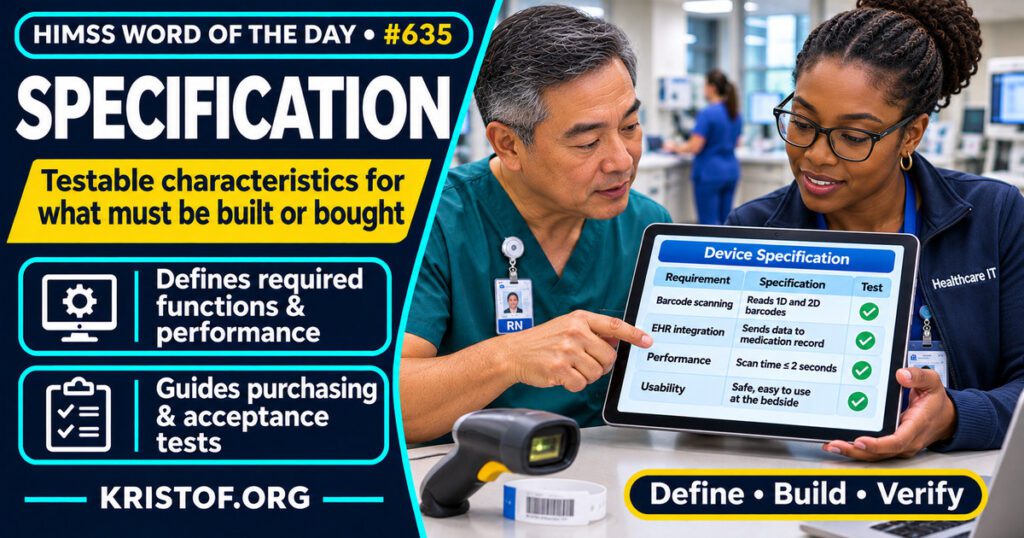
A requirement says what is needed. A specification states the characteristics that satisfy that need in a way that can be checked. For example, a hospital might need to scan medications at the bedside, and the specification would describe the scanner, the label types it must read, and how it connects to the medication record. The scanner example is illustrative.
| What is specified | Example question the specification answers |
|---|---|
| Supplies | Which product characteristics are acceptable? |
| Equipment | What must a device do, and what must it connect to? |
| Systems | Which functions, interfaces, and performance levels are required? |
| Physical structures | What space, power, network, and safety features are needed? |
The table is a simplified teaching summary built from the dictionary’s list of categories.
⚠️ Exam Alert: A requirement states a need, and a specification states the characteristics that meet it. A standard is a specification published by a standards body, and an RFP is the document that asks vendors to respond to the specifications. The words are often used loosely, so a real project should define them in its own documents.
🌐 Why It Matters: Real-World Healthcare IT Context
Specifications matter because they are where an organization’s needs become something a vendor, a builder, or a test team can act on. A vague line in a specification becomes a disagreement later, often after money has been spent.
How specifications are used. A specification usually travels through the whole project. It guides what is requested from vendors, what is built or configured, what is tested before acceptance, and what is checked again after a change. Because each step refers back to the same wording, an unclear line tends to cause trouble at every step. This is a general description of common practice, not a finding from the studies below.
What standards bodies say. ISO/IEC/IEEE 29148:2018, the international standard for requirements engineering, provides guidelines for applying the requirements processes described in two other systems and software lifecycle standards. The ISO catalogue shows that it was last reviewed and confirmed in 2024 and that a third edition is in draft. The standard itself is paywalled and I read only the catalogue description, so I cannot describe its contents in detail.
What studies show. Most published work on specifications in health IT comes from procurement and selection research.
- Seth and colleagues (2024) reviewed the literature and public documents on specifying interoperability requirements when buying health information systems. Their thematic analysis found that challenges with describing needs properly, conflicting needs, and knowledge gaps were shared by most articles, and they called for a model to help bridge knowledge gaps and avoid fuzzy requirements. It is a review based on a broad search, and the abstract does not say how many sources were analyzed in depth.
- Priestman and colleagues (2019) reviewed the procurement of a comprehensive electronic patient record at a specialist academic institution. They report that detailed preparation of organizational requirements and specifications, along with organizational readiness, was important. Their scoring process took significant effort but did little to separate suppliers, while demonstrations and site visits gave a better view of functional ability, and they suggest treating specification requirements as a threshold evaluation. It is a single-institution retrospective, so it shows one organization’s experience.
- Tyllinen and colleagues (2018) described a framework for evaluating usability during EHR procurement, including objectives, procedure, attributes, and methods. The paper describes the framework and does not present detailed results, so it offers a model and not evidence of effect.
- Kushniruk and colleagues (2009) described a framework for testing candidate EHR systems to see whether they meet user and institutional needs. The paper notes that the literature contains systems that failed to meet user needs, ran late, or cost much more than expected. The authors frame system selection in terms of the strength of evidence obtained from testing candidate systems. It is more than a decade old and describes a framework in development.
What I could not find. I did not find a controlled study showing that a particular way of writing specifications leads to better implementation outcomes. The evidence is largely case descriptions, frameworks, and reviews, so it should be read as guidance and not proof.
Common specification problems:
- Vague wording that cannot be tested
- Conflicting needs from different departments
- Missing input from the people who will use the system
- Interoperability expectations left undefined
- Specifications copied from another organization without adjustment
- Treating a long checklist as proof of fit
What supports good specifications:
- Plain wording with one testable statement per line
- Input from clinicians, analysts, IT, and operations early on
- Demonstrations and site visits alongside written scoring
- Usability and workflow testing with realistic scenarios
- Clear interoperability expectations, including the standards to be used
- Version control and a named owner for each specification
🏥 The Nurse’s Perspective: Clinical, Bedside, & Workflow
Nurses often feel the result of a specification long before they see the document.
At the Bedside
Wristband printers, barcode scanners, workstations on wheels, infusion pumps, and monitors are all bought against specifications. A scanner that cannot read a label type, or a cart that does not fit a room, usually traces back to something that was not specified or not tested.
In Clinical Workflow
Nurse informaticists and clinical reviewers help turn needs into testable statements. A line like “supports medication administration” is easier to challenge than a scenario that says what the nurse scans, what the screen shows, and what happens when a scan fails.
In EHR Implementation (Go-Live Perspective)
During an Epic Go-Live, many questions from nurses come down to whether the build matches the expected workflow. At-the-elbow analysts hear “that is not how we do it” and sometimes trace it to a gap in an earlier decision. This post does not claim that any specific go-live had a specification gap. It shows why nurse review of specifications and test scripts belongs in readiness work.
🎓 CAHIMS / CPHIMS & HIMSS Perspective
CAHIMS Exam Domain Mapping
Specifications connect needs, purchasing, and testing:
| CAHIMS Domain | How Specifications Appear |
|---|---|
| Healthcare & Technology Environments | Standards, regulations, and the setting that shape what is required |
| Clinical Informatics | Clinical workflow and content turned into testable statements |
| Healthcare Information & Systems Management | System, interface, and equipment specifications and acceptance testing |
| Management & Leadership | Procurement, vendor selection, contracts, and project governance |
Key Terms to Know Alongside Specification
- Functional requirements — statements of what a system must do for its users
- Request for Proposal — a document that invites vendors to respond to stated needs
- Usability testing — testing how well users can complete tasks with a system
- EHR vendor — a company that supplies and supports electronic health record software
- Interoperability — the ability of systems to exchange and use information
- Acceptance testing — testing to confirm a system meets agreed criteria
HIMSS Organizational Position
HIMSS offers education and research on health information and technology topics through its Resource Center. Members can find related information on the HIMSS Resource Center page.
🧭 More HIMSS Word of The Day Terms
Related terms in the Project and Change Management series:
Browse all Project and Change Management terms or the A–Z glossary.
🔗 Explore Further: External References
- ISO — ISO/IEC/IEEE 29148:2018 Systems and software engineering — Life cycle processes — Requirements engineering https://www.iso.org/standard/72089.html
- Seth et al. (2024), Studies in Health Technology and Informatics — Reviewing Challenges in Specifying Interoperability Requirement in Procurement of Health Information Systems https://pubmed.ncbi.nlm.nih.gov/38269755/
- Priestman et al. (2019), BMJ Health & Care Informatics — Lessons learned from a comprehensive electronic patient record procurement process-implications for healthcare organisations https://pubmed.ncbi.nlm.nih.gov/31072821/
- Tyllinen et al. (2018), Studies in Health Technology and Informatics — A Framework for Usability Evaluation in EHR Procurement https://pubmed.ncbi.nlm.nih.gov/29678000/
- Kushniruk et al. (2009), Studies in Health Technology and Informatics — Selecting electronic health record systems: development of a framework for testing candidate systems https://pubmed.ncbi.nlm.nih.gov/19380964/
- HIMSS — Resource Center https://www.himss.org/resource-center
Term source: HIMSS Dictionary of Health Information and Technology Terms, Acronyms, and Organizations, 6th Edition (2025). All definitions in this series are paraphrased for editorial purposes. Readers are encouraged to consult the primary source for exact language.
Eric Andrew Kristof, RN, CAHIMS is a Healthcare IT professional and HIMSS Arkansas Chapter member based in Hot Springs Village, AR, with hands-on Epic Go-Live experience and a diverse healthcare and IT background. He writes at kristof.org at the intersection of clinical care and healthcare technology.
Leave a Reply