By Eric Andrew Kristof, RN, CAHIMS | Healthcare IT Professional | HIMSS Arkansas Chapter Member
About This Series: The HIMSS Word of The Day is a running blog series drawing from the HIMSS Dictionary of Health Information and Technology Terms, Acronyms, and Organizations, 6th Edition (2025) — the authoritative reference for healthcare IT professionals and the primary study resource for CAHIMS and CPHIMS certification. Each post paraphrases the term in plain language, grounds it in real-world healthcare IT context, and adds a bedside nursing perspective you won’t find in a textbook.
📖 The Term: Encounter Data
Source: HIMSS Dictionary of Health Information and Technology Terms, Acronyms, and Organizations, 6th Edition (2025)
🔍 Plain-Language Definition
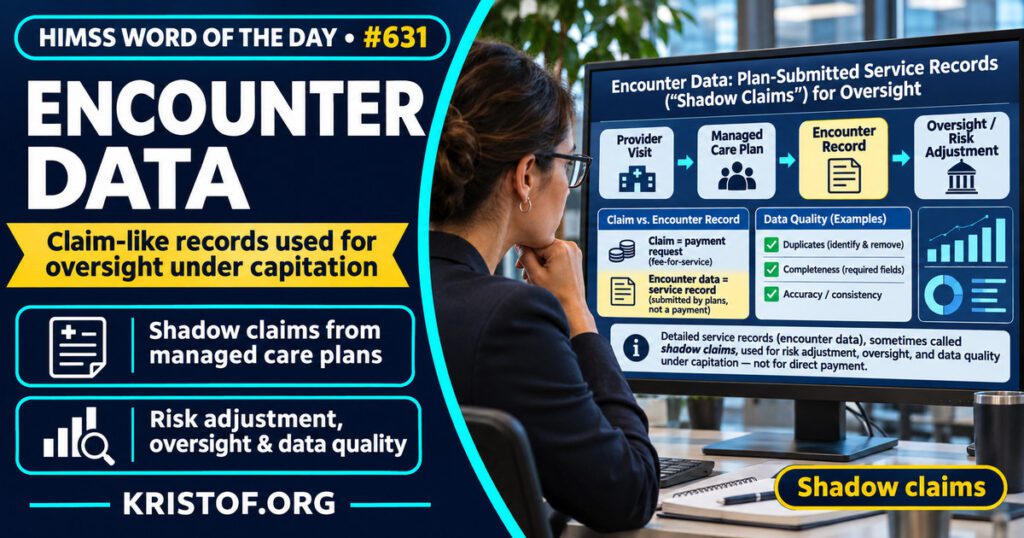
The HIMSS Dictionary describes encounter data as detailed records of the individual services delivered by a managed care entity that is paid on a capitated basis. The level of detail is close to that of a standard claim form, and the dictionary notes that encounter data are sometimes called “shadow claims.”
The nickname makes sense once the payment model is clear. Under fee-for-service, a claim triggers payment for a service. Under capitation, a plan receives a fixed payment for each enrolled member and pays its own network of providers. The government or state agency that funds the plan does not pay for each service, so it relies on a claim-like record from the plan to see what care was delivered. That record is the encounter data.
CMS uses the term for Medicare Advantage as well. Its July 2026 methods document describes MA encounter data as records plans submit for each encounter a beneficiary has with a provider, delivered in separate files by service type such as inpatient hospital, skilled nursing facility, outpatient facility, carrier, durable medical equipment, and home health.
| Feature | Fee-for-service claim | Managed care encounter record |
|---|---|---|
| Submitted by | Provider, to the payer | Plan, to the government or state agency |
| Main purpose | Payment of the service | Oversight, risk adjustment, and analysis (CMS says risk adjustment for MA) |
| Payment fields | Present | Often limited or absent for research users |
| Duplicates and denials | Managed by claim adjudication | Plans may submit paid, denied, or pending records |
⚠️ Exam Alert: Encounter data are plan-submitted service records, which differ from a claim (a request for payment), from a patient encounter (the visit itself), and from an encounter form (a paper or electronic form used at the visit). The dictionary’s alternate name is shadow claims.
🌐 Why It Matters: Real-World Healthcare IT Context
Encounter data matter because managed care covers a large share of beneficiaries, and the only way to see what services plans deliver is through the records plans submit. Those records feed payment, oversight, research, and quality work, so their accuracy has real consequences.
Why CMS collects them. CMS’s methods document says the purpose of MA encounter data is risk adjustment, not paying providers. A CMS fact sheet from a past advance notice explains the history. CMS began using diagnoses from encounter data to calculate risk scores for calendar year 2015, and for 2016 it blended 10% encounter data-based scores with 90% scores from the older Risk Adjustment Processing System. Because the fact sheet is from an earlier year, readers should check CMS’s current risk adjustment notices for what applies today.
The Medicaid side. MACPAC’s pages say that states using managed care also obtain encounter data from plans, and that these data were historically underreported and rarely examined for quality at the federal level. The MACPAC pages are several years old, so they describe an earlier period. They also state that states must have an independent audit of the accuracy, truthfulness, and completeness of plan encounter and financial data at least every three years.
What CMS says about data quality. The July 2026 methods document is candid. It says MA data can be less consistent and sometimes incomplete, and it lists specific issues:
- Plans submit records whether the encounter was paid, denied, or pending, and CMS does not check whether each record is the final action.
- MA records may repeat the same service, with duplicate rates of about 0.4% for inpatient and skilled nursing facility records and about 6% for carrier, durable medical equipment, and outpatient records.
- Invalid provider identifier rates were about 9.6% for carrier and durable medical equipment records in 2016 and about 5.5% in 2023.
- Hospital type cannot be identified directly because the records lack a CMS Certification Number, so an algorithm assigns it.
- CMS excludes home health records from public release because of high duplication and inconsistent episode structures.
What studies show. Published analyses reach similar conclusions: encounter data can be used, but completeness has to be checked.
- Jung and colleagues (2022) examined 2015 MA encounter data. They found 83 of 380 MA contracts with high data completeness, defined by the authors as less than 10% missing hospital stays and visit counts within 10% of HEDIS counts. Among those contracts, resource use for an enrollee with cancer was $14,715 in 2015, based on Traditional Medicare payment rates. The data are from 2015, so the figures show a method and an early picture.
- Choi and colleagues (2020) compared encounter data for pregnant Medicaid beneficiaries in comprehensive managed care with fee-for-service claims in Texas and Florida from 2007 to 2010. Texas encounter data met the authors’ thresholds for all seven measures. Florida’s were usable starting in 2009, with incomplete medical and pharmacy records in 2007 and 2008. Quality varied by state and year and improved over time.
- Duchesneau and colleagues (2026) compared ICD-10-CM comorbidity coding in MA encounter data and fee-for-service claims for 5,158 beneficiaries. After standardization, prevalence was similar overall. Peripheral vascular disorder and renal failure were more common in MA data, and fluid and electrolyte disorders and deficiency anemias were more common in fee-for-service data. The authors say the differences may reflect true differences or coding variation, and they conclude the data appear reliable for aging research while calling for more validation.
What I could not find. I did not find a single current figure for completeness across all MA plans or all Medicaid states. The studies cover specific years, states, and conditions, and quality seems to vary by plan, state, and period. Anyone using encounter data should check the current CMS and state documentation for the year and population in question.
Common encounter data problems:
- Treating encounter data as if they were payment claims
- Using records without checking completeness for the plan or state
- Counting duplicate records as separate services
- Missing or invalid provider identifiers
- Assuming coding patterns are identical to fee-for-service claims
- Overlooking changes in submission rules from year to year
What supports good encounter data practice:
- Completeness checks against another source, such as inpatient stay data
- Documented rules for duplicates, denials, and pending records
- Plan-level monitoring of submission volume and rejections
- Clear documentation that supports accurate diagnosis and procedure coding
- Independent audits of accuracy and completeness
- Awareness of which years and populations a study covers
🏥 The Nurse’s Perspective: Clinical, Bedside, & Workflow
Nurses do not submit encounter data, but their documentation shapes what ends up in them.
At the Bedside
An accurate assessment, a clearly documented change in condition, and a complete record of care provided help coders assign diagnoses and procedures correctly. Those codes flow into claims and, for managed care members, into encounter records.
In Clinical Workflow
Care management and utilization review nurses in provider organizations and plans work with the output of this data. They look at which services were delivered, which follow-up is missing, and which patients may need outreach. Because encounter records can be incomplete or duplicated, the results should be checked against the clinical record before action is taken.
In EHR Implementation (Go-Live Perspective)
During an Epic Go-Live, the word encounter appears constantly, usually meaning a visit that opens a chart. Analysts at the elbow learn quickly that registration, charge capture, and billing build decisions determine whether a visit later produces a clean claim or encounter record. This post does not claim that any specific go-live had an encounter data problem. It shows why early testing of the path from documentation to the data that leaves the organization is worthwhile.
🎓 CAHIMS / CPHIMS & HIMSS Perspective
CAHIMS Exam Domain Mapping
Encounter data link clinical documentation, payment models, and data quality:
| CAHIMS Domain | How Encounter Data Appear |
|---|---|
| Healthcare & Technology Environments | Managed care, capitation, and government health programs |
| Clinical Informatics | Documentation, coding, and the clinical meaning of recorded diagnoses |
| Healthcare Information & Systems Management | Data submission, completeness checks, duplicates, and identifiers |
| Management & Leadership | Contract compliance, audit, and use of data for oversight and quality |
Key Terms to Know Alongside Encounter Data
- Patient encounter — an interaction between a patient and a provider for care
- Payer — an organization that pays or reimburses for healthcare services
- Transaction standard — the agreed format for electronic messages such as claims
- HEDIS (Healthcare Effectiveness Data and Information Set) — a set of performance measures used to compare health plans
- Capitation — payment of a fixed amount per enrolled member, regardless of services used
- Risk adjustment — a method that adjusts payments to plans based on the expected health costs of their members
HIMSS Organizational Position
HIMSS offers education and research on health information and technology topics through its Resource Center. Members can find related information on the HIMSS Resource Center page.
🧭 More HIMSS Word of The Day Terms
Related terms in the Value-Based Care series:
- Quality Measures
- Value-Based Insurance Design (VBID)
- VM (Value Modifier)
- ACG (Ambulatory Care Group)
Browse all Value-Based Care terms or the A–Z glossary.
🔗 Explore Further: External References
- CMS — Medicare Advantage Encounter Data: Methodological Approach for Analyzing Institutional and Non-Institutional Services (July 2026) https://download.cms.gov/encounter_data/medicare%20advantage%20encounter%20data%20analytical%20methods%20508.pdf
- CMS — 2021 Medicare Advantage Advance Notice Part I: Risk Adjustment (Using Encounter Data) https://www.cms.gov/newsroom/fact-sheets/2021-medicare-advantage-advance-notice-part-i-risk-adjustment
- MACPAC — Managed Care Program Integrity https://www.macpac.gov/subtopic/managed-care-program-integrity/
- Jung et al. (2022), Health Services Research — Measuring resource use in Medicare Advantage using Encounter data https://pubmed.ncbi.nlm.nih.gov/34510453/
- Choi et al. (2020), Pharmacoepidemiology and Drug Safety — Usability of encounter data for Medicaid comprehensive managed care vs traditional Medicaid fee-for-service claims among pregnant women https://pubmed.ncbi.nlm.nih.gov/31737976/
- Duchesneau et al. (2026), Medical Care — Differences in the Measurement of Comorbidities Based on ICD-10-CM Coding Definitions Using Medicare Advantage Encounter Data and Fee-For-Service Claims https://pubmed.ncbi.nlm.nih.gov/41557539/
- HIMSS — Resource Center https://www.himss.org/resource-center
Term source: HIMSS Dictionary of Health Information and Technology Terms, Acronyms, and Organizations, 6th Edition (2025). All definitions in this series are paraphrased for editorial purposes. Readers are encouraged to consult the primary source for exact language.
Eric Andrew Kristof, RN, CAHIMS is a Healthcare IT professional and HIMSS Arkansas Chapter member based in Hot Springs Village, AR, with hands-on Epic Go-Live experience and a diverse healthcare and IT background. He writes at kristof.org at the intersection of clinical care and healthcare technology.
Leave a Reply