By Eric Andrew Kristof, RN, CAHIMS | Healthcare IT Professional | HIMSS Arkansas Chapter Member
About This Series: The HIMSS Word of the Day is a running blog series drawing from the HIMSS Dictionary of Health Information and Technology Terms, Acronyms, and Organizations, 6th Edition (2025) — the authoritative reference for healthcare IT professionals and the primary study resource for CAHIMS and CPHIMS certification. Each post paraphrases the term in plain language, grounds it in real-world healthcare IT context, and adds a bedside nursing perspective you won’t find in a textbook.
📖 The Term: GIGO (Garbage In, Garbage Out)
Source: HIMSS Dictionary of Health Information and Technology Terms, Acronyms, and Organizations, 6th Edition (2025)
🔍 Plain-Language Definition
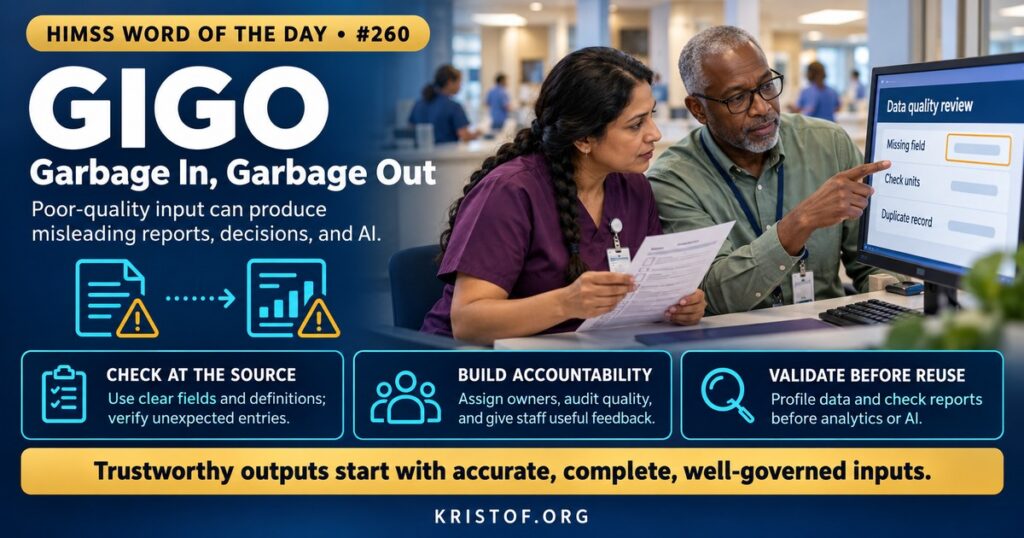
GIGO, short for garbage in, garbage out, expresses a basic idea from computer science and mathematics: the quality of the output depends on the quality of the input. The HIMSS Dictionary describes it as the entry of inaccurate or useless data leading to worthless information. A computer does exactly what it is told with the data it is given. It cannot know that a weight was typed in pounds instead of kilograms, or that a diagnosis was selected for convenience.
In health care, the garbage is rarely random. It is often a missing field, a copied note, a wrong code, an outdated allergy list, or a lab value attached to the wrong patient. The output can be a misleading dashboard, a mistaken quality score, a flawed research finding, or an AI model that learned the wrong lesson.
| Data Quality Dimension | Meaning | Example of Failure |
|---|---|---|
| Accuracy | Values reflect the truth | Wrong weight used for dosing |
| Completeness | Required data are present | Missing allergy or smoking status |
| Consistency | Same fact agrees across records | Different birth dates in two systems |
| Timeliness | Data are available when needed | Result posted hours late |
| Validity | Values fit expected format and range | Temperature entered as 986 |
| Uniqueness | Each entity appears once | Duplicate patient records |
⚠️ Exam Alert: GIGO warns that analysis cannot fix bad input. Data governance sets the rules and ownership for data quality, while data validation checks entries as they are made. Fancy analytics or AI do not remove the problem and can hide it.
🌐 Why It Matters: Real-World Healthcare IT Context
Modern health care runs on secondary use of data: the same entries made for care are reused for billing, public reporting, quality improvement, research, and machine learning. That reuse magnifies the cost of poor input. A mistake in documentation travels into every downstream product built on it.
Researchers have tried to understand what shapes data quality. A 2026 systematic review examined factors associated with the quality of inpatient medical record data, defined as accuracy, completeness, consistency, timeliness, and validity, including front-page information and diagnosis and procedure coding. It included 29 studies, mostly cross-sectional or retrospective audits of moderate methodological quality. The authors identified six categories of factors: clinical documentation and physician-related factors, coding staff capacity and competence, institutional and quality-control mechanisms, information-system support, training and feedback, and external policy or reimbursement pressure. Training and feedback appeared in the most studies, 20, followed by quality-control mechanisms, 19, and coding staff capacity, 18. The review concluded that record quality results from interactions among how data are generated, how they are transformed through coding, how the organization governs them, what technology supports, and what outside incentives exist. It also cautioned that causal interpretation should stay modest because of the study designs.
Another study shows the issue from the research side. In a secondary-use EHR study of patients with non-valvular atrial fibrillation, two sets of clinicians abstracted charts to build a reference standard for risk scores. Agreement between the sets ranged from extremely low to high. A focus group and survey found difficulty assessing items involving timing and social data, and raised problems with missing encounters, truncated notes, low granularity, and a data viewer that did not mirror the live EHR. Even trained clinicians reading the same chart reached different conclusions when the data were incomplete or hard to interpret. The lesson for analysts is that disagreement may reflect data gaps and not only the skill of the reviewer.
AI raises the stakes. A model trained on records with systematic documentation gaps may learn to predict who is documented well, not who is sick. A model tested on clean research data may stumble on messy practice data. The NIST AI Risk Management Framework, a voluntary guide to managing AI risk, points organizations toward attention to the quality, provenance, and representativeness of the data behind a model. Before using a dataset to train or evaluate a model, teams should profile it: how much is missing, how values are distributed, how definitions changed over time, and whether groups of patients are documented differently.
Prevention works best at the source and across the pipeline. At entry, design features that guide good data: required fields where truly needed, validation of ranges and formats, pick lists with clear meanings, defaults that are safe, and alerts for impossible values. In processes, make documentation workflows match real care so staff do not enter data after the fact from memory. In governance, assign owners to critical data elements, define each in writing, measure quality regularly, and feed results back to the people who enter the data. In analytics, validate reports against the chart, document assumptions, and resist the temptation to trust a number because it appears on a polished dashboard.
Common GIGO problems in health care:
- Free-text fields used where discrete data are needed for reporting
- Copy-forward notes that repeat outdated information
- Duplicate or merged patient records
- Inconsistent definitions of the same measure across departments
- Coding based on incomplete documentation
- Analytics built on data nobody has profiled
What supports good data quality:
- Clear data definitions and named owners
- Validation and guidance at the point of entry
- Training and regular feedback to those who document
- Routine audits and dashboards that measure data quality itself
- Collaboration between clinicians, coders, and analysts
- Profiling and bias checks before data are used for AI
🏥 The Nurse’s Perspective: Clinical, Bedside, & Workflow
Nurses create a large share of the structured data in the EHR, so data quality begins with their documentation.
At the Bedside
Entering vital signs, intake and output, pain scores, risk assessments, and medication administration as they happen, in the right fields, keeps the record accurate. Charting from memory at the end of a shift, or choosing a default to save time, creates entries that look complete but may not be true. When a value looks wrong, such as an implausible weight, checking and correcting it right away prevents downstream mistakes in dosing and reports.
In Clinical Workflow
Nurse managers see how data quality affects reports they own: fall rates, pressure injury counts, staffing metrics, and quality measures. When numbers look off, they ask whether the cause is a care problem or a documentation problem. Feedback loops, such as a monthly report showing which assessments are missing, help staff improve.
Nurse informaticists design flowsheets and assessments that make the right entry the easy one, validate that reports pull the intended data, and teach staff how their documentation feeds quality measures and research. They also advise on whether a dataset is fit for a given analysis or AI project.
In EHR Implementation (Go-Live Perspective)
An Epic Go-Live is a high-risk period for data quality, because staff are learning new screens and may enter data in the wrong place or skip fields. At-the-elbow support analysts catch these patterns early, showing nurses where assessments should be documented and noting build issues, such as duplicate fields, that cause confusion. Early data quality reports in the first weeks help leaders target retraining.
🎓 CAHIMS / CPHIMS & HIMSS Perspective
CAHIMS Exam Domain Mapping
GIGO appears in data management, analytics, and quality questions:
| CAHIMS Domain | How GIGO Appears |
|---|---|
| Healthcare & Technology Environments | Data standards, quality measurement, regulatory reporting |
| Clinical Informatics | Documentation practices, data entry design, secondary use |
| Healthcare Information & Systems Management | Data validation, governance, master data, interfaces |
| Management & Leadership | Data stewardship, accountability, training, audit programs |
Key Terms to Know Alongside GIGO
- Data Quality — fitness of data for its intended use, including accuracy and completeness
- Data Governance — policies and roles for managing data as an asset
- Data Validation — checks that data meet defined rules when entered
- Secondary Use — using data for purposes beyond the care for which they were collected
- Data Profiling — examining data to understand content, completeness, and anomalies
- Data Steward — person accountable for a data domain’s quality and definition
HIMSS Organizational Position
HIMSS supports data quality and responsible analytics through its research, education, and community work. Members can find related resources through the HIMSS Resource Center.
🔗 Explore Further: External References
- Liao et al. (2026), BMC Health Services Research — Factors Associated With Inpatient Medical Record Data Quality in Hospital Settings: A Systematic Review https://pubmed.ncbi.nlm.nih.gov/42786492/
- Mullin et al. (2017), Studies in Health Technology and Informatics — Secondary Use of EHR: Interpreting Clinician Inter-Rater Reliability Through Qualitative Assessment https://pubmed.ncbi.nlm.nih.gov/28809201/
- NIST — AI Risk Management Framework https://www.nist.gov/itl/ai-risk-management-framework
- HealthIT.gov — Health IT Playbook https://www.healthit.gov/playbook/
- HealthIT.gov — United States Core Data for Interoperability (USCDI) https://isp.healthit.gov/united-states-core-data-interoperability-uscdi
Term source: HIMSS Dictionary of Health Information and Technology Terms, Acronyms, and Organizations, 6th Edition (2025). All definitions in this series are paraphrased for editorial purposes. Readers are encouraged to consult the primary source for exact language.
Eric Andrew Kristof, RN, CAHIMS is a Healthcare IT professional and HIMSS Arkansas Chapter member based in Hot Springs Village, AR, with hands-on Epic Go-Live experience and a diverse healthcare and IT background. He writes at kristof.org at the intersection of clinical care and healthcare technology.
Leave a Reply