By Eric Andrew Kristof, RN, CAHIMS | Healthcare IT Professional | HIMSS Arkansas Chapter Member
About This Series: The HIMSS Word of the Day is a running blog series drawing from the HIMSS Dictionary of Health Information and Technology Terms, Acronyms, and Organizations, 6th Edition (2025) — the authoritative reference for healthcare IT professionals and the primary study resource for CAHIMS and CPHIMS certification. Each post paraphrases the term in plain language, grounds it in real-world healthcare IT context, and adds a bedside nursing perspective you won’t find in a textbook.
📖 The Term: Episode of Care
Source: HIMSS Dictionary of Health Information and Technology Terms, Acronyms, and Organizations, 6th Edition (2025)
🔍 Plain-Language Definition
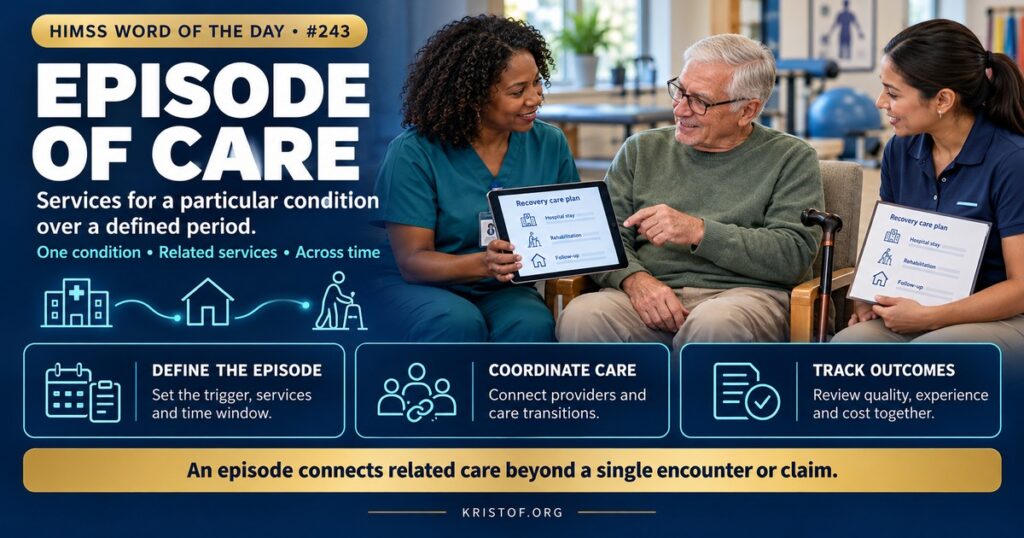
An episode of care is the set of services a facility or provider delivers for a particular medical problem, condition, or illness during a defined period. The HIMSS Dictionary notes that an episode can be brief, continuous, or made up of several intervals separated by short breaks in care. The key idea is that the unit of analysis is the problem, not the individual visit or claim.
Defining an episode requires decisions: what triggers it, what services count, how long it lasts, and who is accountable. A surgical episode might begin with an admission and end 30 or 90 days after discharge. A chronic condition episode might run for a year.
| Episode Design Choice | Question Answered | Example |
|---|---|---|
| Trigger | What starts the episode? | A hospital admission for hip replacement |
| Included services | What counts toward it? | Surgery, rehab, readmissions, follow-up visits |
| Duration | How long does it run? | Through 30 or 90 days after discharge |
| Attribution | Who is accountable? | The hospital or physician group |
| Risk adjustment | How are patient differences handled? | Adjusting for age and comorbidity |
| Quality measures | How is success judged? | Complications, readmissions, patient-reported outcomes |
⚠️ Exam Alert: An episode of care groups services around a condition over time, while an encounter is a single interaction and a claim is a single bill. A bundled payment pays a single amount for an episode. Attribution decides which provider is responsible for an episode’s cost and quality.
🌐 Why It Matters: Real-World Healthcare IT Context
Fee-for-service payment rewards volume, and each provider sees only a piece of the patient’s journey. Episode-based models try to align incentives across the whole course of treatment, so that the hospital, surgeon, and post-acute providers share responsibility for outcomes and cost. This is one of the main designs in value-based care.
Medicare has tested several. CMS describes its Transforming Episode Accountability Model, or TEAM, as a mandatory model in which selected acute care hospitals coordinate care from surgery through 30 days after hospitalization for people with Original Medicare who undergo one of five surgical procedures: lower extremity joint replacement, surgical hip and femur fracture treatment, spinal fusion, coronary artery bypass graft, and major bowel procedures. TEAM runs for five performance years from January 1, 2026, through December 31, 2030, in selected core-based statistical areas. Its predecessor for joint replacement, the Comprehensive Care for Joint Replacement model, or CJR, ran from 2016 to 2024.
A systematic review of CJR covered 23 studies, mostly quasi-experimental analyses of Medicare claims involving millions of hip and knee replacement episodes. Of the 16 studies that assessed 90-day costs, 10 reported major savings, with estimated reductions between $469 and $1,322 per episode, largely from reduced use of institutional post-acute care, especially skilled nursing facilities. Some analyses suggested savings diminished over time and that net savings were limited after reconciliation. Most studies found no increase in 90-day complications or mortality, and several reported small decreases in readmissions. A separate study examined patient-reported outcomes under CJR. The findings show that episode models can change where patients go after surgery without obvious harm in the measured outcomes, though effects on spending vary by design and time.
Episode models depend on data. Systems must identify the trigger event, link all related claims and clinical records, apply the correct window, and attribute the episode to the right entity. That requires reliable patient identifiers, accurate diagnosis and procedure coding, and integration across hospital, physician, and post-acute data. Clinical data matter too: risk adjustment and quality measures depend on documentation of comorbidities, functional status, and complications. Care teams need real-time views, not reports months later, to flag high-risk patients, coordinate discharge, and follow up after the stay.
The episode view also exposes gaps. A patient discharged to home with poorly arranged follow-up may return to the emergency department within weeks, and the cost lands in the episode. Hospitals respond by improving discharge planning, partnering with skilled nursing facilities and home health agencies, using navigators, and tracking post-discharge calls and appointments. For anesthesia and other physicians whose payment is included in the bundle, the model changes incentives to prevent complications and optimize perioperative care.
Common episode of care problems:
- Unclear episode definitions that differ between payer, hospital, and physicians
- Data not linked across settings, so post-acute care is invisible
- Attribution that does not match who controls care decisions
- Risk adjustment based on incomplete documentation
- Savings driven by shifting costs, not improving care
- Reports that arrive too late for the care team to act on
What supports successful episode management:
- A clear, shared episode definition and responsibility map
- Data integration across hospital, physician, and post-acute settings
- Preoperative planning and discharge coordination
- Preferred post-acute partners with shared metrics
- Real-time episode dashboards for care teams
- Monitoring of quality and patient-reported outcomes alongside cost
🏥 The Nurse’s Perspective: Clinical, Bedside, & Workflow
Nurses carry out much of the work that determines whether an episode goes well, from preparation to follow-up.
At the Bedside
Preoperative teaching, early mobility, pain control, and clear discharge instructions all affect recovery during the episode. Nurses see who has support at home and who does not, and that knowledge shapes the choice between home and a skilled nursing facility. A well-timed call after discharge can catch a problem before it becomes a readmission.
In Clinical Workflow
Nurse case managers and navigators track patients through the whole episode, coordinating with post-acute providers and checking that follow-up appointments are made. Unit nurses document functional status and risk factors that feed risk adjustment and discharge planning. Nurse leaders review episode reports with surgeons and hospital leaders to find patterns, such as which discharge destination leads to more returns.
Nurse informaticists help build episode registries and dashboards, define which documentation fields drive the metrics, and make sure alerts for high-risk patients are usable.
In EHR Implementation (Go-Live Perspective)
An Epic Go-Live that includes care episode tools requires training on the documentation behind them and on new discharge workflows. At-the-elbow support analysts help nurses find episode-based worklists and discharge checklists, and they note where required fields are hard to find or duplicated, since missing data weaken both care coordination and measurement.
🎓 CAHIMS / CPHIMS & HIMSS Perspective
CAHIMS Exam Domain Mapping
Episodes of care appear in value-based care, data, and payment questions:
| CAHIMS Domain | How Episode of Care Appears |
|---|---|
| Healthcare & Technology Environments | Payment models, CMS programs, care continuum |
| Clinical Informatics | Care coordination, documentation, risk adjustment, transitions |
| Healthcare Information & Systems Management | Data integration, patient matching, attribution logic, dashboards |
| Management & Leadership | Contracting, financial risk, performance measurement, partnerships |
Key Terms to Know Alongside Episode of Care
- Bundled Payment — single payment for the services in an episode
- Attribution — assignment of a patient or episode to an accountable provider
- Post-Acute Care — services after a hospital stay, such as skilled nursing or home health
- Risk Adjustment — statistical adjustment for patient differences
- Care Transition — movement of a patient between settings
- Reconciliation — comparison of actual spending with a target after the episode
HIMSS Organizational Position
HIMSS supports value-based care and the data infrastructure behind it through its research, education, and public policy work. Members can find related resources through the HIMSS Resource Center and Public Policy and Advocacy pages.
🔗 Explore Further: External References
- CMS — Transforming Episode Accountability Model (TEAM) https://www.cms.gov/priorities/innovation/innovation-models/team-model
- CMS — Comprehensive Care for Joint Replacement Model (CJR) https://www.cms.gov/priorities/innovation/innovation-models/cjr
- Sontag-Milobsky et al. (2026), Journal of Arthroplasty — Impact of the Comprehensive Care for Joint Replacement Model on Spending and Care Endpoints: A Systematic Review https://pubmed.ncbi.nlm.nih.gov/42456787/
- Trombley et al. (2022), Health Services Research — Impact of the Comprehensive Care for Joint Replacement Model on Patient-Reported Outcomes https://pubmed.ncbi.nlm.nih.gov/35238397/
- Ghoshal et al. (2026), Anesthesiology — Medicare’s 2026 to 2030 Transforming Episode Accountability Model (TEAM): Implications for Anesthesiologists https://pubmed.ncbi.nlm.nih.gov/42715596/
Term source: HIMSS Dictionary of Health Information and Technology Terms, Acronyms, and Organizations, 6th Edition (2025). All definitions in this series are paraphrased for editorial purposes. Readers are encouraged to consult the primary source for exact language.
Eric Andrew Kristof, RN, CAHIMS is a Healthcare IT professional and HIMSS Arkansas Chapter member based in Hot Springs Village, AR, with hands-on Epic Go-Live experience and a diverse healthcare and IT background. He writes at kristof.org at the intersection of clinical care and healthcare technology.
Leave a Reply