By Eric Andrew Kristof, RN, CAHIMS | Healthcare IT Professional | HIMSS Arkansas Chapter Member
About This Series: The HIMSS Word of the Day is a running blog series drawing from the HIMSS Dictionary of Health Information and Technology Terms, Acronyms, and Organizations, 6th Edition (2025) — the authoritative reference for healthcare IT professionals and the primary study resource for CAHIMS and CPHIMS certification. Each post paraphrases the term in plain language, grounds it in real-world healthcare IT context, and adds a bedside nursing perspective you won’t find in a textbook.
📖 The Term: Healthcare Clearinghouse
Source: HIMSS Dictionary of Health Information and Technology Terms, Acronyms, and Organizations, 6th Edition (2025)
🔍 Plain-Language Definition
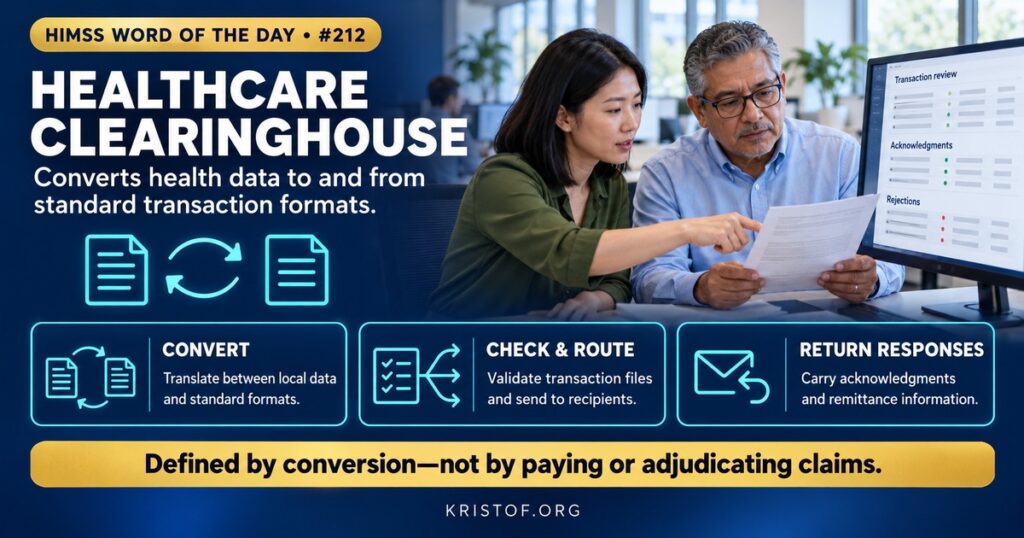
A healthcare clearinghouse is an organization that takes health information in a nonstandard format, or with nonstandard content, and converts it into the standard data elements or standard transaction HIPAA requires. It also works in the other direction, taking a standard transaction and converting it into a form the receiving organization can use. The HIMSS Dictionary describes both directions of this translation role.
The federal regulation is broader than the everyday picture of a claims-scrubbing service. In 45 CFR 160.103, a health care clearinghouse is a public or private entity, including a billing service, repricing company, community health management information system, and value-added network or switch, that performs either of the two conversion functions, directly or by facilitating the processing.
| Entity | Role | Example Activity |
|---|---|---|
| Healthcare Clearinghouse | Converts data to and from standard transactions | Turns a practice’s billing file into a standard claim for a payer |
| Health Plan | Pays for or provides coverage | Adjudicates the claim and returns a remittance |
| Health Care Provider | Delivers care and bills for it | Submits claims electronically |
| Practice Management or EHR Vendor | Supplies software | Generates billing data from the record |
| Business Associate | Performs services involving PHI for a covered entity | A clearinghouse often serves providers this way |
⚠️ Exam Alert: HIPAA names three kinds of covered entities: health plans, health care providers that conduct standard transactions electronically, and health care clearinghouses. A clearinghouse is defined by its conversion function, not by whether it submits claims. A clearinghouse can also act as a business associate when it serves a provider or plan.
🌐 Why It Matters: Real-World Healthcare IT Context
Before HIPAA’s Administrative Simplification provisions, every payer could ask for its own claim format. Providers either built a separate interface for each plan or paid an intermediary to do so. The standard transaction rules reduced that burden by naming common formats for claims, eligibility inquiries, claim status, payment and remittance advice, and other exchanges. CMS maintains the list of adopted transactions and their standards. Clearinghouses remain useful because providers and plans still arrive with different systems, different data quality, and different timing needs.
A typical flow shows the value. A practice management system exports a batch of claims. The clearinghouse checks the files for formatting errors and missing required fields, converts them into the standard claim transaction, routes each to the right payer, and returns acknowledgments and rejection reports. Later it may carry the remittance advice back and convert it for the provider’s accounts-receivable system. Providers get fewer rejected claims and a single connection instead of dozens.
Regulatory status matters. Because the regulation lists clearinghouses among covered entities, they must follow the Privacy, Security, and Breach Notification Rules directly. When a clearinghouse handles data on behalf of a provider or plan, it also has business associate obligations to those customers. The overlap is a source of confusion on exams and in contracts, so organizations document which role applies to which data flow.
The 2024 cyberattack on Change Healthcare put clearinghouse dependence in the public eye. The HHS Office for Civil Rights published frequently asked questions about the incident, including how covered entities and business associates should think about notification responsibilities. The disruption affected claims and payment flows widely enough that CMS distributed $3.3 billion in relief funding to providers experiencing revenue disruption, including $2.2 billion to hospitals. A 2025 analysis in Health Affairs found that the opt-in, one-size-fits-all design of that funding led to overpayments to many participating hospitals and underparticipation by many hospitals that had likely been disrupted. A JAMA Health Forum viewpoint also used the event to discuss consolidation in health care and the need to clarify cybersecurity priorities.
The lesson for health IT leaders is concentration risk. When many providers route transactions through the same intermediary, one failure becomes a regional or national revenue problem. Good practice includes knowing which clearinghouses sit in the organization’s critical path, having contract language on security and incident notification, keeping alternate submission paths where feasible, and rehearsing downtime procedures for billing the same way clinical teams rehearse EHR downtime.
Common clearinghouse-related problems:
- No inventory of which clearinghouses and downstream vendors touch claims
- Single path for all payer connections with no fallback
- Unclear contract terms for breach notification and recovery
- Rejections not reviewed because the clearinghouse reports go to one person
- Confusion about whether the clearinghouse is acting as a covered entity or business associate
- Poor upstream data quality that clearinghouse edits can only partly repair
What supports resilient clearinghouse use:
- A current map of all transaction flows and intermediaries
- Business associate agreements that address security and notification
- Documented alternate billing and cash-flow procedures
- Regular review of rejection and denial trends
- Security questionnaires and attestations from vendors
- Tabletop exercises that include revenue cycle scenarios
🏥 The Nurse’s Perspective: Clinical, Bedside, & Workflow
Clearinghouses sit far from the bedside, but their work shapes what nurses document and how quickly patients can get care.
At the Bedside
Accurate documentation of diagnoses, procedures, supplies, and time supports clean claims. When documentation is incomplete, claims can reject or deny, and billing teams may send queries back to clinical units. Nurses who understand that these queries trace back to claim edits are better prepared to answer them quickly.
Eligibility and authorization checks also move through standard transactions. When those checks fail, a scheduled procedure can be delayed, and unit staff may be the ones explaining the delay to patients.
In Clinical Workflow
Nurse case managers and utilization review nurses work closely with registration and billing staff on authorizations and denials. A clearinghouse outage can slow responses from payers, which creates backlogs for these teams. Clear escalation paths and downtime workflows keep patient care moving while the business side recovers.
Nurse informaticists contribute by reviewing documentation tools so that the data needed for billing is captured as part of care rather than added afterward, and by taking part in downtime planning that includes revenue cycle impacts.
In EHR Implementation (Go-Live Perspective)
An Epic Go-Live includes testing of the billing interfaces that carry charges and claims to clearinghouses and payers. Revenue cycle analysts watch rejection reports closely in the first weeks, since new workflows often create new error patterns. At-the-elbow support analysts help clinicians understand why a charge or documentation field matters downstream and pass along recurring rejection themes for build fixes.
🎓 CAHIMS / CPHIMS & HIMSS Perspective
CAHIMS Exam Domain Mapping
Clearinghouses appear in HIPAA, standards, and revenue cycle questions:
| CAHIMS Domain | How the Clearinghouse Appears |
|---|---|
| Healthcare & Technology Environments | HIPAA covered entities, Administrative Simplification, standard transactions |
| Clinical Informatics | Documentation that supports coding and claims |
| Healthcare Information & Systems Management | Interfaces, EDI, vendor dependence, downtime planning |
| Management & Leadership | Contracts, risk management, business continuity |
Key Terms to Know Alongside the Healthcare Clearinghouse
- Covered Entity — health plan, clearinghouse, or provider that conducts standard electronic transactions
- Business Associate — party that performs services involving PHI for a covered entity
- Standard Transaction — HIPAA-adopted format for exchanges such as claims and eligibility
- EDI (Electronic Data Interchange) — structured electronic exchange of business documents
- Remittance Advice — payer’s explanation of payment or denial for a claim
- Concentration Risk — exposure created when many organizations depend on one provider
HIMSS Organizational Position
HIMSS supports standards-based exchange, administrative simplification, and cybersecurity readiness through its public policy work, research, and Healthcare Cybersecurity Community. Members can find related resources through the HIMSS Resource Center and Public Policy and Advocacy pages.
🔗 Explore Further: External References
- eCFR — 45 CFR 160.103, Definitions (Health Care Clearinghouse) https://www.ecfr.gov/current/title-45/subtitle-A/subchapter-C/part-160/subpart-A/section-160.103
- CMS — Administrative Simplification: Transactions https://www.cms.gov/priorities/key-initiatives/burden-reduction/administrative-simplification/transactions
- HHS — Change Healthcare Cybersecurity Incident Frequently Asked Questions https://www.hhs.gov/hipaa/for-professionals/special-topics/change-healthcare-cybersecurity-incident-frequently-asked-questions/index.html
- Neprash et al. (2025), Health Affairs — Lessons From CMS Relief Funding After Cyberattack On Change Healthcare https://pubmed.ncbi.nlm.nih.gov/41329887/
- Kanter (2024), JAMA Health Forum — Lessons From the Change Healthcare Ransomware Attack https://pubmed.ncbi.nlm.nih.gov/39302668/
- HHS — Covered Entities and Business Associates https://www.hhs.gov/hipaa/for-professionals/covered-entities/index.html
Term source: HIMSS Dictionary of Health Information and Technology Terms, Acronyms, and Organizations, 6th Edition (2025). All definitions in this series are paraphrased for editorial purposes. Readers are encouraged to consult the primary source for exact language.
Eric Andrew Kristof, RN, CAHIMS is a Healthcare IT professional and HIMSS Arkansas Chapter member based in Hot Springs Village, AR, with hands-on Epic Go-Live experience and a diverse healthcare and IT background. He writes at kristof.org at the intersection of clinical care and healthcare technology.
Leave a Reply